
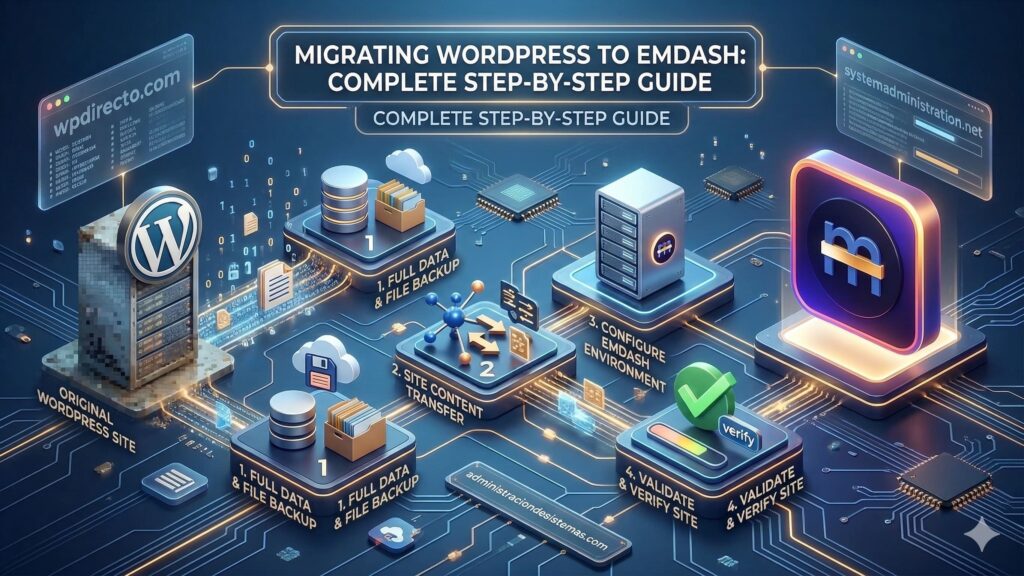
Cloudflare has decided to take a full dive into one of the most competitive areas of the web: content management systems. Their proposal is called EmDash, an open-source CMS written in TypeScript, built on Astro, and introduced by the company itself as a “spiritual successor” to WordPress. This isn’t a small claim, given that WordPress still dominates a large portion of online publishing, but it also carries a legacy architecture—particularly when it comes to themes and plugins—that has long raised security and maintenance concerns.
The interesting aspect of EmDash isn’t just the catchy headline but its approach. Cloudflare designed it to function as a modern CMS with an admin panel, media library, content modeling, and flexible deployment. It can run on their infrastructure using Workers, D1, and R2, but the project can also be launched in a Node.js environment with SQLite, making it easier for developers and technical teams to test without immediately diving into a more complex cloud deployment.
Adding to this is another key factor explaining its growing interest in tech media: Cloudflare doesn’t present it solely as a new CMS but as an alternative especially tailored for WordPress users. The official repository highlights features like import from WXR, from the WordPress REST API, or from WordPress.com, including posts, pages, media, and taxonomies. In other words, it doesn’t force starting from scratch, though it doesn’t promise a magic migration where everything’s resolved with a single click.
A new CMS with a very specific promise
The main promise of EmDash is quite straightforward: to preserve the flexibility and familiarity that made WordPress great, but backed by a more modern technical foundation. Instead of a traditional PHP core with plugins sharing full system access, EmDash opts for an architecture aligned with current development trends in JavaScript and TypeScript. Their official repo also emphasizes tools designed for agents, importing from WordPress, and deployments compatible with various environments.
This doesn’t mean it will replace WordPress overnight. In fact, some early external analyses describe it as a still-raw project, more suited for testing, lab environments, or new developments rather than an immediate solution for large, established sites. Early issues are already appearing in the public repo—something normal for such a recent launch—which reinforces that EmDash is still in an early evolutionary phase.
Why is it catching the attention of WordPress users?
The hook for the WordPress world is in migration. Many users are reluctant to abandon their current CMS but are seeking ways to experiment with more modern options without losing content or SEO. EmDash aims to address this by offering content import from WordPress and a foundation on Astro, which can blend static pages with routes rendered on demand. The official Astro documentation notes that when using dynamic routes on Cloudflare, you must rely on the @astrojs/cloudflare adapter, while static-only pages don’t need that extra layer.
This technical detail reveals the true positioning of the product. EmDash isn’t so much like a traditional, quick-install CMS with a monolithic panel but more like a hybrid—a modern CMS, an editorial framework, and a developer platform rolled into one. For a tech news outlet, this probably represents the core opportunity: it doesn’t compete solely with WordPress as a content manager but also with the next-generation stacks that combine headless CMS, modern frontend, and native cloud deployment.
What it offers now and what’s still upcoming
In the short term, EmDash is appealing for several reasons: it’s open-source, has a clear path to import content from WordPress, and is built on Astro, one of the most highly regarded frameworks for content sites. Plus, its deployment via Cloudflare aligns well with a more distributed web with blended static and dynamic content.
However, there are clear limitations. The ecosystem is still very young, compatibility with WordPress plugins and themes is far from complete, and the experience currently seems more tailored toward technical users than those seeking a “no-touch” migration. In other words, EmDash is promising for experimentation, starting new projects, or planning future migrations, but it’s not yet a mature, frictionless replacement for a complex, production WordPress site. This assessment aligns with the tone of the initial technical reviews following its announcement.
Should you keep an eye on it?
Yes, especially if you keep realistic expectations. EmDash doesn’t seem like a product for the average WordPress user to migrate their entire site in a single afternoon and forget about it. But it’s one of the most interesting launches of the year for those closely following CMS evolution, cloud deployments, and the future of digital publishing.
The reason is simple: it arrives at a moment when many teams want more control over their infrastructure, better security for extensions, and a more modern tech base for content experiences. If Cloudflare manages to consolidate the project, grow its ecosystem, and streamline the migration process, EmDash could become one of the key names to watch in the next phase of content management software. For now, its most reasonable role is as a promising alternative worth serious testing—especially in staging environments or new projects where the cost of experimentation is lower.
Frequently Asked Questions
What is EmDash exactly?
It’s an open-source CMS developed by Cloudflare, written in TypeScript, built on Astro, and presented as a “spiritual successor” to WordPress.
Can it import content from WordPress?
Yes. The official repository indicates it can import posts, pages, media, and taxonomies from WXR, the WordPress REST API, or from WordPress.com.
Do I need to use Cloudflare to try EmDash?
Not necessarily. The project can also run on Node.js with SQLite, allowing testing outside Cloudflare’s native cloud environment.
Is it ready to replace WordPress in any project?
It doesn’t yet appear to be a universal solution for complex sites. EmDash is in an early phase, with open issues and a clearly technical focus. It’s more realistic today to see it as a promising platform for testing and new ventures.
Source: Migrating from WordPress to EmDash and Migration: WordPress to EmDash
