
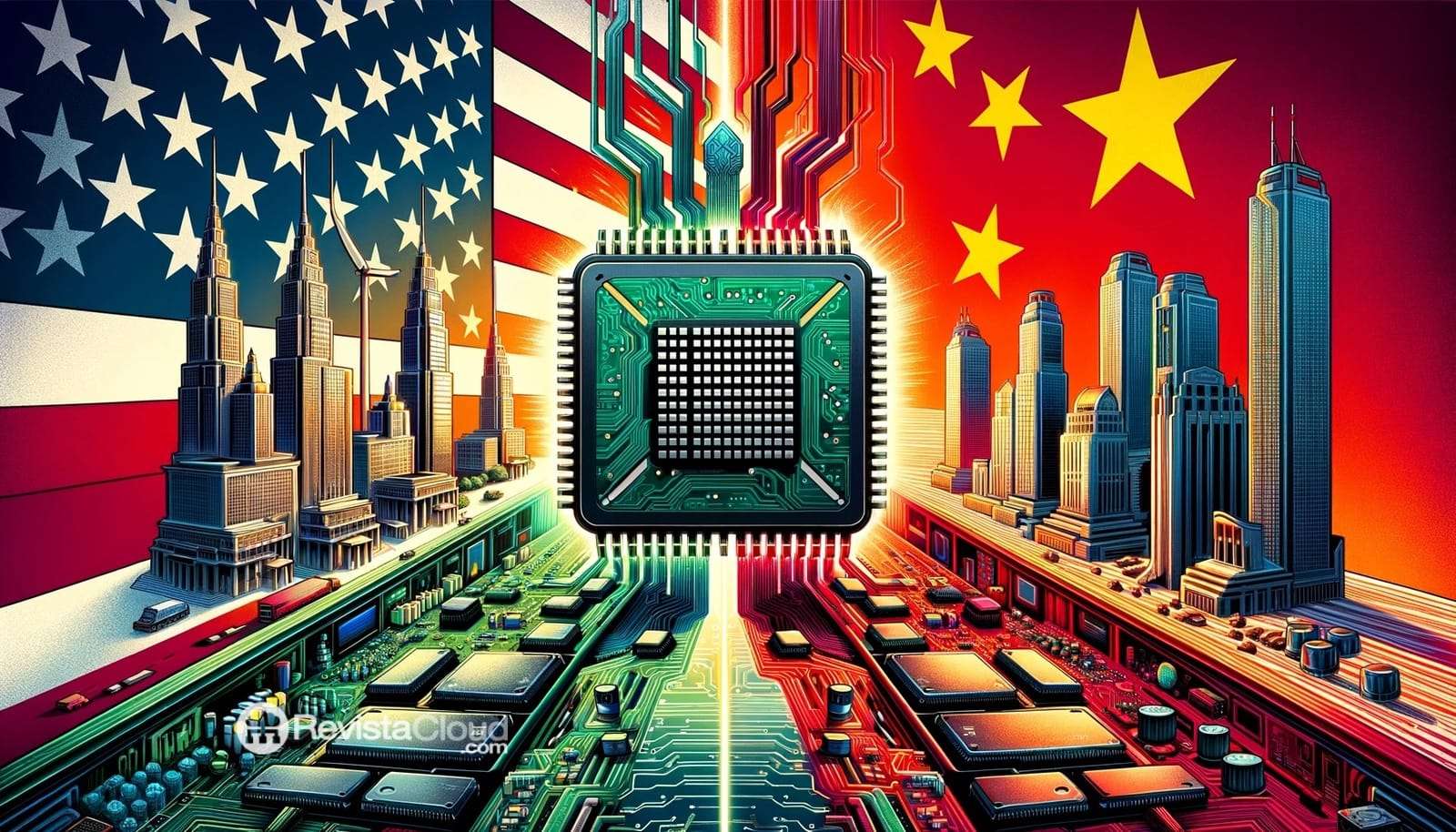
The United States has once again shifted in the tech war with China, this time targeting Hua Hong Semiconductor, the second-largest Chinese contract chip manufacturer. The Department of Commerce reportedly sent “is-informed” letters to several semiconductor fabrication equipment suppliers to halt certain shipments destined for Hua Hong and Huali Microelectronics, its advanced manufacturing branch in Shanghai.
This measure comes at a particularly sensitive moment. Hua Hong is not only a significant foundry for mature processes and specialized chips; it has also become an increasingly watched piece within Beijing’s efforts to reach the 7-nanometer node, the process that so far only SMIC has managed to produce within China with recognized capacity. Washington seeks to cut off access to critical tools before this secondary industrial route gains traction.
What Washington has ordered
According to Reuters, last week the U.S. Department of Commerce sent letters to various wafer equipment manufacturers, including Lam Research, Applied Materials, and KLA, to halt certain shipments of equipment and materials to two Hua Hong facilities that U.S. authorities consider relevant for the production of advanced chips. The communication also affects Huali Microelectronics, a subsidiary involved in developing the 7nm process.
These “is-informed” letters are a widely used instrument in U.S. export controls. They are not a broad regulation published after a lengthy regulatory process but rather direct communications to specific companies to impose new licensing requirements or restrictions on certain customers, products, or destinations. Their advantage for Washington is speed. Their downside for industry is uncertainty: a shipment can be blocked immediately without the market having time to adapt.
This decision targets a critical point in the value chain. Manufacturing advanced chips depends not only on design but also on a complex combination of lithography, deposition, etching, metrology, defect control, process software, chemicals, wafers, and maintenance. Companies like Applied Materials, Lam Research, and KLA supply essential tools for many of these steps. If access is restricted, the ability to scale an advanced node may be limited, even if the process design exists on paper.
| Element | What is known |
|---|---|
| Affected company | Hua Hong Semiconductor and Huali Microelectronics |
| US objective | Prevent China from advancing toward advanced nodes, especially 7 nm |
| Regulatory tool | “Is-informed” letters from the Department of Commerce |
| Cited suppliers | Lam Research, Applied Materials, and KLA |
| Facility(s) targeted | Hua Hong/Huali plants linked to advanced processes |
| Context | Technological tensions ahead of a scheduled Trump-Xi meeting in May |
Why Hua Hong is a concern now
Hua Hong has long been known for its strength in mature processes and specialized applications: power, automotive, microcontrollers, sensors, connectivity chips, and components for industrial markets. Initially, it wasn’t the company most associated with China’s advanced logic frontier—that role was primarily held by SMIC.
The shift occurred when it emerged that Huali Microelectronics was preparing a 7nm process at its Fab 6 plant in Shanghai, supported by SiCarrier, a company linked to Huawei’s ecosystem. Reuters reported in March that Huali aimed to reach an initial capacity of several thousand 7 nm wafers per month by the end of 2026. If this plan advances, China would have a second domestic foundry capable of working at that node, albeit with limitations and likely without the efficiency levels of TSMC or Samsung at their best.
This point is critical. Moving from experimental or limited capacity to useful production for AI chips requires stability, performance, repeatability, and access to tools. Washington seems to act before Hua Hong can establish this phase. The goal isn’t just to block a specific product but to prevent the formation of an alternative industrial base around Huawei, SiCarrier, Huali, and Chinese accelerator designers.
This also reveals that the U.S. is refining its restriction policies. Over recent years, the focus has been on GPUs, AI accelerators, HBM memory, lithography equipment, and advanced nodes. Now, control is expanding to Chinese foundries that could become internal substitutes for local customers impacted by sanctions or loss of TSMC access.
A message for suppliers and customers
For U.S.-based equipment suppliers, China remains a huge market. Any restrictions on key manufacturers can lead to lost sales, delays, and increased pressure on forecasts. But the political message is clear: Washington’s priority is to prevent China from gaining autonomy in advanced chips for AI, defense, supercomputing, and critical communications.
For Hua Hong, the blow comes at a growth phase. The company closed 2025 with revenues of $2.402 billion, up from $2.004 billion in 2024, according to its financial disclosures. It also improved its gross margin, although its profitability remains far below that of global industry leaders like TSMC or Samsung.
The problem for China isn’t just financial. A foundry can invest billions in capacity, but without access to process tools, spare parts, upgrades, or technical support, progress slows and costs increase. Beijing has sped up developing local equipment providers, but it still depends on foreign technologies at several critical stages of advanced manufacturing.
Predictably, Chinese reactions will be twofold: diplomacy—arguing that the U.S. is using national security to hinder China’s technological development—and industry—providing more support for substitution, increasing funding for local manufacturers, and exerting more pressure on Chinese companies to design chips that can be made with domestically available processes.
A more surgical phase in the chip war
The novelty of this episode isn’t just in Hua Hong’s name but in the precision of the move. The U.S. doesn’t need to block the entire Chinese semiconductor sector to have an impact. It can target specific facilities, suppliers, tools, or flows and cut off access precisely where it believes advanced capacity is forming.
This approach offers advantages for Washington but also risks. The more targeted the restrictions, the greater the incentives for China to seek alternative routes, buy through third parties, turn to non-U.S. suppliers, or accelerate domestic development. Conversely, broader restrictions could cause more harm to Western companies relying on the Chinese market.
The timing is also significant. The information emerges ahead of a scheduled meeting between Donald Trump and Xi Jinping in Beijing in May, adding political pressure to an already strained relationship involving tariffs, export controls, AI, Taiwan, and supply chains. In semiconductors, every technical gesture is also a diplomatic message.
Hua Hong doesn’t suddenly become as threatening as TSMC. Its potential 7nm process would be far from the most advanced nodes used for cutting-edge AI chips. Nonetheless, for China, achieving 7nm with multiple foundries offers strategic value: reducing dependence on SMIC, boosting domestic capacity, and creating more options for local designer companies that are sanctioned or excluded from international suppliers.
The U.S. decision confirms that the chip war is no longer just about stopping China from buying the most advanced accelerators. It also aims to prevent China from manufacturing its own at scale. Here, Hua Hong, less prominent until now compared to SMIC, takes on a much more visible role.
FAQs
What has the U.S. done against Hua Hong?
The Department of Commerce reportedly sent “is-informed” letters to equipment suppliers to halt certain shipments of tools and materials to Hua Hong and Huali Microelectronics facilities.
Why is Hua Hong a concern for Washington?
Because its subsidiary Huali is preparing capabilities for 7nm manufacturing, a key node for advanced chips and AI, aligned with China’s strategy for technological self-sufficiency.
Which equipment companies are affected?
Reports cite Lam Research, Applied Materials, and KLA, three major U.S. suppliers of semiconductor fabrication equipment.
Does this mean China can’t make 7nm chips?
Not necessarily. SMIC has already demonstrated capacity at that node, and Hua Hong/Huali may continue attempting to progress with alternative resources. But restrictions could delay, increase costs, or limit their ability to scale production.
