
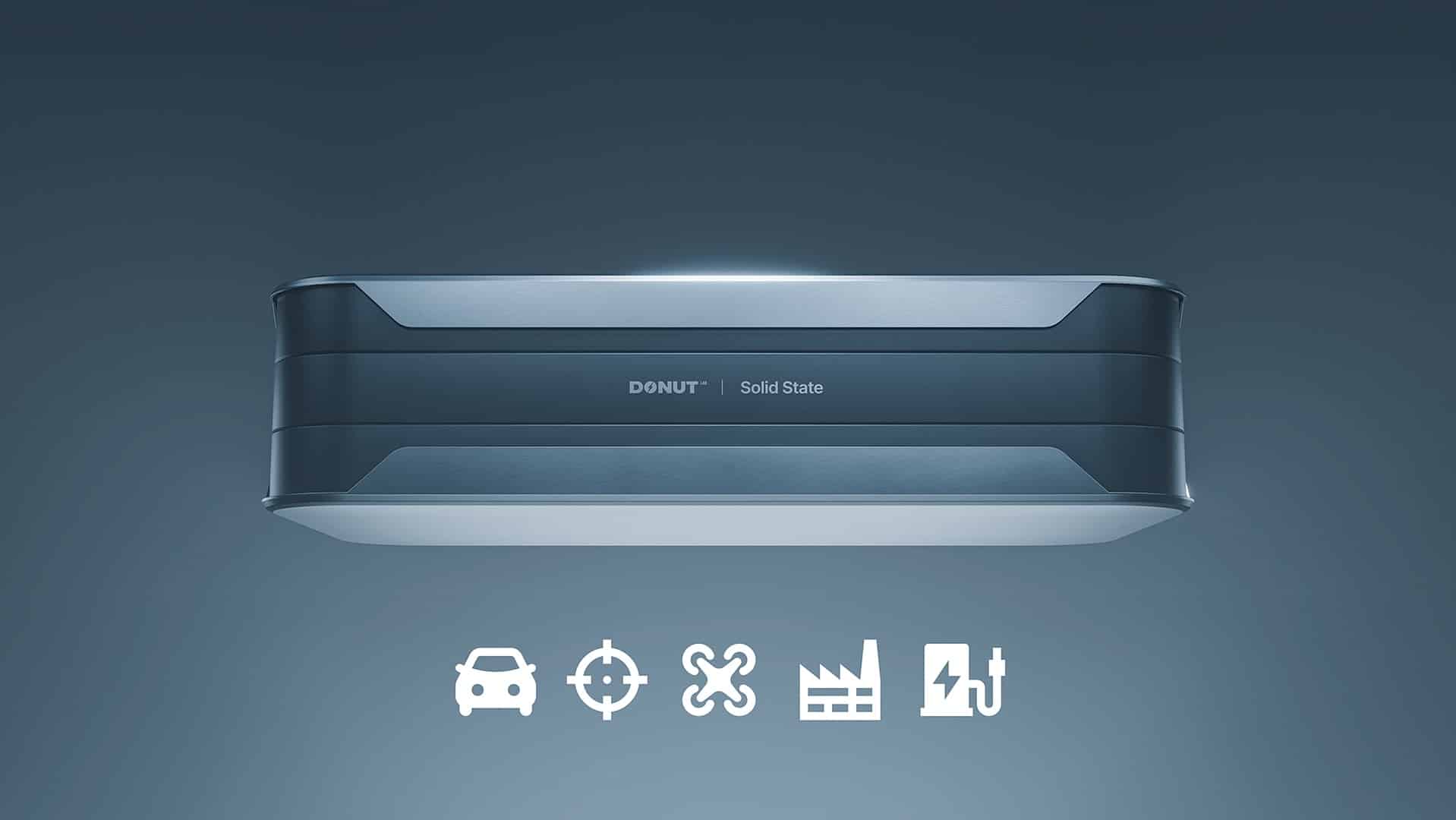
Donut Lab’s presentation at CES 2026 has reignited a debate that has been stuck in promises for years: the truly all-solid-state battery (all-solid-state) ready for production. The company (linked to the Verge Motorcycles ecosystem) insists that their “Donut Battery” is no longer a laboratory prototype but a platform ready for OEMs, with figures that, if confirmed, could raise the industry standard.
What Donut Lab is claiming (and where it comes from)
In their public communication, Donut Lab states that their battery:
- achieves 400 Wh/kg energy density,
- allows full charging in 5 minutes,
- is designed for up to 100,000 cycles,
- and aims to be safer (without flammable liquid electrolyte) and lower cost than conventional lithium-ion batteries.
Furthermore, Donut Lab claims it is already in production vehicles, citing the Verge TS Pro (electric motorcycle) as a “first case,” and states that their platform is “available today” for manufacturers at “mass production capacity.”
Up to this point, the key point: these are corporate claims. There is coverage from automotive/tech media recognizing these claims, but most relies on information provided by the company at the event (not independent tests published).
The “contradiction” 350 Wh/kg vs 400 Wh/kg: the most likely explanation
Your intuition is correct: it’s not unusual for a brand to announce a “maximum” figure (at cell level) and see a different number on a stand panel (at module or pack level), because each level adds casing, connectors, electronics, structure, and thermal margin.
The interesting part is that an external clue does appear: a Chinese media outlet covering CES mentions statements/indications pointing to 350 Wh/kg as the current state and 400 Wh/kg as the target, which aligns with the idea that one figure is a “goal” or measurement under specific conditions (format, module, integration, etc.).
To provide some context, recent scientific reviews indicate that commercial lithium-ion batteries have achieved (depending on chemistry and format) around ~300 Wh/kg in some cases. So talking about 400 Wh/kg is a significant jump, and that’s why the fine print (measurement level, C-rate, temperature, actual degradation) can change everything.
Are there “more current” verifiable updates outside the scenario narrative?
Currently, the most “new” and tangible info beyond the narrative is:
- The emphasis on “production” and “available today” as a differentiator from traditional giants, who typically speak of 2027–2030. Even brands with years of experience have projected later commercial timelines (with adjustments).
- The 350 vs 400 Wh/kg nuance has already appeared in CES coverage (not just speculation on Twitter), suggesting the company is modulating its message based on the level (cell/module) or industrial maturity.
- However, there is still no (publicly and easily verifiable) comprehensive validation package—third-party reports, complete degradation curves, testing protocols, certifications (UN 38.3/UL) linked to the final product, or critical technical details (exact chemistry, architecture, charge rate at C, performance at different temperatures with reproducible methodology).
What questions would “serious press” and engineering ask before considering it revolutionary
If you want to separate “hype” from “breakthrough,” here are 8 crucial questions (and why there’s been so much buzz about solid-state batteries for a decade):
- Is 400 Wh/kg at the cell, module, or pack level? (and in which exact format).
- Full charge in 5 minutes—at what power level and with what battery size? (not the same for 5 kWh vs 80 kWh).
- What does “up to 100,000 cycles” mean exactly? (depth of discharge, temperature, State of Charge window, end-of-life criteria).
- Degradation curves: ability vs cycles with auditable data—not just a single number.
- Safety: what tests are publicly available? (penetration, overcharge, shock, thermal).
- Real industrial scalability: where is it manufactured, yield rate, and what portion of the Bill of Materials is “abundant”?
- Cost: under what conditions can it be “cheaper than Li-ion” (full pack), and when?
- Automotive compatibility: what thermal/structural integration does it require?
If Donut Lab starts publishing verified answers (“with documentation”) to these points, then yes: we might be at a turning point. Otherwise, for now, it remains one of the most ambitious promises from CES 2026.