
Electronic signature has evolved from being a one-off tool to a common part of daily work. Contracts, client onboarding, employment documents, authorizations, confidentiality agreements, and internal forms are now signed from a mobile device or browser. The convenience is clear, but so is the cost as a company scales up users, envelopes, verifications, integrations, and support.
DocuSign remains one of the industry leaders. Its brand inspires trust, it has a broad ecosystem of integrations, and it offers plans tailored to different needs. However, its commercial model doesn’t fit all teams equally well. According to its official eSignature pricing page in the United States, the Personal plan costs $10 per month with annual billing and includes 5 envelopes per month. The Standard plan costs $25 per month per user, also billed annually, and includes 100 envelopes per user per year. Business Pro increases to $40 per month per user, with the same annual envelope limit per user within that tier.
The numbers start to add up when multiplied. A team of 10 users on Business Pro begins at $4,800 annually before taxes and possible add-ons. With 50 users, the base reaches $24,000 per year. If additional features like SMS, identity verification, advanced workflows, support, or custom limits are needed, the cost changes. DocuSign offers higher-tier plans and IAM with different conditions, including options for unlimited envelopes from web or mobile in some plans. But for many SMEs, the first contact with electronic signature often still involves a user-based structure, plan, and envelopes.
What Does DocuSeal Offer
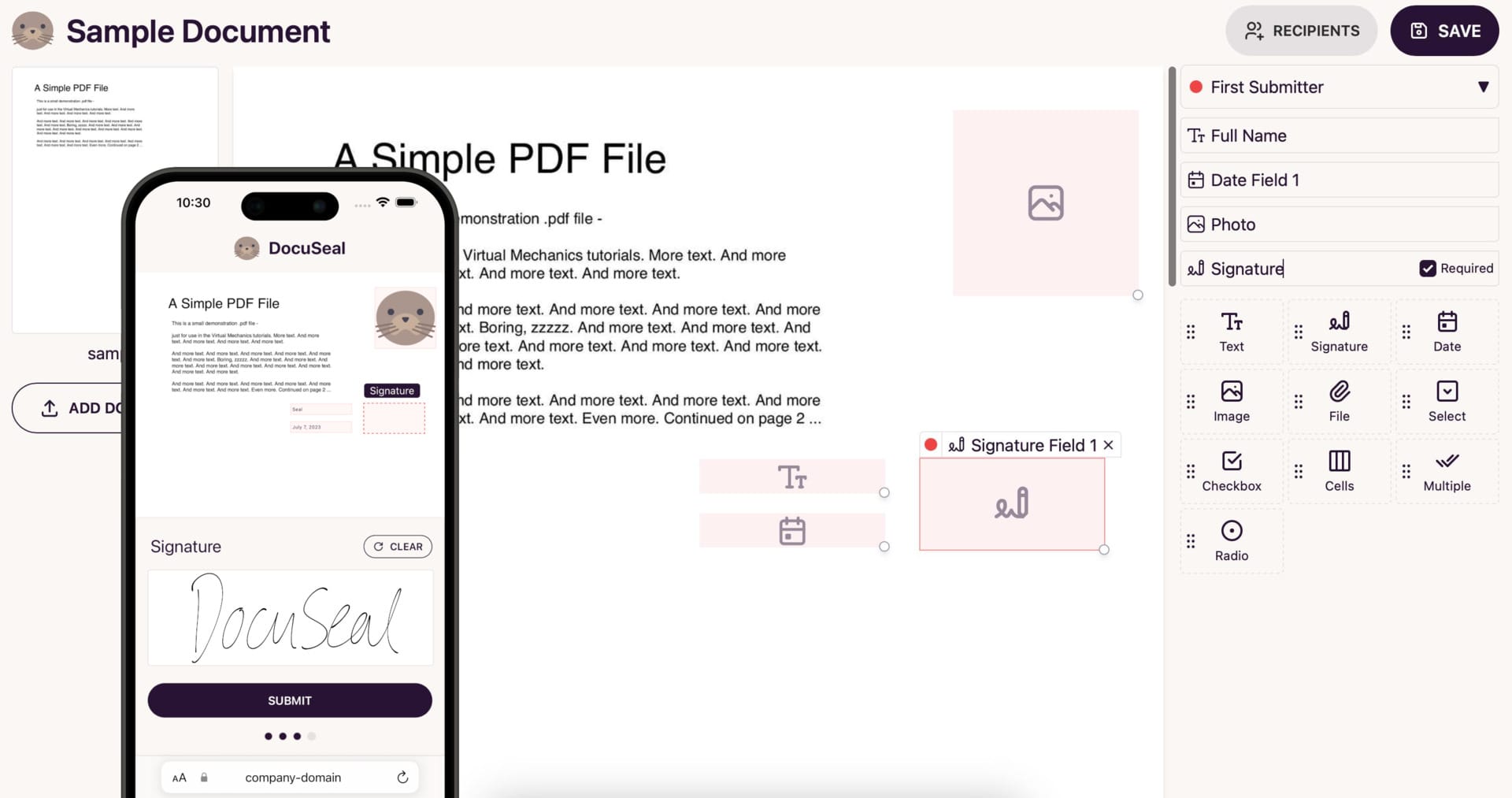
DocuSeal appears as an open alternative for creating, filling out, and signing digital documents. The project is hosted on GitHub under the AGPL-3.0 license and presents itself as a platform to convert PDFs into signable forms, add fields via a visual interface, manage multiple signers, send automatic emails, verify PDF signatures, and deploy the tool on own servers.
The main appeal for a tech-savvy environment isn’t just “cost savings.” It’s the control model. DocuSeal can be self-hosted, meaning documents, templates, contracts, and customer data can remain on own infrastructure or in a cloud chosen by the organization. For companies working with sensitive documentation, this difference can be as significant as the price.
The basic deployment with Docker is straightforward:
docker run --name docuseal
-p 3000:3000
-v .:/data
docuseal/docuseal
By default, the container uses SQLite for data and configuration, although the project allows switching to PostgreSQL or MySQL via the DATABASE_URL variable. For internal testing, SQLite may suffice. For production, typical best practices include adding an external database, backups, HTTPS, access control, persistent storage, and clear update policies.
DocuSeal’s open source edition includes important features: a visual PDF form builder, signatures, dates, checkboxes, file uploads, multiple signers per document, SMTP email, storage on disk or cloud services like AWS S3, Google Storage, and Azure, user management, PDF signature verification, mobile web, and API/webhooks support.
| Feature | DocuSign | Self-hosted DocuSeal |
|---|---|---|
| Basic electronic signature | Yes | Yes |
| Signable PDF forms | Yes | Yes |
| Multiple signers | Yes | Yes |
| Document audit trail | Yes | Yes |
| Self-hosting | No in the typical SaaS model | Yes |
| Direct storage control | Limited to the provider | Yes, depending on deployment |
| API access | Depends on the plan | Available, with commercial considerations |
| SSO/SAML | Higher-tier plans | DocuSeal Pro |
| Mass sending | Depends on the plan | DocuSeal Pro |
| White labeling | Depends on the plan | DocuSeal Pro |
It’s important to note that: DocuSeal isn’t “completely unlimited and free” in every scenario. The self-hosted open source version allows usage without license fees for basic functionalities. However, Pro features come at a cost. On-premises, DocuSeal Pro is priced at $240 per year per user, with $0.20 per signed document via API or embedding. In the cloud, the Pro plan is offered as a $20 monthly or $200 annual upgrade, depending on the provider’s options.
Where the Real Savings Lie
The most accurate comparison depends on usage. A small business that only needs to prepare documents, send for signature, and store on its own server can save significantly with DocuSeal. In this case, the main costs are the server, maintenance, and technical time. For a technically skilled team, the total expense may be much lower than a per-user SaaS solution.
Companies requiring SSO, white labeling, mass sending, conditional fields, embedded API, SMS verification, or integration support will need to opt for DocuSeal Pro. Yet, the overall cost can still be attractive compared to commercial alternatives—especially if volume is well managed and data control is a priority.
| Scenario | Practical takeaway |
|---|---|
| Freelancer with few documents | Docusign Personal may be convenient; DocuSeal requires server operation |
| SME with recurring documents | Self-hosted DocuSeal can reduce costs if there is internal technical support |
| SaaS seeking integration | API requires Pro plan and payment per signed document |
| Company with SSO and roles | Compare enterprise Docusign with DocuSeal Pro |
| Regulated sector | Choice depends on compliance, audit, identification, legal advice |
| Highly privacy-sensitive organization | Self-hosting can be a clear advantage |
The hidden cost of DocuSeal lies in operation. Self-hosting entails managing security, backups, availability, monitoring, updates, and incident response. It’s not a minor issue. Misconfiguration in a signing tool could expose contracts, personal data, or internal documents. For some teams, this control is an advantage; for others, it’s a responsibility they prefer to delegate.
On the other hand, Docusign doesn’t just sell signatures. It offers trust, branding, support, integrations, and an established enterprise framework. In legal, procurement, or HR departments, this trust can outweigh the cost. There may also be clients or suppliers already integrated with Docusign—resisting change.
APIs as a Battlefield
The most interesting area for developers is in API and embedding capabilities. Many companies prefer to integrate signing into their own products—client onboarding, rental agreements, medical consents, employment contracts, KYC, financing, or approval workflows—rather than sending documents manually from a web interface.
DocuSeal supports this kind of integration, but its pricing shouldn’t be overlooked. Documentation states that productive API and embedding usage requires a Pro plan and costs $0.20 per signed document. A single request can include multiple files and signers and still count as one document completion—which can be competitive for many cases.
An example of creating a signature request:
curl -X POST "https://firma.tuempresa.com/api/submissions"
-H "X-Auth-Token: $DOCUSEAL_API_KEY"
-H "Content-Type: application/json"
-d '{
"template_id": 123,
"send_email": true,
"submitters": [
{
"role": "Customer",
"email": "[email protected]",
"name": "Example Customer"
}
]
}'
This approach allows an application to generate documents, send for signature, and receive webhook events on status changes. For technical teams, it’s an attractive proposition: less dependence on a closed provider and easier customization of the signing experience within the product.
The volume impacts economics: if an app signs 200 documents per month via API, the official DocuSeal estimate is $20 for the Pro seat plus $40 for signed documents—a total of $60 per month. Signing 10,000 documents monthly requires a more nuanced comparison, likely involving volume negotiations, suitable infrastructure, and support considerations.
Electronic Signatures, Validity, and Trust
It’s important to distinguish between digitally signing a PDF and meeting all legal evidentiary requirements for different types of contracts. In Europe, the eIDAS regulation classifies simple, advanced, and qualified electronic signatures. In the US, frameworks like ESIGN and UETA apply. Compatibility claims by platforms don’t automatically guarantee the same legal weight across all uses.
For internal documents, low-risk authorizations, or standard private agreements, an electronic signature with traceability—IP, email, timestamp, audit trail—can suffice. For regulated processes, qualified signatures, enhanced identification, or strict audits, legal and technical review are essential.
This aspect applies to both Docusign and DocuSeal. Docusign offers more enterprise layers and advanced identity features in higher plans. DocuSeal provides control and integration, but the legal validity ultimately depends on process configuration, signer identification, evidence retention, and applicable law.
A Better Comparison Requires Closer Look
DocuSeal isn’t a free clone of Docusign for all scenarios. It’s an open source alternative with a very different approach: self-hosting, control, integration, and an open edition that can cover many basic needs without licensing costs. Its Pro features and API are paid, and that should be factored into serious cost calculations.
Nevertheless, its emergence is significant. For years, many companies believed electronic signatures required a closed SaaS with per-user billing; an add-on or a tiered plan. DocuSeal shows another path: an open platform deployable on private infrastructure, adaptable to internal workflows.
For a technical team, the decision should start from several questions: how many documents are signed monthly, how many users need template management, whether API integration is necessary, if SSO is required, where documents should reside, what level of identification is needed, and who will operate the system.
Electronic signature is no longer just an administrative function. It’s part of the company’s information system. Therefore, the conversation should go beyond per-user pricing—also considering data sovereignty, integration, compliance, signing experience, support, and the ability to change providers without remaking the entire process.
FAQs
Is DocuSeal a real alternative to Docusign?
Yes, for many basic signing cases, self-hosting, and tailored integration. For large enterprises with advanced compliance, support, and identity needs, the comparison must be evaluated case by case.
Is DocuSeal completely free?
The open source self-hosted version is free for basic functions. Features like SSO, white labeling, mass mailing, SMS, advanced roles, production API, or embedding are part of DocuSeal Pro.
What is the cost of Docusign Business Pro?
On the official eSignature page in the US, it’s listed at $40 per month per user, with 100 envelopes per user per year in that plan.
Can I host DocuSeal on my own server?
Yes. DocuSeal offers self-hosted deployment options, which can run via Docker. For production, configure with HTTPS, backups, access control, and a persistent database.
Does DocuSeal signature have legal validity?
It depends on the country, document, identification method, and preserved evidence. For sensitive or regulated documents, it’s advisable to consult legal experts regarding the process.
