
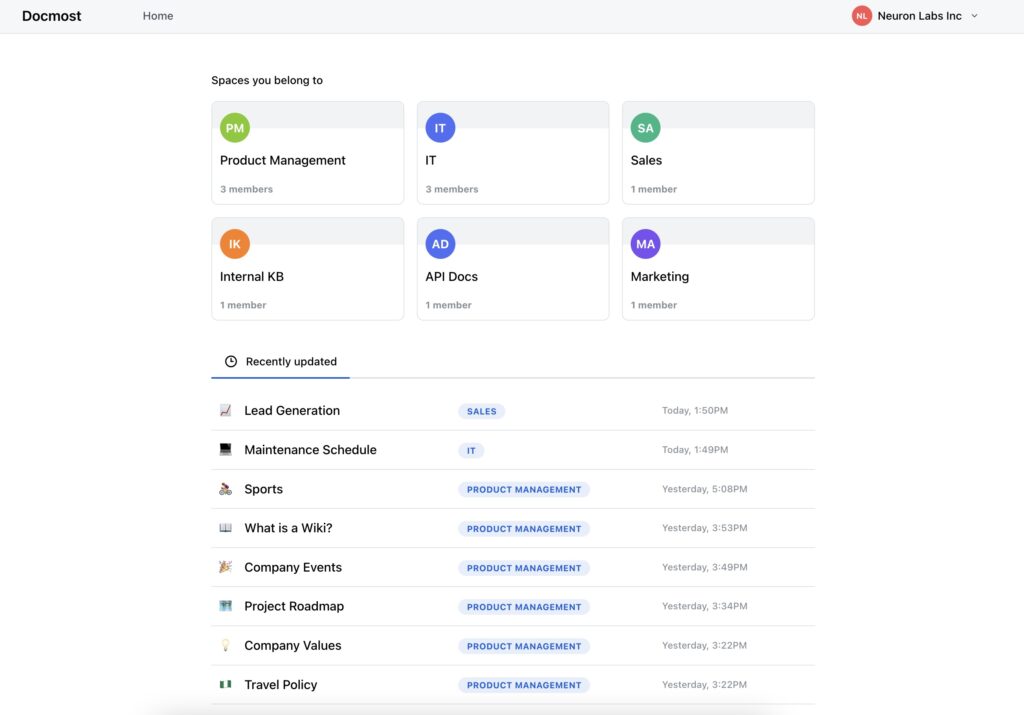
The collaborative software market has been dominated for years by platforms like Confluence and Notion, but gradually alternatives are emerging that aim to attract businesses and technical teams tired of relying entirely on closed services. One of the most attention-grabbing recently is Docmost, an open-source project positioned as collaborative wiki and documentation software featuring real-time editing, workspaces, permissions, comments, and a clearly self-deployment focus. On GitHub, the official repository already exceeds 19,600 stars, with over 1,200 forks, and a recent release, v0.71.0, published on March 31, 2026.
Docmost openly states its positioning. Both on its repository and on its official website, it is defined as an open-source alternative to Confluence and Notion. This is particularly relevant as many organizations reconsider where they store internal knowledge, how they manage permissions, and to what extent they want to depend on external SaaS services for critical documentation. The project’s documentation highlights a particularly sensitive point for some companies: it can be run completely self-hosted and also in air-gapped environments, without external dependencies.
This feature is not minor. In regulated sectors, government agencies, industrial environments, or companies with strict compliance policies, the debate is no longer just which tool is more convenient but also how much control exists over data, users, and infrastructure. Docmost specifically aims to excel in this area by combining a relatively modern visual experience with the possibility of keeping everything within the corporate perimeter. Nonetheless, the project also offers a cloud version for those who prefer not to self-host, hinting at a hybrid strategy between an open-source community and a more conventional commercial offering.
A Clear Approach: Collaborative Documentation for Modern Teams
Docmost’s feature set is quite familiar to anyone who has worked with internal knowledge tools. Its official documentation highlights functions such as real-time collaborative editing, organization by Spaces, permissions at the space and workspace level, groups, comments, page history, full-text search, attachments, hierarchical navigation, and the ability to share pages publicly via links. It also supports tables, KaTeX equations, collapsible blocks, mentions, Markdown shortcuts, and dark mode.
Where Docmost tries to differentiate itself is in the integration of visual and technical content. The project includes support for diagrams with Draw.io, Excalidraw, and Mermaid, making it especially attractive for product, engineering, systems, or technical documentation teams. Additionally, its documentation mentions support for embedding services like Airtable, Loom, or Miro, bringing the experience closer to what many users expect from tools like Notion—yet without abandoning the more structured approach of a collaborative wiki.
In other words, Docmost seeks to fill the middle ground between the traditional corporate wiki and a flexible workspace closer to Notion. This positioning offers significant potential, as many companies have been seeking exactly that balance: a tool that isn’t as rigid as a classic wiki but also not as dependent on less-structured workflows that can lead to document chaos.
Self-Hosted, but Not Fully “Open” in Every Aspect
One aspect to watch carefully is the licensing model. The core of Docmost is licensed under AGPL 3.0, but the repository itself clarifies that some features are distributed under a different Enterprise license. Explicitly covered directories include parts of the client, server, and the ee package. In other words, Docmost is open source at its core, but not everything it offers is on the same open plane.
This is also reflected in the documentation. Exclusive or enterprise-related features include SSO via SAML/OIDC, LDAP, MFA with TOTP, an API, AI-based writing assistance and search functions, full-text search within PDF and DOCX attachments, comment resolution, more granular public sharing controls, and notably, for those migrating from other platforms, the Confluence importer and DOCX importer. Import from Notion, on the other hand, is listed as part of the general product capabilities.
This division illustrates the strategy behind the project: a sufficiently functional open core aimed at fostering community and self-hosted deployments, coupled with a corporate layer that caters to more advanced organizational needs. While not unique in infrastructure or collaboration software, it is important to recognize that Docmost is not fully “free” in every component.
Why It Might Matter in 2026
The interest in tools like Docmost isn’t driven solely by pricing or licensing considerations. It also reflects a broader shift in the market. Increasingly, organizations want to reduce dependence on specific platforms, regain control over their internal documentation, and explore environments capable of operating both on private clouds and isolated installations. In this context, a project that offers real-time collaboration, quality editing experience, diagram support, granular permissions, and options for on-premises or air-gapped deployment becomes significantly more relevant than it might have seemed a few years ago.
Furthermore, the comparison with Confluence and Notion isn’t accidental. Confluence remains widely adopted in corporate settings but is often seen as heavy and less user-friendly. Notion has gained immense popularity due to its flexibility but may not fit scenarios where data control, self-management, and regulatory compliance outweigh SaaS convenience. Docmost aims to position itself precisely in this intersection: more open and controllable than Notion, more modern and lightweight than the traditional image many associate with Confluence.
Of course, the key will be whether it can build a strong community and a solid base of enterprise deployments. Still, the GitHub stats, development pace, and the project’s explicit positioning suggest it is not just a niche curiosity. At least for now, Docmost is becoming one of the noteworthy names to watch in the open-source collaborative software space.
Frequently Asked Questions
What exactly is Docmost?
It is an open-source collaborative software for wiki and documentation, designed for teams to create, organize, and share knowledge with real-time editing, workspaces, permissions, comments, and page history.
Can it be installed on private servers?
Yes. The official documentation states that it is fully self-hostable and can even operate in air-gapped environments without external dependencies. There is also a cloud version available for those who prefer not to manage it themselves.
What features are included in the Enterprise edition?
Features such as LDAP, SSO via SAML/OIDC, MFA with TOTP, API, AI capabilities, search within attachments, and the Confluence and DOCX importers.
Is it fully open source?
The core of Docmost is licensed under AGPL 3.0, but the repository indicates that some parts are distributed under a different Enterprise license.