
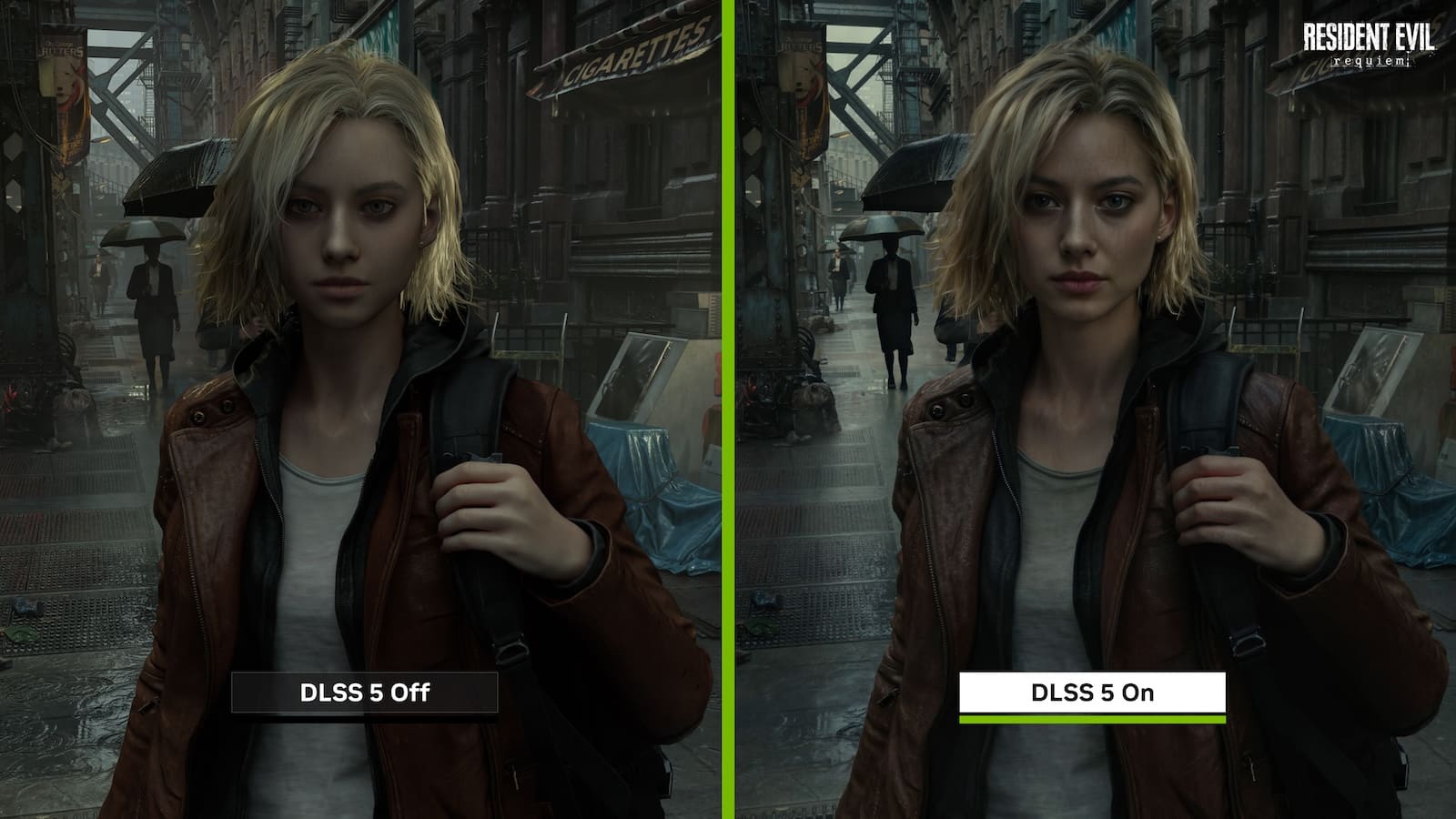
NVIDIA unveiled at GTC 2026 one of those technologies that, at least on paper, aims to move the conversation about PC gaming several steps forward. It’s called DLSS 5, arriving this fall, and is no longer envisioned solely as a performance-boosting tool but as a real-time neural rendering layer capable of enhancing visual fidelity in each scene with more realistic lighting and materials. The company itself describes it as its most significant leap in graphics since the advent of real-time ray tracing in 2018.
NVIDIA’s goal is clear: for DLSS to cease being just a technology for resolution reconstruction or frame generation and instead become an active part of how the final image on screen is created. According to the official announcement, DLSS 5 uses the color and motion vectors of each frame as input to apply a neural model that “infuses” pixels with photorealistic lighting and materials, always anchored to the game’s original 3D content and maintaining consistency across frames.
It’s no longer just about higher FPS, but about changing the final quality
This is the major conceptual shift. NVIDIA recalls that DLSS was born in 2018 as a technology focused on performance enhancement, initially through upscaling and later through full-frame generation. Over time, it became a de facto industry standard, integrated into over 750 games, according to the company. But DLSS 5 aims to push this evolution into a new realm: perceived visual quality.
The company claims that the new model has been trained end-to-end to understand complex scene semantics, including characters, hair, fabrics, translucent skin, and various lighting conditions—from silhouettes to cloudy environments. Based on this foundation, DLSS 5 seeks to improve effects that are very difficult to resolve in real-time within milliseconds per frame, such as subsurface scattering on skin, glossiness of certain materials, or light-hair interactions. NVIDIA also assures that all of this can be executed in real time at up to 4K resolution.
In industrial terms, the message is powerful because it directly addresses an old limitation of game rendering. NVIDIA emphasizes that a game frame, with roughly 16 milliseconds budget, is still far from the complexity of a Hollywood VFX shot, where a single frame can take minutes or hours to process. DLSS 5’s thesis is that this gap will no longer be closed solely through brute force but through a mix of traditional rendering and AI-guided neural generation.
The real test will be whether the promise holds up outside of demos
Like any major NVIDIA announcement, there’s a convincing part on stage, and a part that will only be judged once the technology is available on the market. What is confirmed today is that DLSS 5 will arrive in fall, support the Streamline framework for easier integration, and has initial backing from major publishers and studios. However, there are no large-scale public tests in final-game titles yet to assess its behavior in terms of stability, latency, artifacts, artistic control, or GPU load.
That nuance is very important. NVIDIA promises a technology capable of enhancing image quality without compromising the studio’s artistic intent. To that end, it emphasizes that DLSS 5 will include controls for intensity, color grading, and masks to determine where and how to apply the enhancements. This aspect is almost as critical as the model itself, because a common concern with generative AI in graphics has always been the loss of artist control. In theory, DLSS 5 does not replace the studio’s engine work or visual pipeline but acts as an additional layer that respects the scene’s structure.
It’s also beneficial that the integration remains within the Streamline ecosystem. NVIDIA explains that this layer functions as an open, cross-cutting solution that simplifies incorporating super-resolution techniques and other graphics effects through a single integration. This reduces friction for developers and importantly, prevents DLSS 5 from appearing as an entirely new technology requiring a complete pipeline overhaul.
Industry backing is broad, but execution will be the challenge
NVIDIA has highlighted the strong ecosystem supporting the launch. Partners listed include Bethesda, CAPCOM, Hotta Studio, NetEase, NCSOFT, S-GAME, Tencent, Ubisoft, and Warner Bros. Games. Additionally, announced titles feature games like Starfield, Assassin’s Creed Shadows, Resident Evil Requiem, Hogwarts Legacy, Delta Force, NARAKA: BLADEPOINT, Phantom Blade Zero, and The Elder Scrolls IV: Oblivion Remastered. For a technology of this nature, early adoption is almost as crucial as the technical innovation itself.
In the tech world, the interesting takeaway isn’t just that DLSS 5 can look better, but what it implies for the future of real-time rendering architecture. If the approach works, games will rely less on physically simulating every effect directly and more on models that reconstruct or enrich the image within strict artistic and temporal limits. This shifts part of the value from classic rasterization and pure ray tracing to a layer of visual inference, practically transforming the GPU from a mere graphics calculator into a neural scene interpretation engine.
This is where the true significance of the announcement lies. DLSS 5 isn’t just a new bullet point for a GTC slide. It’s NVIDIA’s attempt to redefine the role of AI within the graphics pipeline. If DLSS 3 and 4 helped gamers accept that AI could multiply FPS and reconstruct large parts of the image, DLSS 5 aims to take the next step: convincing developers and users that AI can also contribute to the final visual appearance of a game without it feeling like a cheap shortcut. That’s the leap NVIDIA seeks to make in 2026. If successful, it could be much more impactful than a simple performance boost.
Frequently Asked Questions
What exactly is DLSS 5?
It’s the new generation of DLSS announced by NVIDIA at GTC 2026. The company describes it as a real-time neural rendering model that enhances visual fidelity by adding more photorealistic lighting and materials to each scene.
When will DLSS 5 be available?
NVIDIA has confirmed that DLSS 5 will arrive in fall 2026.
Does DLSS 5 focus on gaining performance or improving image quality?
According to NVIDIA, both are possible, but the primary focus of DLSS 5 is on visual quality. The company presents this version as an evolution from performance-oriented DLSS toward a technology centered on graphical fidelity.
Which studios and games will support it?
NVIDIA mentioned publishers and studios like Bethesda, CAPCOM, Ubisoft, Tencent, and Warner Bros. Games, with titles such as Starfield, Assassin’s Creed Shadows, Resident Evil Requiem, and Hogwarts Legacy.