
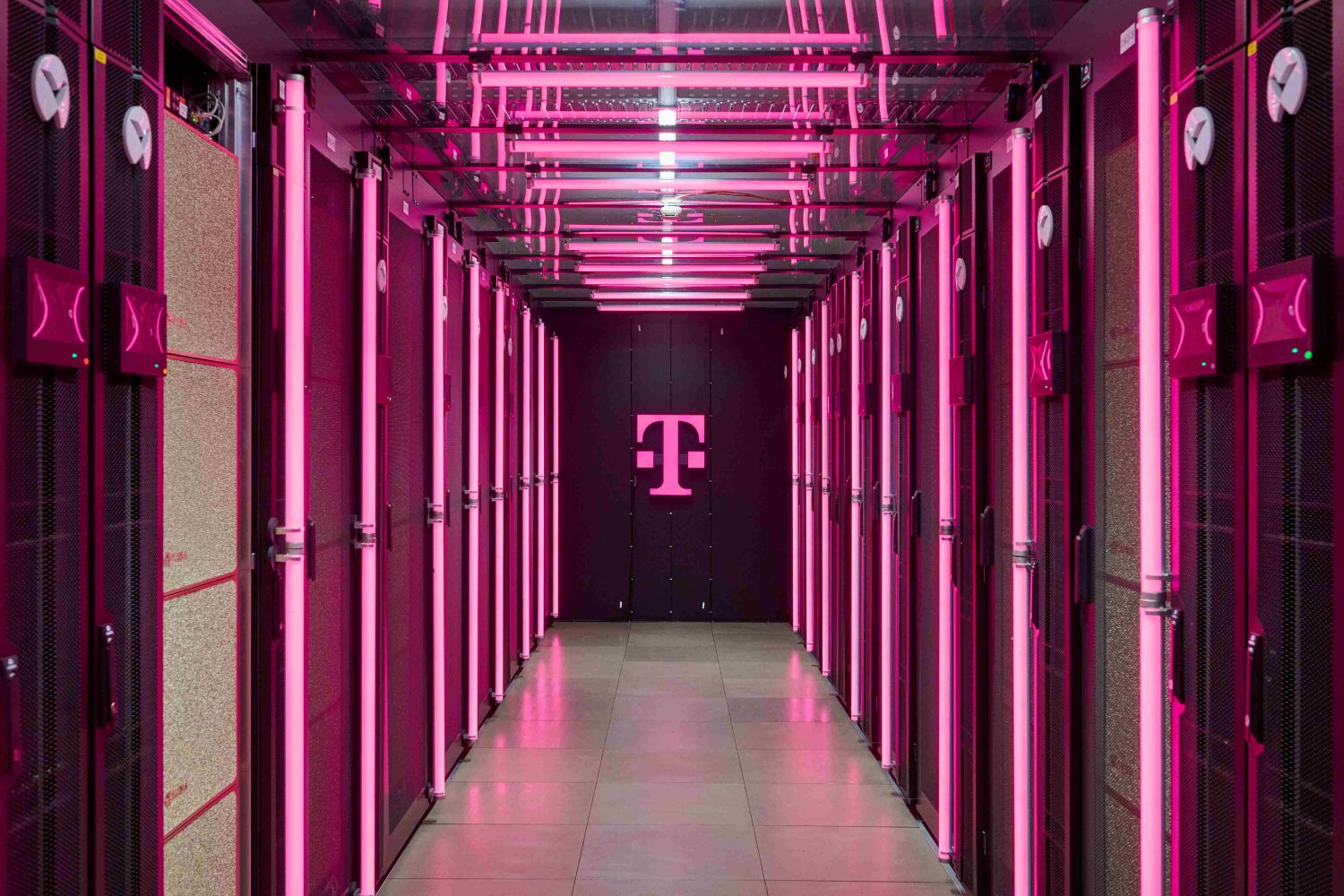
Deutsche Telekom officially launched its Industrial AI Cloud today in the presence of representatives from politics, business, and science. The so-called AI factory has been built over the past six months in collaboration with NVIDIA and data center partner Polarise, providing companies, research institutions, and the public sector in Germany and Europe with a sovereign, high-performance computing capacity for artificial intelligence applications.
The new infrastructure, located in Tucherpark in Munich, establishes a new AI hub in Germany. Several companies are already utilizing these computing capabilities, including Agile Robots, a Munich-based provider that combines AI and robotics, and PhysicsX, which specializes in technical simulations to reduce product and component development times. The AI factory is already operating at over one-third of its capacity with existing customers.
Deutsche Telekom CEO Tim Höttges emphasized that the company is investing in AI across Germany and Europe, noting that the Munich AI factory is the foundation for innovative business models for industry, startups, and public administrations, as well as for digital sovereignty. Also speaking at the event was Germany’s Federal Finance Minister Lars Klingbeil, who highlighted the need to combine public and private investment for the success of the Investment Plan and underscored the importance of technological leadership for Germany’s future economic model.
The Munich Industrial AI Cloud already offers computing and storage resources for AI applications. The infrastructure is based on nearly 10,000 NVIDIA Blackwell GPUs, including NVIDIA DGX B200 systems and NVIDIA RTX PRO™ Server GPUs, with a computing power of up to 0.5 exaFLOPS. According to the company, this capacity would enable 450 million EU citizens to simultaneously use an AI assistant or Chatbot. Deutsche Telekom operates the AI factory on German soil under strict data protection, security, and availability requirements, with a strong focus on sustainability.
The AI factory serves as the foundation for the so-called “Germany Stack,” which Deutsche Telekom offers together with SAP. T-Systems, a Deutsche Telekom subsidiary, is responsible for the infrastructure and platform layer, including T Cloud, while SAP provides the Business Technology Platform and enterprise and AI applications. This technology stack enables the rapid, secure, and compliant deployment of customized solutions for sectors such as public administration, security, industry, and small and medium-sized enterprises.
In the industrial sector, the collaboration between Siemens and Deutsche Telekom combines engineering, secure and sovereign IT, connectivity, and computing power for AI. The integration of Siemens’ SIMCenter simulation portfolio into the Industrial AI Cloud allows for high-precision simulations and digital twins, facilitating virtual product launches and reducing costs. According to Cedrik Neike, CEO of Digital Industries and Member of Siemens AG’s Management Board, these solutions are already a reality in Munich and also benefit small and medium-sized enterprises.
The AI factory reuses an existing data center in Munich, approximately 10,700 square meters in size, as part of the Tucherpark revitalization. The former Hypovereinsbank data center has been fully modernized and now operates entirely on renewable energy. It has been designed for maximum energy efficiency, with a cooling system that uses water from the nearby Eisbach and plans to repurpose waste heat to provide heating to the surrounding district.
An ecosystem of industry partners, research institutions, and startups is emerging around the Industrial AI Cloud. These organizations can create digital twins, simulate manufacturing processes, develop robotics applications, or access high-performance sovereign computing for research projects. The platform is already available for industry clients, startups, research institutions, and the public sector, with flexible contracting options tailored to their needs.
One of the first major projects hosted on the Industrial AI Cloud is SOOFI (Sovereign Open-Source Foundation Models). Leibniz University Hannover has awarded Deutsche Telekom the technical infrastructure to develop a new, open-source, sovereign language model with around 100 billion parameters, trained and operated entirely in Europe and focused on European languages.
Representatives from SAP, NVIDIA, and the German Research Center for Artificial Intelligence (DFKI) agreed that the new infrastructure strengthens European technological sovereignty and provides the necessary foundation for scalable, secure, and high-performance industrial AI in Germany and Europe.