
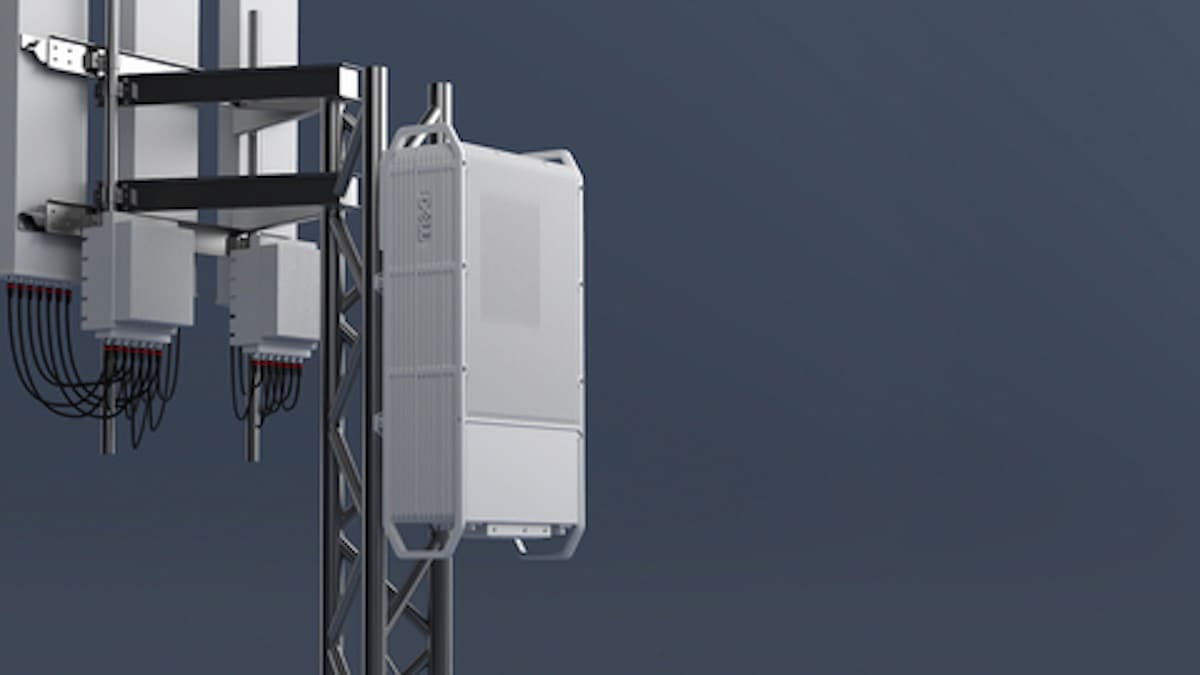
The densification of mobile networks and the rise of edge computing are pushing operators to deploy processing capacity exactly where there was only radio before. The challenge is that the “where” matters as much as the “how much”: in dense urban environments, rooftops, facades, streetlight poles, or remote locations, space, available power, and environmental protection often impose physical constraints. Based on this reality, Dell Technologies has introduced the PowerEdge XR9700, a rugged, fully sealed server that the company describes as “class-leading” for combining a IP66 dust and moisture-proof design with closed-loop liquid cooling, designed to operate outdoors without protection and run both Cloud RAN/Open RAN and AI workloads at the edge.
The XR9700 isn’t envisioned as a “mini data center,” but as computing infrastructure that can be literally mounted on poles, roofs, or building exteriors, enabling “zero footprint” deployments (no street-level cabinets) in areas where installing a traditional rack is unfeasible. In telecom terms, this capability can be decisive for expanding coverage and capacity in 5G hot spots, and bringing inference and analytics closer to the data source.
A sealed, silent server designed for extreme temperatures
The XR9700’s unique strength lies in its mechanical and thermal design. Dell encloses it in an ultra-compact IP66 chassis with GR-3108 Class 4 certification, built to withstand environments with extreme temperatures, dust, and humidity. Its closed-loop liquid cooling and thermal management architecture enable, according to the company, consistent operation between -40 °C and 46 °C, withstanding direct sunlight radiation, all within a 15-liter format.
Practically, this opens the door to a trend the sector has pursued for years: moving part of the RAN processing closer to the antenna, but without relying on containers, ventilated cabinets, or climate control infrastructure that increases cost and complexity.
Intel Xeon 6-core and support for up to 15 5G sectors per server
Under the hood, the XR9700 relies on the Intel Xeon 6 SoC with Intel vRAN Boost and Intel AMX. Dell positions this combination as the foundation for running Cloud RAN functions efficiently, while also supporting edge AI workloads.
The figure that contextualizes the team’s ambition is its declared capacity: the XR9700 provides processing power and fronthaul connectivity to support up to 15 5G sectors in a single server. Although optimized for Cloud RAN, Dell emphasizes the platform’s flexibility to run edge and AI workloads depending on the network architecture and service requirements.
As operators seek software-defined alternatives to traditional RAN, consolidating more “sectors per box” in complex locations could make the difference between a viable deployment and just a pilot project.
Remote operation: iDRAC and hands-off provisioning
Another critical aspect of extreme edge deployments is operation. If the server is mounted on a pole or building rooftop, each visit costs money. Dell integrates the XR9700 into its PowerEdge XR-Series family and maintains compatibility with its usual management tools. Specifically, the company highlights iDRAC for remote visibility and control, and zero-touch provisioning (ZTP) capabilities to deploy and operate equipment without recurring physical intervention.
Additionally, Dell notes that compatibility with the same validated Cloud RAN software used in the PowerEdge XR8720t can simplify certifications and accelerate telecom deployments—especially relevant given that cross-validation processes often take months.
Telecom ecosystem: Rakuten Mobile, Samsung, and Intel lend their support
The launch is accompanied by statements pointing to the product’s fit within the virtualized RAN ecosystem. Dell mentions Rakuten Mobile as one of its launch customers, with plans to deploy the XR9700 across its nationwide mobile network in Japan. Rakuten’s RAN head, Sudhakar Pandney, links the new server to the efficiency and performance of its cloud-native Open RAN infrastructure, emphasizing its usefulness in demanding outdoor environments to strengthen Cloud RAN capabilities and edge applications.
Samsung, for its part, frames the device within the push toward end-to-end, software-defined, “AI-native” networks. Executive VP Ji-Yun Seol describes the XR9700 as a promising avenue for expanding vRAN in complex edge deployments and improving operational efficiency, a significant validation in a market where installation scenarios often break the “one-size-fits-all” approach.
Intel also uses the announcement to reinforce its narrative of efficiency per watt and per space. Cristina Rodriguez, VP and General Manager of Network & Edge at Intel, states that the Xeon 6 SoC aims for leading performance combined with improved power and space efficiency, and that collaboration with Dell helps bring open, virtualized, AI-driven innovations to especially challenging environments.
Availability: second half of 2026
Dell targets global availability of the PowerEdge XR9700 in the second half of 2026. The timeline aligns with the telecom cycle: the gap between announcement, sampling, validation, and deployment typically tends to be lengthy—especially for equipment installed outside controlled data centers.
Nevertheless, the message from the XR9700 is clear: a serious move toward true edge computing—where cabling is minimal, weather conditions are harsh, and space is expensive. If Cloud RAN aims to become mainstream and coexist with AI inference at the edge, hardware capable of supporting that promise must be able to survive where data centers do not exist.
Frequently Asked Questions (FAQ)
What is the purpose of an IP66 ruggedized server in outdoor Cloud RAN deployments?
It enables deploying Cloud RAN/Open RAN compute in locations without protected cabinets (poles, facades, rooftops), bringing processing closer to the cell site and facilitating capacity upgrades where space and power are limited.
What does it mean that the PowerEdge XR9700 supports up to 15 5G sectors in a single server?
It’s the maximum processing capacity Dell indicates for consolidating RAN processing in one device, which could reduce node count, simplify operations, and accelerate deployments in dense 5G scenarios.
Why is closed-loop liquid cooling important at extreme edge?
Because it helps maintain thermal stability without relying on room cooling systems, allowing operation over wide temperature ranges and in harsh environmental conditions—a key factor for outdoor computing.
How is a server installed on a pole or rooftop managed without frequent visits?
With remote management tools like iDRAC and zero-touch provisioning (ZTP), enabling control, diagnostics, and deployment configurations with minimal physical visits.