
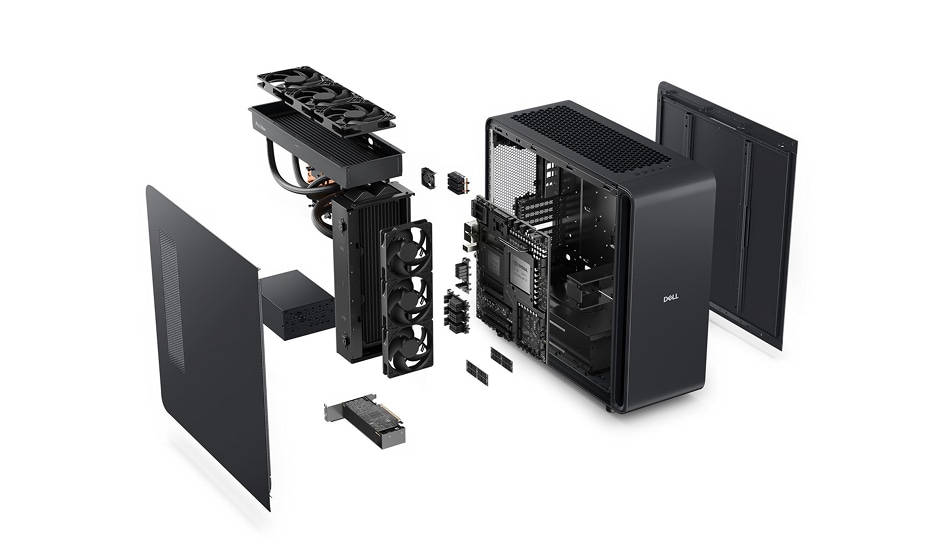
Dell Technologies aims to take the next phase of enterprise AI out of data centers and bring it closer to developers’ workstations. The company has announced support for NVIDIA NemoClaw and NVIDIA OpenShell on its Dell Pro Max with GB10 and GB300 systems, a combination designed to build and run long-duration autonomous agents locally, with more control over privacy, permissions, and security. Dell also claims to be the first OEM to market a desktop with the NVIDIA GB300 Grace Blackwell Ultra Desktop Superchip, a machine that offers capabilities once mainly associated with lab or cluster infrastructure.
This move quite accurately reflects where the market is heading. The conversation around AI is no longer just about larger models or copilots suggesting text and code, but about systems capable of persistent action, launching sub-agents, using tools, and maintaining tasks for hours or days. An evident tension arises: the more autonomous an agent, the more access it requires to data, applications, and resources; yet deploying such an agent securely in an enterprise environment becomes more complicated. Dell and NVIDIA seek to address this tension with a specific solution: ample local memory, extreme computing power, and a runtime that enforces isolation and permissions from infrastructure, not just from prompts.
A desktop PC transformed into a supercomputer for agents
The most striking piece of the announcement is the Dell Pro Max with GB300. Dell presents it as a “desktop supercomputer,” which doesn’t seem like an overstatement given the specifications published by the company itself. The system leverages the GB300 Grace Blackwell Ultra Desktop Superchip and offers up to 20 petaFLOPS of performance in FP4 along with 748 GB of coherent memory. The technical sheet details a configuration with a NVIDIA Grace 72-core Neoverse V2 CPU, 496 GB of LPDDR5X memory, 252 GB of HBM3e for graphics, and 16 TB SSD. It comes with Ubuntu 24.04 LTS and NVIDIA developer tools, showing that this is not just future promise but a platform already available in Dell’s catalog.
Dell states that this configuration enables local work with autonomous agents at billion-parameter scale, which, even read cautiously, clearly targets research teams, advanced developers, corporate labs, and organizations wanting to test or deploy agents without relying constantly on the cloud. Dell’s logic is straightforward: if the agent can run locally, then latency is low, privacy is better, and operation isn’t dependent on continuous connectivity or exposing sensitive data externally.
The lower tier is the Dell Pro Max with GB10, also supporting OpenShell. This machine delivers up to 1 petaFLOP in FP4 and 128 GB of unified coherent memory, with a more compact and energy-efficient approach. Dell targets “always-on” agents—persistent autonomous systems or assistants. Additionally, the company states it is co-designing with NVIDIA an air-gapped solution for federal clients, intended to run autonomous agents on classified or highly sensitive data in physically isolated environments without external connections.
NemoClaw and OpenShell: the missing security layer
The other part of the news relates to software. NVIDIA NemoClaw was introduced this week as an open-source stack for the OpenClaw community, enabling simple deployment of models like Nemotron and the NVIDIA OpenShell runtime with a single command. According to NVIDIA, NemoClaw is part of the NVIDIA Agent Toolkit and aims to provide autonomous agents with a more secure and manageable foundation.
What’s truly important here is OpenShell. NVIDIA describes it as an open-source runtime that sits between the agent and infrastructure, providing sandboxing, granular permissions, isolation, privacy routing, and policy enforcement from an external layer beyond the agent itself. The idea is that agents start with zero permissions, each action is governed by policies, and inference remains private by default. NVIDIA’s technical blog also explains that OpenShell allows existing programming agents, including OpenClaw, Claude Code, or Codex, to run within this isolated environment without modification.
This has greater significance than it may appear. Until now, much of the discourse around agents focused on their ability to generate code, invoke tools, or decompose tasks. But the real challenge for many companies is not whether the agent is intelligent, but whether it’s deployable. If an agent can modify files, open browsers, use command-line interfaces, access internal data, or chain actions for hours, then the question shifts from model capability to runtime, permissions, and containment. Dell and NVIDIA are working to turn precisely that into a product.
From AI hype to real infrastructure
Dell justifies this bold move by recalling that the OpenClaw launch in January 2026 showcased the potential of autonomous agents and garnered over 100,000 stars on GitHub in its first week, according to the company. Beyond the figure, the key signal is that the market now sees agents not just as a chatbot evolution but as a new software layer capable of executing complex tasks with less direct supervision.
However, making this a reality requires a different kind of infrastructure. An always-on agent isn’t enough with just a powerful GPU; it needs abundant memory, stability, the ability to maintain long context, sustained local performance, and risk containment measures. On this front, Dell is positioning the desktop as a new node for development—and in some cases, deployment. It won’t replace data centers or cloud services, but it can change how advanced teams prototype, tune, and validate agents before deploying them into production.
The big question is whether these machines will find a sufficiently broad market beyond highly specialized teams. The proposal makes sense for applied research, security, defense, and development of models and agents working on sensitive or disconnected data, but they likely remain distant from the standard enterprise desktop. Still, Dell is sending a clear message: autonomous AI won’t only be in the cloud. There will also be a contest to bring that power and control to the edge, the desktop, and in-house labs.
Frequently Asked Questions
What is Dell Pro Max with GB300?
It’s a high-performance desktop from Dell based on NVIDIA GB300 Grace Blackwell Ultra Desktop Superchip, aimed at developing and running autonomous agents and advanced AI workloads locally.
How much memory does the Dell Pro Max with GB300 have?
Dell cites 748 GB of coherent memory. The technical sheet details it as 496 GB of LPDDR5X and 252 GB of HBM3e.
What does NVIDIA OpenShell do?
It’s an open-source runtime that runs autonomous agents within isolated environments, providing granular permissions, security policies, and privacy by default.
What is NemoClaw for?
NemoClaw is an NVIDIA open-source stack that installs models like Nemotron and the OpenShell runtime with a single command, facilitating more secure deployment of autonomous agents.