
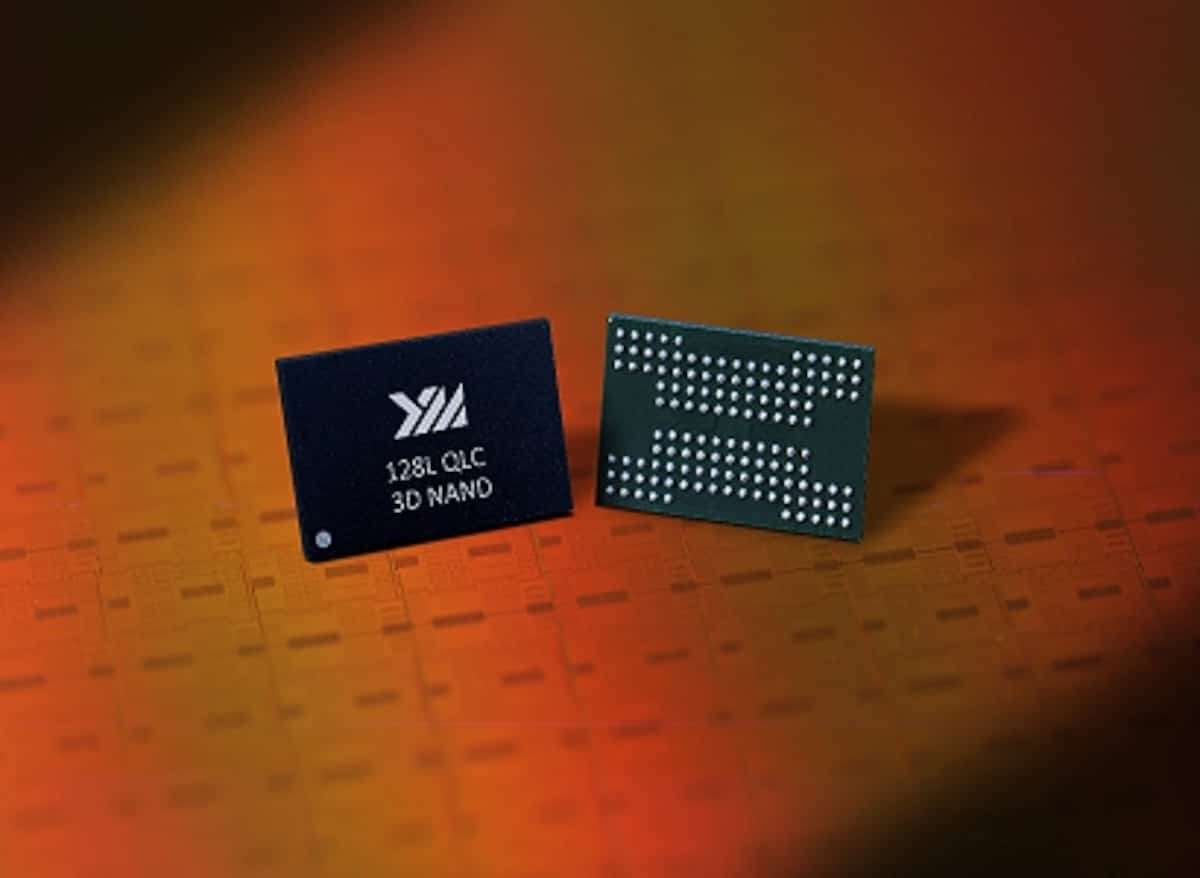
CXMT, China’s largest DRAM memory maker, is preparing to enter the NAND flash memory business at a time of strong AI-driven demand. According to sources consulted by Reuters, the company wants to set up an experimental research and production line at its new Beijing plant and has already held talks with potential customers, including an AI-focused startup.
CXMT’s NAND memory plans in 30 seconds
- CXMT is preparing an R&D line for NAND at its new Beijing plant.
- The company is already in talks with potential customers interested in AI storage.
- YMTC, which specializes in NAND, would gain a direct Chinese competitor in this market.
- Demand for AI servers is straining memory supply and pushing up prices.
- TrendForce expects NAND supply pressure to start easing in the second half of 2027, though the market remains subject to change.
The move represents a significant shift for CXMT, known until now mainly for its DRAM business. The company wants to diversify its production as memory makers face growing demand from AI servers and heavy pressure on available capacity.
The move also opens up new competition within China. YMTC, Yangtze Memory Technologies, already develops and manufactures NAND flash, while CXMT has built its position around DRAM. If the Beijing project moves from the experimental phase to commercial volume production, the two companies would end up competing in the same market.
Market conditions help explain the timing. TrendForce notes that NAND flash remained in deficit throughout 2026 due to rising AI-related demand and limited capacity expansion. The firm estimates a supply deficit of 4-5% for 2026, though it expects the supply-demand balance to turn positive during the second half of 2027.
CXMT Wants to Test NAND in Beijing Before Making the Industrial Leap
According to Reuters, CXMT plans to set up a research-and-development production line for NAND inside its new Beijing plant. The company has also created a research institute in the Chinese capital, where one of the projects is tied to developing this technology. For now, the available information points to R&D and experimental production activities, with no confirmed date for that line to begin operating.
The next commercial step could come even before mass production. Reuters reports that CXMT has already held talks with potential customers, including an AI startup interested in using future NAND chips in storage products aimed at AI systems and supercomputers. That company’s identity hasn’t been made public.
This matters because a new memory plant needs much more than technical capability. Commercial production requires customers, sufficient volumes, and a supply chain able to sustain the process for years. Early talks may indicate that CXMT is gauging demand before committing to a larger industrial expansion, but they don’t yet amount to production contracts or a commercial launch.
Pricing context is another factor. TrendForce estimates that memory prices rose sharply during 2026 and that big cloud service providers’ spending on DRAM and NAND flash could account for 68% of their total infrastructure investment in 2027. The firm attributes part of this pressure to the strong growth in AI infrastructure investment.
AI’s Expansion Is Changing Manufacturers’ Priorities
Memory has become one of the most strained components in systems built for AI. In DRAM, manufacturing HBM memory, used by AI accelerators, consumes a large number of wafers and competes for capacity with other products.
TrendForce calculates that HBM and server RDIMM memory will together account for 51% of DRAM bits produced in 2026. The firm expects DRAM supply to remain constrained through 2027, as new capacity projects won’t contribute meaningful volumes until the second half of that year or even 2028.
NAND presents a different picture. Demand for enterprise and server storage is growing, but weakness in certain consumer markets and the shift toward new manufacturing processes could increase the number of bits produced. That’s why enterprise storage demand tied to AI is expected to follow a different path from DRAM during 2027.
In July, the firm forecast that NAND constraints would start to ease in the second half of 2027. It also noted that Chinese manufacturers could significantly ramp up production as new equipment arrives at their plants, approaching 19% of global NAND bit output.
That adds another wrinkle for CXMT. The company wouldn’t be entering a market with guaranteed permanent shortages, but rather trying to take advantage of a window of high demand and prices while it builds its own technological capacity. If supply rises quickly during 2027, commercial conditions could look different by the time CXMT is ready to produce at greater scale.
CXMT and YMTC Are Converging on Each Other’s Turf
CXMT’s possible entry into NAND also narrows the historical divide between China’s two big memory makers. CXMT has focused its business on DRAM, while YMTC has built its business around NAND flash.
Reuters also notes that YMTC had already sent samples of low-power DRAM to potential customers, pointing to a move in the opposite direction. Competition between the two companies could therefore gradually spread across both major memory categories.
For CXMT, the project comes after a major capital raise. The company raised around $8.6 billion in a public share offering in 2026, according to Reuters, and is also preparing a second memory plant in Beijing. That capital provides resources to keep expanding capacity, though it doesn’t mean all of it will go toward the NAND project.
The company will also have to contend with the sector’s leading international manufacturers, including Samsung Electronics, SK Hynix, and Micron. Technological competition doesn’t depend solely on the number of wafers produced: manufacturing processes, NAND layer counts, production yields, controllers, quality, and the ability to reliably supply large volumes all come into play too.
CXMT’s entry also doesn’t guarantee that China will immediately increase its global NAND share. It will first need to develop competitive technology, produce samples, validate products with customers, and achieve yields adequate for volume production.
The timing of the announcement does coincide with a period in which enterprise storage is seeing extra demand from data centers. TrendForce noted in September that enterprise storage products are under supply pressure due to demand from AI and cloud services.
For now, CXMT’s project should be understood as an expansion still in development, not a fully operational new NAND plant. The open question is how long the company will need to move from research to marketable products, and how the market will have evolved by the time that happens.
The situation also highlights an important divide within the memory market. The current shortage doesn’t affect all products the same way. TrendForce expects DRAM to remain supply-constrained through 2027, while NAND could move toward a more balanced situation during the second half of the year.
For CXMT, that difference could determine the pace of its expansion. Entering NAND while prices are high can improve the project’s economics, but building manufacturing capacity takes years and heavy investment. If the market normalizes before that capacity reaches meaningful volume, the entry conditions will look different.
CXMT’s decision also shows just how much AI is reshaping the memory industry’s priorities. The pressure doesn’t come only from accelerators: servers need more DRAM, more storage, and more capacity to handle the data and context used while models run. The result is increasingly intense competition for manufacturing capacity across different types of memory.
Frequently Asked Questions
What does CXMT want to manufacture?
CXMT is preparing an R&D and experimental production line for NAND flash memory at its new Beijing plant. The company is currently working on developing this technology and hasn’t yet confirmed a date for large-scale commercial production.
Who is China’s leading NAND manufacturer?
YMTC is the Chinese manufacturer specializing in NAND flash that would compete directly with CXMT if the latter’s project reaches commercial production. CXMT has traditionally focused its business on DRAM memory.
Why is CXMT entering the NAND market now?
The move coincides with a period of strong memory demand tied to AI servers and NAND supply constraints. TrendForce expects these constraints to start easing during the second half of 2027.
Will the NAND shortage continue through 2027?
TrendForce expects the NAND market to move gradually toward a more balanced situation during the second half of 2027, as bit production increases and new capacity comes online. The final outcome will depend on demand and on how quickly manufacturers expand production.
