
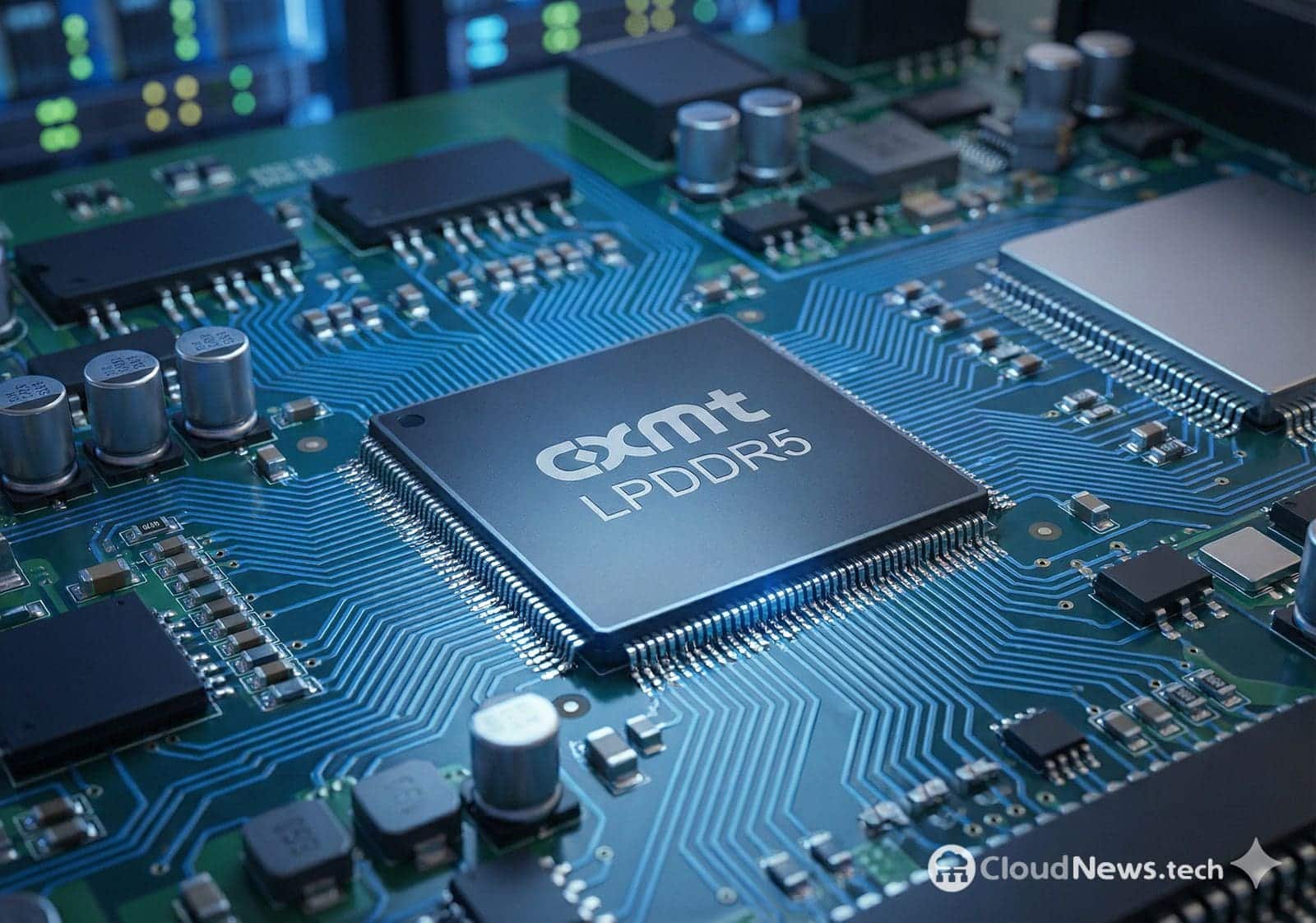
ChangXin Memory Technologies (CXMT) has ceased to be just China’s low-cost alternative in the memory market. The shortage of DRAM caused by the growth of artificial intelligence data centers allows the manufacturer to charge more for certain DDR5 server modules than Samsung, while closing multi-billion dollar contracts and speeding up the construction of new factories.
The key points of CXMT’s rise in 30 seconds
- CXMT is reportedly selling 64 GB DDR5 server modules at prices higher than the roughly $1,240 charged by Samsung.
- The company has signed supply agreements valued at $7 billion with ByteDance and $3 billion with Tencent.
- Its manufacturing costs remain higher than those of its competitors.
- The company aims to exceed 600,000 wafers per month with new factories.
- Its main limitation continues to be access to advanced equipment and delays in HBM development.
This shift is striking because CXMT built much of its growth offering lower-cost memory than Samsung, SK Hynix, and Micron. That strategy helped it gain clients within China and gradually reduce the country’s dependence on the three major manufacturers that have dominated the global DRAM market for years.
Now, artificial intelligence has disrupted that balance. Manufacturers are allocating an increasing portion of their resources to high bandwidth memory (HBM), used alongside GPUs and other accelerators. Producing HBM involves more steps, stricter controls, and greater capacity per finished memory batch, which reduces the wafers available for conventional DDR5 manufacturing.
At the same time, AI servers incorporate larger amounts of main memory. The combined effect of these factors has shrunk the available supply and given suppliers unusual negotiating power in a sector used to cycles of excess supply and sharp price declines.
CXMT moves beyond competing only on price
Supply chain sources cited by Reuters indicate that CXMT is charging more than the approximately $1,240 per unit requested by Samsung for certain 64 GB DDR5 RDIMM modules for servers. The exact price of the Chinese product has not been made public, so this comparison should be seen as a reference for specific contracts rather than a general rate for all CXMT memory.
RDIMM modules, or registered memory modules, are designed for servers and workstations. They incorporate additional components that reduce electrical load on the controller and allow higher amounts of memory to be installed stably. Their prices cannot be directly compared to those of DDR5 modules used in consumer PCs.
This increase shows that CXMT no longer always needs to offer discounts to sell its product. When demand far exceeds supply, customers purchase based not only on price but also on availability, delivery times, the supplier’s ability to maintain supply, and chip compatibility with their platforms.
That bargaining power may have even caused tension with Huawei. According to published information, the tech firm requested some form of relief after several price hikes, but CXMT maintained its conditions. The relationship has not necessarily been broken, although engineers from SiCarrier, a related equipment manufacturer linked to Huawei, were expelled in June from a CXMT R&D area in Hefei.
The company has also secured large agreements with Chinese tech groups. Reuters reports a five-year contract with ByteDance valued at over $7 billion and approximately $3 billion in other supply commitments with Tencent. These are cumulative amounts over several years, not revenue recognized at once.
China’s industrial policy also favors the purchase of domestic components. Some state-owned enterprises face restrictions on buying foreign memory, while authorities aim for CXMT and Yangtze Memory Technologies Corporation (YMTC) to prioritize domestic needs.
CXMT benefits from three simultaneous factors: a global demand at record highs, a domestic market protected for security reasons, and Chinese clients seeking alternatives to Samsung, SK Hynix, and Micron.
Manufacturing at higher costs no longer prevents high margins
Charging more than Samsung does not mean CXMT has achieved the same operational efficiency. SemiAnalysis estimates that its DDR5 manufacturing cost is roughly 30% higher than that of the three major international producers per finished bit of memory.
This gap may stem from factors such as chip size, wafer performance, process steps, equipment productivity, and process maturity. A factory that yields fewer functional chips per wafer must spread its costs over a smaller volume of sellable product.
The current scarcity allows CXMT to offset this disadvantage. SemiAnalysis estimates its operating margin was near 70% during Q1 2026. This exceptional period does not guarantee it can sustain such margins as new factories come online or supply pressures ease.
Conventional memory still accounts for nearly all of CXMT’s revenues. About 99% of its 2025 income came from DDR and LPDDR products, with HBM still representing a tiny share.
This composition explains why the company is capitalizing on the higher prices of DDR5. Samsung and SK Hynix enjoy more advanced HBM positions and can focus investments on higher-value AI accelerators. CXMT currently earns most of its profits from memory used as main RAM in servers, PCs, and mobile devices.
Although CXMT has produced HBM and planned volume manufacturing of HBM3 in 2026, available information places its technology about two generations behind the most advanced solutions from SK Hynix, Samsung, and Micron.
Two new factories to approach industry leaders
CXMT aims to reduce supply limitations through large-scale industrial expansion. The company is building new facilities in Shanghai and Hefei and is negotiating development of a third plant. These projects could raise capacity to over 600,000 wafers per month once fully operational.
SemiAnalysis predicts that by the end of 2026, CXMT will process approximately 350,000 wafers per month—close to Micron’s estimated 385,000. This is expected to increase to about 420,000 in 2027 and 500,000 in 2028.
Making direct wafer count comparisons requires caution. Two manufacturers processing the same volume don’t necessarily produce the same amount of memory. Chip density, node technology, and manufacturing efficiency determine how many useful bits each factory produces eventually.
Nonetheless, the expansion places CXMT at a scale capable of disrupting the market. SemiAnalysis projects an addition of roughly 85,000 wafers per month in capacity during 2026, another 70,000 in 2027, and nearly 80,000 in 2028. Despite these investments, analysts foresee DRAM supply remaining below demand due to persistent AI system consumption.
The main obstacle remains equipment access. China cannot currently acquire EUV lithography systems from ASML used by the most advanced manufacturers. CXMT relies on deep ultraviolet (DUV) lithography, which involves more exposures and steps to achieve increasingly smaller structures.
This approach allows continued progress but generally increases costs, production times, and defect risk. It also makes matching competitors with EUV access more difficult.
Political pressures add further uncertainty. In June 2026, the U.S. Department of Defense added CXMT and YMTC to its list of companies allegedly linked to the Chinese military. This designation does not automatically impose export restrictions but may lead to bans on contracting, investment, or technology access. Chinese companies often deny such accusations.
YMTC already faces tighter U.S. restrictions. Micron has supported expanding restrictions on Chinese competitors’ access to manufacturing equipment.
CXMT thus faces a unique situation: it can command high prices and fund rapid expansion but must convert this scarcity period into lasting industrial improvements. Building factories increases volume, but narrowing the gap with Samsung, SK Hynix, and Micron also requires boosting efficiency, lowering costs, and advancing HBM technology without access to some of the most sophisticated equipment.
Frequently Asked Questions
Does CXMT always charge more than Samsung for DDR5 memory?
Not necessarily. The comparison refers to specific 64 GB DDR5 RDIMM modules and particular supply conditions. There’s no public rate that applies universally to all CXMT products and contracts.
Why has server memory prices increased so much?
The growth of AI data centers has driven up demand for DDR5 and HBM. Additionally, manufacturing HBM consumes more capacity, reducing the wafers available for conventional memory.
Can CXMT compete technologically with Samsung and SK Hynix?
It already competes in DDR5 and is gaining market share but still faces cost disadvantages and remains behind in HBM. Restrictions on access to advanced equipment make closing this gap difficult.
How much memory can CXMT produce?
SemiAnalysis estimates about 350,000 wafers per month by the end of 2026, potentially increasing to over 500,000 in 2028. Its new projects could push this further beyond 600,000.
