
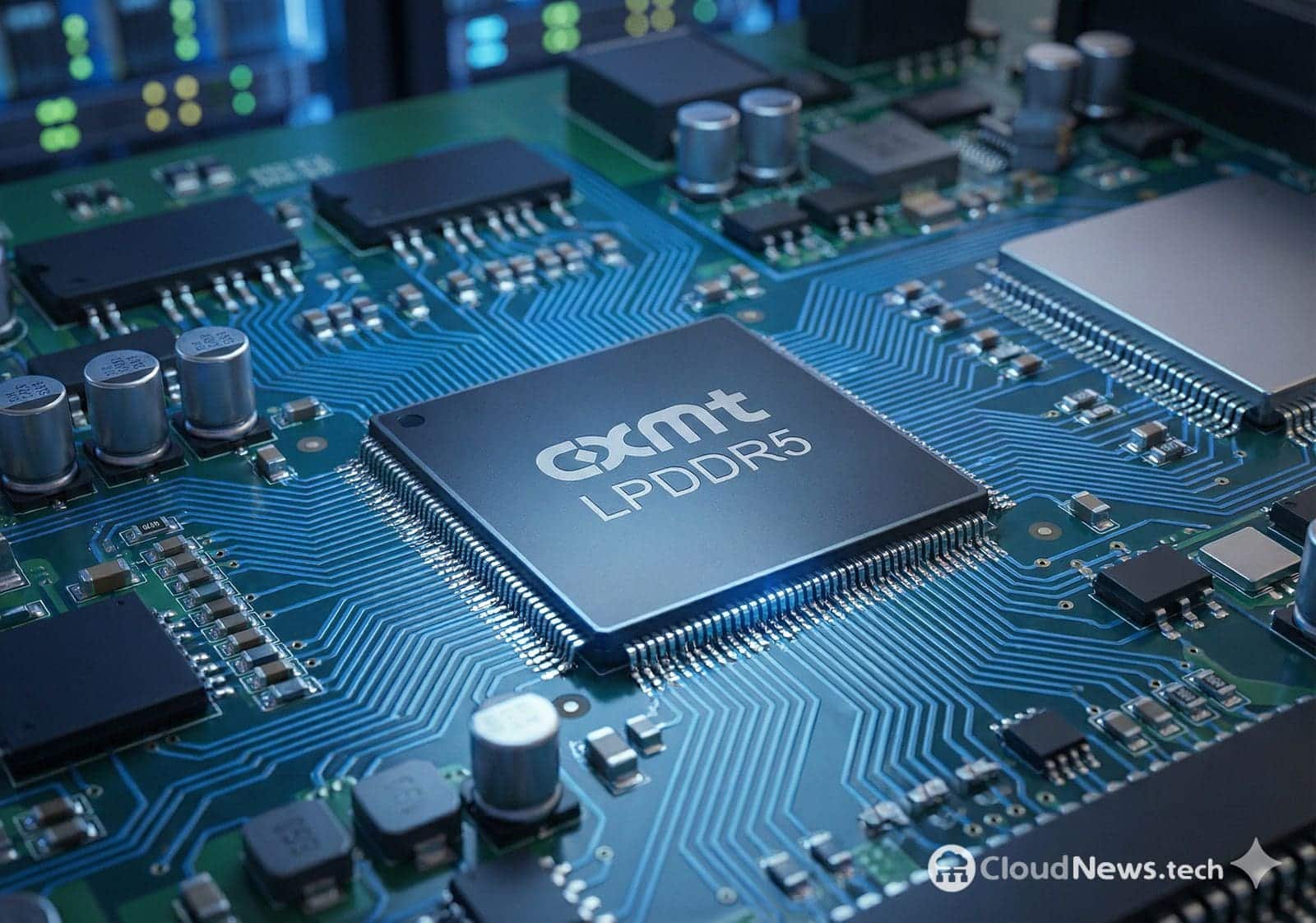
The significant push by China to build an indigenous DRAM memory industry is hitting a very tangible limit: industry capacity isn’t growing at the pace set by plans, and when it does, actual production doesn’t always keep up. This is the emerging conclusion around ChangXin Memory Technologies (CXMT), the Chinese manufacturer that has become the country’s flagship in DRAM, but which—according to market data cited by South Korean press—may have already reached its operational maximum and is facing a 2026 “plateau” due to restrictions on access to advanced equipment.
According to Omdia information accessed by ChosunBiz, CXMT’s average monthly wafer production stands at around 240,000 units, a level described as maximum after several quarters of continuous growth since 2024. From that point, industry sources project that the company will remain stagnant during 2026, not due to lack of demand or ambition, but because of a combination of supply chain limitations for equipment and the ongoing challenge of improving process yield.
A capacity ceiling in a market dominated by giants
To understand the scale of this slowdown, it’s helpful to contextualize the industry landscape. In terms of estimated annual capacity, ChosunBiz notes that CXMT still lags well behind the industry leaders: its DRAM capacity is roughly half of SK hynix and just over a third of Samsung Electronics. For reference, last year’s capacity figures were approximately 7.6 million wafers for Samsung, 6 million for SK hynix, and 3.6 million for Micron. Within this context, CXMT’s planned doubling of wafer output in 2025—compared to the previous year—is seen more as an initial “catch-up” than an immediate threat to the established hierarchy.
The paradox is that, even when nominal capacity improves, market share can lag behind if the yield doesn’t match. That’s where the second major barrier comes into play.
The Achilles’ heel: low yield at 10 nm nodes
Yield—the percentage of functional chips produced from a wafer—is the KPI that divides industrial ambition from profitability. And in DRAM, where the design and process complexity is very high, this variable is decisive.
According to figures attributed to Counterpoint Research by South Korean media, CXMT’s DRAM 1x (10 nm first-generation) would have a 42% lower performance compared to the DRAM 1a (10 nm fourth-generation) from major manufacturers, and CXMT’s yield hovers around 50%. This level limits actual production despite the factory’s capacity to process more wafers. In other words: CXMT can be “producing” many wafers, but not converting this volume into sellable chips as efficiently as its rivals.
This discrepancy helps explain why some analysts and industry sources insist that CXMT’s impact on the global market remains modest—less than headline capacity expansion figures suggest. In an industry where every percentage point of yield counts, going from 50% to mature levels requires not just investment but also time, accumulated expertise, and often stable access to advanced equipment and services.
The bottleneck: restrictions on advanced machinery
The most repeated analysis points to the U.S. regulatory pressure on export controls and support for advanced semiconductor manufacturing tools. The simple logic is that if access to cutting-edge equipment or even maintenance of installed tools is restricted, expansion slows and improving yield becomes more costly. As nodes become finer, dependence on state-of-the-art equipment increases.
Meanwhile, U.S. policymakers are debating tighter controls. Recently, Reuters reported that U.S. legislators are proposing stricter restrictions on China’s access to advanced manufacturing equipment, including not only export controls but also components and maintenance services that keep complex manufacturing lines operational.
This trend is compounded by another political debate with indirect industrial impacts: in November 2025, Reuters highlighted a legislative proposal to limit Chinese equipment purchases by U.S. companies receiving CHIPS Act funding, with exemptions and exceptions possible. While CXMT isn’t the main target, this context illustrates how equipment access has become a geopolitical asset.
China aims for “self-sufficiency” in equipment, but timing is crucial
In this race, Beijing is seeking to reduce dependence through policies supporting local development of manufacturing tools. According to ChosunBiz, analyst Cha Yong-ho (LS Securities) indicates that China is channeling resources from its third major investment fund into hardware and machinery, aiming to accelerate the “localization” of equipment. The hypothesis is that if this strategy succeeds, CXMT could resume expansions—including new capacity in Shanghai—by 2027.
However, industry insiders acknowledge that the path is long. Unlike NAND, DRAM is particularly sensitive to process precision, especially as it transitions to more advanced nodes that require critical tooling. The ongoing debate about the availability and control of advanced lithography equipment—especially by U.S. allies—is a persistent structural friction point for China.
A player that is growing but still far from the “top 3” dominance
Beyond the current short-term setback, CXMT is not a minor player. Reuters recently reported the company’s plans to raise 29.5 billion yuan (about 4.2 billion USD) through a Shanghai IPO, aimed at funding capacity upgrades and DRAM technology improvements. They also estimated CXMT’s global market share at around 4% based on Q2 2025 revenue. This data reflects a sobering reality: CXMT is now visible on the global stage, but still far from challenging the market leadership held by Samsung, SK hynix, and Micron.
Thus, the outlook for 2026 is seen as a transitional one: less brute-force expansion, more focus on yield optimization, ensuring equipment supply, and consolidating technological pathways. In an industry where growth is measured both in wafers and in sellable chips, the capacity ceiling is only half the challenge. The other—and perhaps the more difficult—half is making each wafer produce more useful DRAM, consistently and profitably.
Frequently Asked Questions
What does it mean that CXMT has reached a “ceiling” of 240,000 wafers per month?
It indicates that, based on market data cited by Omdia, the company is operating near its current maximum monthly capacity, with limited prospects for capacity expansion in 2026 due to equipment constraints and factory expansion hurdles.
Why is yield so important in DRAM compared to other memories?
Because DRAM’s process and design complexity mean small variations significantly impact the percentage of functional chips. A low yield drastically reduces effective production and increases the cost of each sellable chip.
How do U.S. export restrictions impact CXMT’s expansion?
They can limit access to advanced tools and complicate the procurement of spare parts and maintenance services, slowing capacity expansion and yield improvements at advanced nodes.
Could CXMT resume its expansion pace in 2027?
Some analysts cited by South Korean press suggest that if China makes progress in “localizing” equipment, further expansion might restart from 2027 onwards, though it will depend heavily on technological results and regulatory developments.
via: biz.chosun