
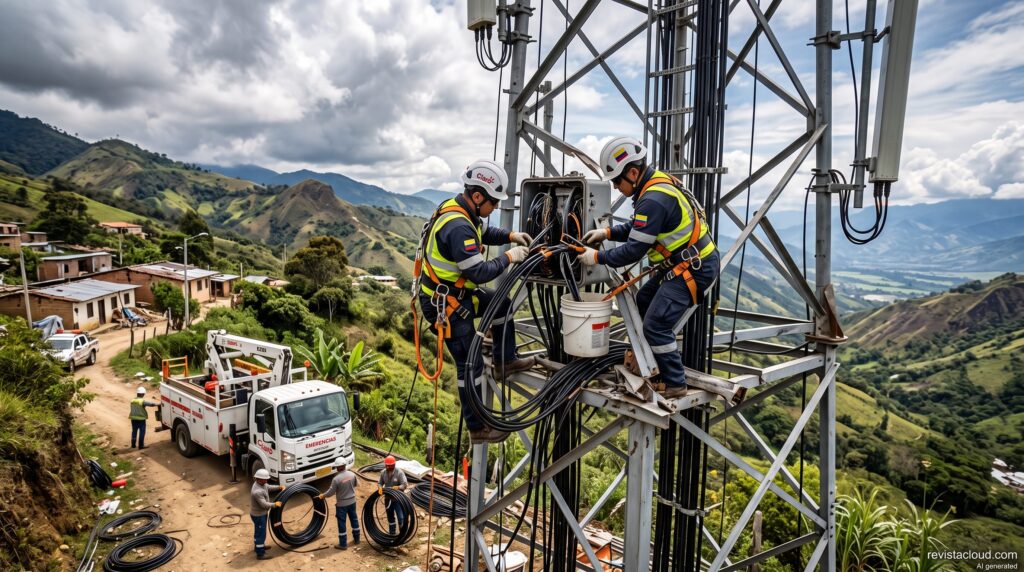
Colombia’s telecommunications networks are progressing towards normalcy after the 7.4 magnitude earthquake on August 10, which particularly affected the western part of the country and has caused around 290 fatalities according to the latest reports. Since then, operators have been working to restore base stations, fiber optics, and nodes affected by the quake, and in the case of Claro, the company reports having already restored 80% of its stations and all fiber nodes in the affected areas.
The key points of telecommunications after the earthquake in 20 seconds
- The magnitude 7.4 earthquake particularly impacted Chocó, Valle del Cauca, and the Coffee Region.
- Claro claims to have recovered 80% of its affected base stations and all its fiber nodes.
- 26 generators have been deployed to keep parts of the infrastructure operational.
- Power outages, access to certain areas, and fuel shortages continue to influence repair efforts.
- Several providers have offered additional or free connectivity to those affected.
Restoring communications has become a vital part of disaster response, impacting a broad swath of the country. Reuters highlights Cali and Pereira as among the hardest-hit cities, while rescue operations have had to contend with hundreds of aftershocks and severe damage to homes and infrastructure.
In these circumstances, recovering a mobile antenna involves more than just restoring WhatsApp or Internet service. Connectivity enables emergency teams to coordinate, contact family, access official information, and keep business and administrative services operational.
Base stations, fiber optics, and electricity: three priorities
The earthquake simultaneously tested multiple layers of telecommunications infrastructure.
Operators had to work on mobile base stations, fiber optic networks, and main nodes, but the problem was not always within their own networks. A station might survive structurally but still be out of service if its power supply is cut or its connection to the rest of the network is interrupted.
Claro states that approximately 80% of its affected base stations are now operational, and all its fiber nodes have been restored in the affected areas.
In the first three days after the quake, the company managed to restore nearly half of the affected stations. Continued efforts have stabilized much of the infrastructure, though full service normalization across all municipalities has not yet been achieved.
Energy has been a critical element in recovery efforts.
Recovery efforts included installing 26 generators in cities like Quibdó, Pereira, and Cali. These units provide temporary power to telecom facilities when the main grid is down.
While common in data centers and critical infrastructure, generators have a clear limitation: they require fuel.
Prolonged power outages can quickly turn into logistical challenges. Having generators is not enough; physical access and fuel supply must also be maintained throughout the emergency.
Access to damaged areas complicates full recovery
Operators continue to face multiple hurdles in returning 100% of services.
Extended power outages, damaged roads and infrastructure, access difficulties, and fuel shortages all affect repair operations.
This issue is especially complex in rural areas.
Reuters reports that some indigenous communities in Chocó near the epicenter were initially isolated and faced difficulties accessing basic services and communications. The earthquake’s epicenter was in San José del Palmar, Chocó, at a depth of approximately 107 kilometers.
Tigo has deployed technical teams and ongoing monitoring efforts to stabilize its infrastructure. Their issues are due to a combination of physical damage, power outages, and an unusually high volume of traffic.
This last factor is often overlooked.
After a natural disaster, operational networks can see a sharp increase in usage. Thousands of people try to call family, send messages, check news, or access emergency services simultaneously. Surviving infrastructure must absorb this additional demand, which was previously distributed across more stations.
Modern telecoms incorporate mechanisms to redistribute traffic, but simultaneous loss of antennas, links, and power can significantly reduce available capacity.
Coordination between companies and authorities is essential to prioritize the restoration of facilities serving hospitals, emergency services, shelters, and other critical infrastructure.
Free data and Starlink as emergency connectivity
Response efforts have gone beyond repairing terrestrial networks.
According to information released after the earthquake, users of Claro, Tigo, WOM, and Starlink in Chocó, Valle del Cauca, Risaralda, Quindío, and Caldas received various measures to maintain connectivity, including free mobile data.
Starlink has also reportedly provided free service in affected zones and credits to reactivate certain subscriptions.
Satellite connections are especially valuable in emergencies because they do not rely on the continued functioning of terrestrial infrastructure.
A terminal needs power and a clear view of the sky, but it can establish a connection without depending on the same fiber routes and ground stations used by fixed networks.
This does not make satellites a substitute for mobile or fiber networks—capacity, costs, terminals, and features differ—but they can serve as a complementary option when earthquakes, floods, or fires damage terrestrial infrastructure.
An earthquake reveals the extent of a network’s redundancy
Colombia’s earthquake also offers a real-world test of something typically invisible to users: the amount of infrastructure needed for Internet and phone services to operate daily.
A seemingly simple connection can depend on a base station, power supply, batteries, transport fiber, aggregation nodes, data centers, and multiple interconnection routes.
Redundancy ensures that the failure of one component doesn’t necessarily interrupt service. Problems arise when a disaster impacts multiple layers simultaneously.
According to Reuters, the Colombian earthquake was the strongest recorded in the country this century. Five days after the quake, the death toll was around 290 dead, nearly 4,000 injured, and about 140 missing, with rescue operations still ongoing.
Telecommunications are only a part of a broader emergency, but their swift recovery significantly influences other operations.
The progression from initial outages to having 80% of Claro’s affected stations operational demonstrates the resilience of these networks. However, the last 20% may be the most challenging — corresponding to areas with the most damage, power issues, or access restrictions.
Frequently Asked Questions
When did the earthquake occur in Colombia?
The earthquake took place on August 10, 2026, in western Colombia. It reached a magnitude of 7.4 and had its epicenter in San José del Palmar, Chocó.
Which areas experienced telecommunications problems?
Problems particularly affected departments like Chocó, Valle del Cauca, Risaralda, Quindío, and Caldas, with cities such as Cali and Pereira hit especially hard.
How much of Claro’s infrastructure has been recovered?
The company indicates that approximately 80% of its affected base stations and all fiber nodes in damaged areas are operational again.
Why can a power outage cause mobile coverage to disappear?
Antennas and telecom equipment require electricity. Batteries and generators can provide temporary power, but prolonged outages demand fuel, maintenance, and physical access to facilities.
via: infobae
