
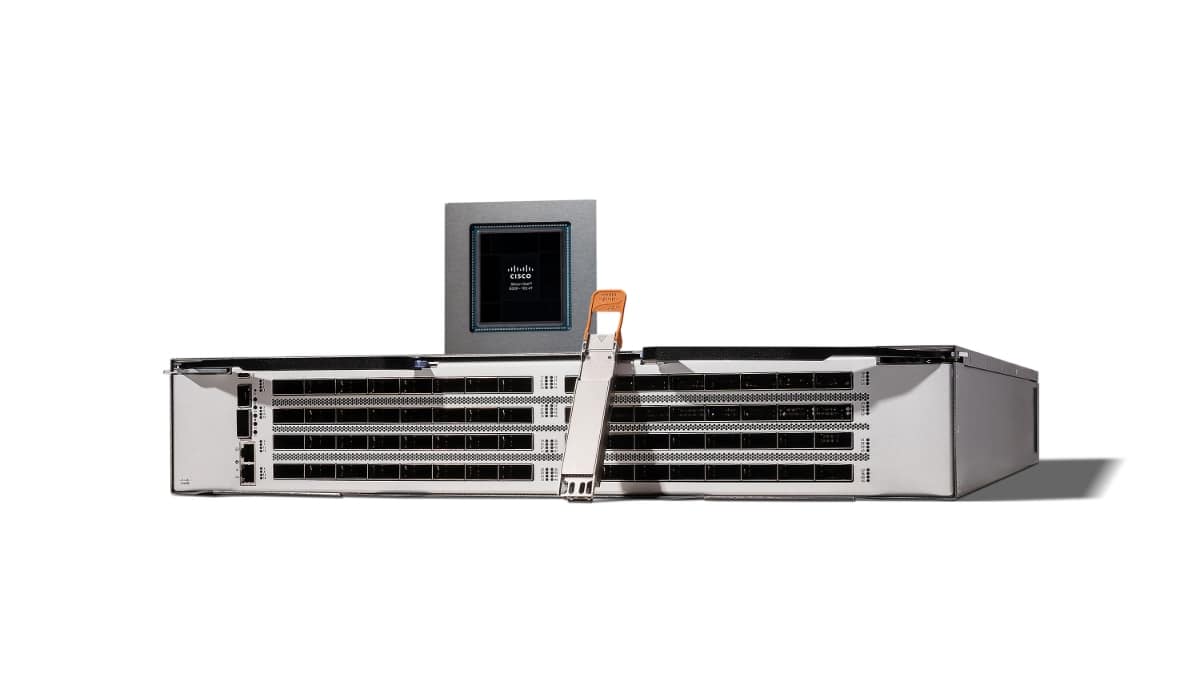
Cisco has announced new silicon, switching and optical connectivity technologies for networks built for artificial intelligence (AI) data centers. The announcements, made at the OCP Global Summit 2026, include the 51.2 Tbps Silicon One G302 switching chip, the expansion of the 102.4 Tbps Silicon One G300 systems, and a joint project with NVIDIA to develop optical modules capable of reaching 400 Gbps per lane. The company also confirmed that its Silicon One P200 systems are already running in production environments at major cloud providers.
Cisco’s new networks in 20 seconds
- Cisco expands Silicon One with the G302, a 51.2 Tbps switching chip expected to start reaching customers before the end of 2026.
- The first systems based on the 102.4 Tbps G300 are already shipping to customers.
- Microsoft and Alibaba Cloud have announced infrastructure deployments based on Silicon One P200.
- Cisco and NVIDIA are preparing an open specification for 400 Gbps-per-lane optical modules.
The announcement points to a shift in how networks connecting thousands of AI accelerators are designed. As models demand more compute capacity, the network must move large volumes of data between different servers, racks and data centers without congestion or communication failures slowing down the accelerators’ work.
Cisco wants to address that need with an architecture that combines network chips, switching systems, coherent optics and management tools. The approach relies on Silicon One, its family of network processors, and on open technologies such as SONiC, the network operating system used by large cloud operators.
From the data center to the facility cluster: the challenge of connecting AI
One of the main threads of the announcement is the so-called scale-across architecture, aimed at connecting compute resources spread across different facilities. Unlike a traditional connection between data centers, this approach seeks to let accelerators located in different sites take part in the same coordinated job.
To achieve that, the network has to control latency, manage congestion and recover from problems without unnecessarily interrupting tasks. When hundreds or thousands of accelerators work on a joint operation, slow communication can leave part of that compute capacity waiting for data to arrive.
Cisco combines Silicon One P200 silicon, systems with large memory buffers to manage traffic, and coherent optical technologies in this architecture. The company argues that this combination makes it possible to connect distributed AI networks through a common architecture, with built-in programmability and security capabilities.
The P200 has already reached production environments. Microsoft has confirmed it uses systems based on this processor, while Alibaba Cloud has announced the large-scale deployment of its Quantum Cat routers, designed in-house by the Chinese company and equipped with Cisco silicon.
In Alibaba’s case, the announced routing capacity reaches 51.2 Tbps per system. The company combines Cisco’s chips with its own equipment and the SONiC operating system. The example illustrates how a provider can use commercial silicon without depending on a closed, end-to-end network system.
These references provide signals of real-world use, although they don’t allow for an independent comparison of the performance of the different architectures or reveal every detail of their deployments.
Silicon One G300 and G302: more capacity inside the rack
Cisco also presented advances for the networks that connect servers within a single data center. In this area, the company confirmed that the Silicon One G300, previously announced with a 102.4 Tbps capacity, is now available for customer testing and that the first systems based on it are already shipping.
The additional new product is the G302, a switching chip with an announced capacity of 51.2 Tbps and 200 Gbps SerDes. SerDes is the technology that allows data to be transmitted serially at high speed between a system’s components. Cisco is positioning this processor for top-of-rack (ToR) switches, installed in each rack to collect traffic from servers and connect it to the rest of the data center network.
The G302 includes support for 1.6 Tbps optics and integration with direct-to-chip liquid cooling systems. This technique transfers heat away from high-density components toward a cooling liquid loop, an increasingly relevant option in equipment that concentrates high compute and communication power.
The company expects to begin shipping the G302 before the end of 2026. This is, therefore, a timeline announced by the manufacturer, not general availability that can already be confirmed in every market.
The technical goal is to increase network capacity within the rack itself and reduce the bottlenecks that appear when connecting large sets of servers and accelerators. A chip’s rated capacity, however, doesn’t determine a facility’s performance on its own: the overall architecture, software, configuration and operating conditions also play a role.
Cisco and NVIDIA prepare 400 Gbps-per-lane optics
Another announcement centers on USFP, short for Ultra-Dense Small Form Factor Pluggable, a high-density optical module proposal that Cisco is developing together with NVIDIA. The design aims to reach 400 Gbps per lane, compared with the 200 Gbps per lane of the reference solutions used in the two companies’ comparison.
According to Cisco and NVIDIA’s estimates, USFP could deliver four times the bandwidth density and 1.3 times the energy efficiency of 200 Gbps-per-lane optics. These are figures provided by their own backers, tied to the comparison of their designs, rather than results from an independent evaluation published alongside the announcement.
The proposal seeks to increase transmission capacity without moving away from the pluggable optical module model. This approach makes it possible to replace or keep components without necessarily having to replace the entire network system, while also offering deployment flexibility.
Cisco and NVIDIA plan to drive an open specification for USFP through a community-led, multi-vendor project. The goal is to widen participation from other manufacturers and prevent a technology of this kind from depending exclusively on a proprietary implementation.
For now, the announcement refers to the development work and the future specification. It doesn’t amount to confirming that a definitive standard already exists, or that every compatible piece of equipment is already commercially available.
SONiC and network management also factor into the strategy
The push for open infrastructure includes SONiC (Software for Open Networking in the Cloud), an open-source network operating system that allows a common software environment to be used across equipment from different manufacturers. Cisco announced that its customers will be able to adopt Cisco-validated versions of SONiC through Nexus One, its data center architecture.
The company also plans to extend support with Live Protect starting in mid-2027. This technology uses runtime protection mechanisms to reduce exposure to certain vulnerabilities during the period between a flaw’s disclosure and the installation of a permanent fix. Its arrival for SONiC customers is part of the announced plans, so it shouldn’t be read as a feature that’s already available to all of them.
Out-of-band management is another area addressed. These networks make it possible to access and manage equipment even when the main network stops working, which is useful during an outage or a security incident.
For this function, Cisco introduced the 8001 system, based on Silicon One A100 and available in 10G or 1G configurations. The company positions it for management networks in large AI infrastructures, with support for SONiC, familiar programming interfaces and automation. The goal is to reduce dependence on separate management environments and make operations easier from the rack level up to the infrastructure as a whole.
Cisco’s presentation thus combines products at different stages of maturity: some are already in production or shipping to customers, while others have planned dates or still require specifications to be developed. That distinction will matter for companies evaluating their next AI networks.
Frequently asked questions
What’s the capacity of the Cisco Silicon One G300?
Cisco states a switching capacity of 102.4 Tbps for the Silicon One G300. The first systems based on this chip are already shipping to customers, according to the company.
What is the Silicon One G302 for?
The G302 is a 51.2 Tbps switching chip aimed mainly at top-of-rack equipment. It’s designed to connect servers within racks and link them to the rest of the data center network.
What is the USFP optics announced by Cisco and NVIDIA?
USFP is a high-density optical module proposal capable, according to its backers, of transmitting 400 Gbps per lane. Cisco and NVIDIA plan to develop an open specification to encourage participation from other manufacturers.
What role does SONiC play in these networks?
SONiC is an open-source network operating system that allows equipment to be managed through a common software platform. Cisco has announced support for validated versions on its Nexus One architecture and plans to extend Live Protect coverage starting in mid-2027.
