
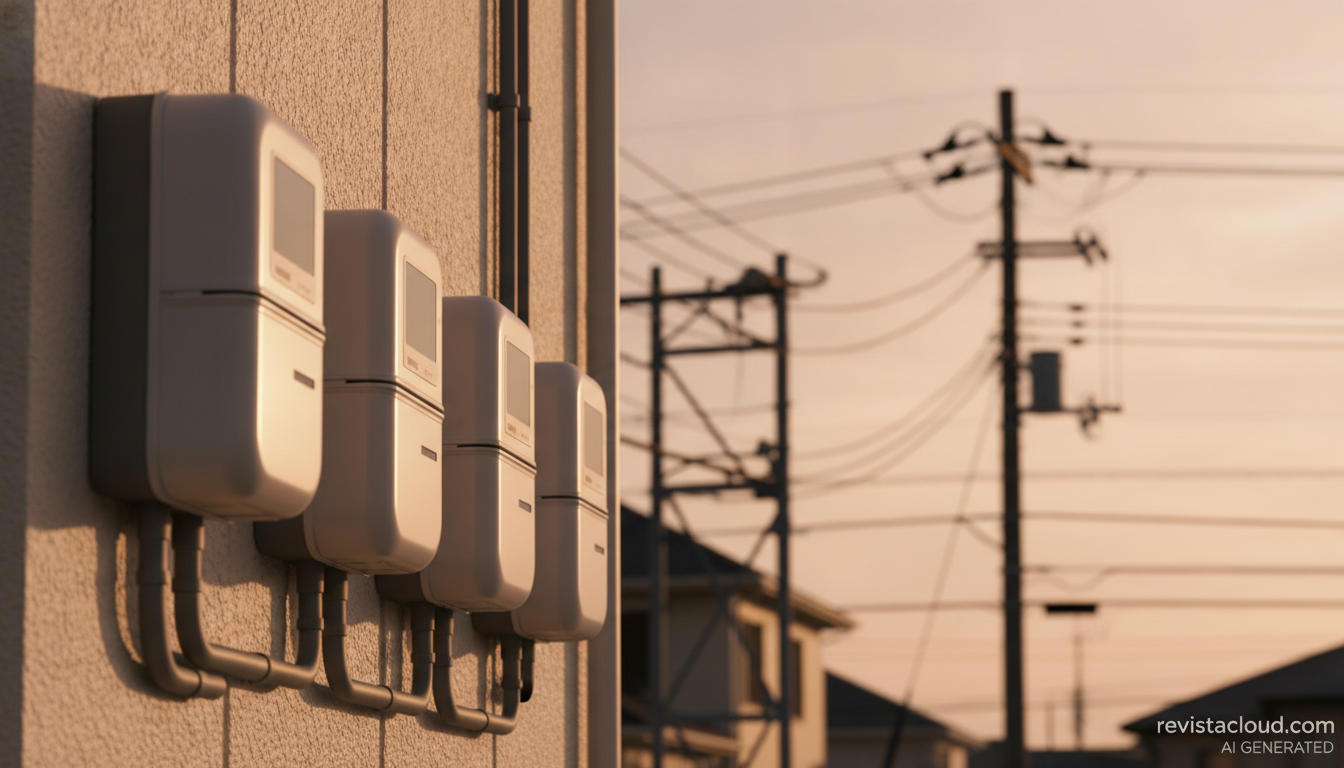
Chubu Electric Power Grid, the electricity transmission and distribution company serving the Japanese prefectures of Aichi, Mie, Gifu, Nagano, and Shizuoka, has reached 10 million smart meters under its advanced metering infrastructure (AMI) program, Oracle announced on November 4, 2026. The milestone comes alongside an upgrade of the platform that processes that data, Oracle Utilities Meter Data Management (MDM), to its latest version.
Chubu’s 10 million meters with Oracle in 20 seconds
- Chubu Electric Power Grid, a utility in central Japan, manages 10 million smart meters with Oracle software.
- It has upgraded Oracle Utilities MDM, with Hitachi, for 15-minute interval readings.
- The change prepares for second-generation meters, which Japan began installing in fiscal year 2025.
- Oracle doesn’t specify whether the system runs on its cloud or on-premises.
It’s worth separating what each party actually contributes. The meters are the physical devices installed in homes and businesses. Oracle doesn’t make them: it supplies the software that collects, validates, and distributes the readings those devices send. The announcement talks about an AMI rollout “with Oracle,” but what the US company actually provides is that data layer, which Chubu has used since it launched its smart meter control and management system in 2013.
According to Oracle, the new version of MDM improves scalability, readiness for interval reads, and operational resilience across residential and commercial meters. The announcement doesn’t provide metrics to verify this, such as daily reading volumes, terabytes stored, or processing times. Nor does it say whether the platform runs on Oracle Cloud Infrastructure or in the utility’s own data centers, or what the project cost.
What changes with the Oracle Utilities MDM upgrade
The most concrete technical point in the announcement is that the upgraded system now supports second-generation smart meters and 15-minute interval readings, along with complex data-delivery requirements, according to Oracle. The company says Chubu needed to modernize an environment that runs continuously and at large scale without stopping operations, while also meeting the new interval-reading requirements.
Yu Hashikura, head of the Advanced Grid Group within Chubu Electric Power Grid’s distribution department, says in the announcement that “upgrading our Oracle Utilities MDM platform is a critical step in preparing for second-generation smart meters.” He adds that planning, testing, and teamwork enabled a smooth transition, and that the system provides a foundation for a grid with more distributed resources, such as electric vehicles and rooftop solar.
Oracle worked with Hitachi, Ltd. and other partners it does not identify. According to the announcement, the project went through design-and-build, development, testing, validation, and performance-testing phases. Mark Webster, senior vice president of Oracle Infrastructure Industries, says that “modern utilities need smart, scalable platforms capable of turning growing volumes of data into useful business outcomes.”
On use cases, the announcement mentions three. Retailers operating in the Chubu area can alert customers when consumption threatens to exceed a target and track rooftop solar generation. Oracle adds that new services are expected to make use of surplus electricity, without specifying them. And the data allows for more precise billing and time-of-use rates, aimed at shifting consumption away from peak hours. All of this is presented as platform capability; the announcement doesn’t say how many customers already receive those alerts or which retailers offer them.
A rollout Chubu had already called complete in 2023
The 10 million figure isn’t new. According to Chubu Electric Power Grid’s English-language website, the company began installing smart meters in October 2014, surpassed one million a year starting in July 2015 (taking advantage of the legal verification expiry of older devices), and completed installation for all its customers — around 10 million units — in March 2023. The customer profile Oracle keeps on its website refers to “more than 10 million” meters managed. The 2026 announcement therefore presents as a current milestone a volume the utility actually reached more than three years ago; the real news is the MDM upgrade.
Oracle had already published another announcement about this customer back in June 2020. At the time, Chubu had around 7 million meters installed and was preparing to reach 10 million connected homes and businesses by 2023. That announcement detailed that the utility chose Oracle in 2013, began pilots in 2014, and used, in addition to MDM, Oracle Utilities Smart Grid Gateway (SGG), which centralizes metering infrastructure data and executes remote commands such as connections and disconnections. The current announcement makes no mention of SGG.
On company size, Chubu Electric Power Grid’s corporate profile states that it was established on April 1, 2020, is headquartered in Nagoya, and had 9,533 employees as of March 31, 2023. That page doesn’t publish its service area or customer count, so the most direct reference remains its fleet of roughly 10 million meters.
Japan’s timeline and the comparison with Spain
Chubu’s rollout fits the national plan. The 2024 Energy White Paper from the Agency for Natural Resources and Energy, part of the Ministry of Economy, Trade and Industry (METI), states that by the end of fiscal year 2023 around 99.9% of smart meter installation had been completed. Timelines varied by region: Tokyo in fiscal year 2020; Kansai and Chubu in 2022; Hokkaido, Tohoku, Hokuriku, Chugoku, Shikoku, and Kyushu in 2023; and Okinawa by the end of fiscal year 2024. Japan’s fiscal year ends in March, which lines up with the March 2023 date Chubu gives.
The next phase is already underway. According to METI, the switch to next-generation meters begins in fiscal year 2025 and should reach nearly all customers by the early 2030s. METI’s study-group draft conclusions on this next generation, dated March 2022, call for energy data at 5-minute intervals in addition to 15-minute values. For anyone following how the power grid has become a bottleneck for the energy transition, Chubu’s announcement shows that much of that preparation happens in the systems that process the readings, not just in cables and substations.
Spain got to first-generation meters earlier. Order ITC/3860/2007 set out the plan to replace meters of up to 15 kW with remote-management equipment, with a deadline of December 31, 2018. According to Spain’s National Commission for Markets and Competition (CNMC), by the end of 2018 more than 26.8 million meters were actually integrated into the grid — 99.14% of that fleet. The same report noted that 34 companies missed their targets, and that Endesa attributed its delays mainly to customers who refused the switch.
| Japan (Chubu) | Spain | |
|---|---|---|
| Rollout start | October 2014 | Plan set in 2007 |
| First-generation completion | March 2023 (around 10 million) | 31/12/2018 (26.8 million integrated) |
| Next step | New generation from fiscal year 2025 | Not covered in these sources |
Utilities’ interest in this data runs in parallel with that of the big tech providers, who also see the grid as a constraint on their own plans, as shown by NVIDIA’s recent alliance with power companies around its DSX platform.
Frequently asked questions
What Oracle software does Chubu Electric Power Grid use?
The 2026 announcement cites Oracle Utilities Meter Data Management, which it has just upgraded to its latest version. In 2020, Oracle also mentioned Oracle Utilities Smart Grid Gateway as the piece that centralizes metering infrastructure data.
Does the system run on Oracle Cloud?
Neither the 2026 announcement, Oracle’s customer profile, nor the 2020 announcement states whether the platform runs on Oracle Cloud or in the company’s own data centers.
When did Chubu finish installing smart meters?
According to Chubu Electric Power Grid’s website, it completed installation for all its customers — around 10 million units — in March 2023, after starting in October 2014.
What are Japan’s next-generation smart meters?
They are the devices that will replace the first generation starting in fiscal year 2025, with an official goal of reaching nearly all customers by the early 2030s. The 2022 draft specification calls for data at 5- and 15-minute intervals.
This article is also available in Spanish: «Chubu Electric actualiza con Oracle la gestión de sus 10 millones de contadores», on revistacloud.com.
Sources:
- Oracle: Chubu Electric Power Grid Launches 10 Millionth Smart Meter with Oracle (04/11/2026)
- Oracle: Chubu Electric Deploys Smart Meters with Oracle (22/06/2020)
- Oracle: Chubu Electric Power Grid customer profile
- Chubu Electric Power Grid: Smart Meter Rollout Ratio
- Chubu Electric Power Grid: Corporate Profile
- METI / ANRE: 2024 Energy White Paper, chapter 3-2-3
- METI / ANRE: Smart Meter Q&A
- METI: next-generation smart meter study group draft conclusions (March 2022)
- BOE: Order ITC/3860/2007
- CNMC: note on smart meters integrated by the end of 2018 (12/06/2019)
