
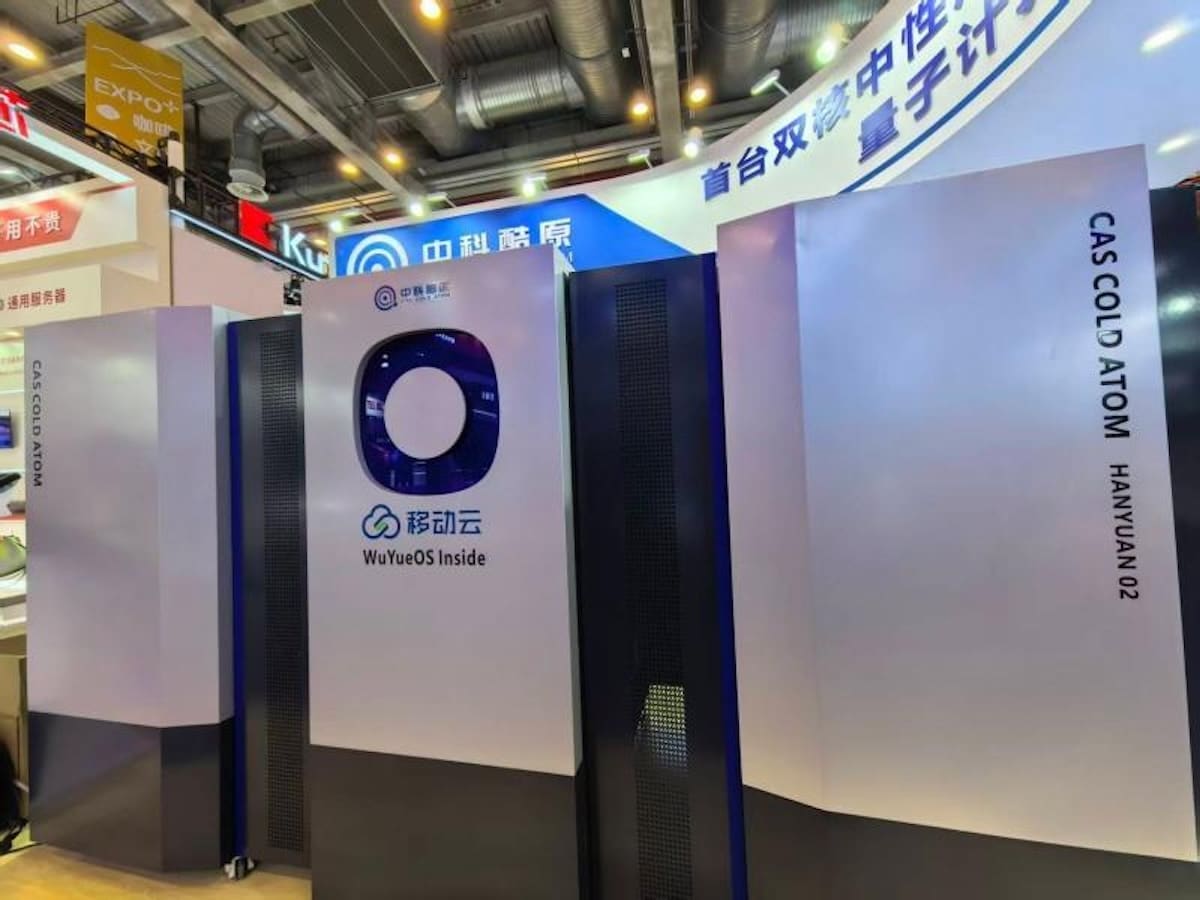
China has introduced Hanyuan-2, a neutral-atom quantum computer that its developers describe as the world’s first with a dual-core architecture. The system was announced by Zhongke Kuyuan Technology, a Wuhan-based company linked to the Chinese Academy of Sciences, as an evolution of Hanyuan-1, the device launched by the firm in 2024 as its first commercial quantum computer based on this technology.
The machine combines two independent arrays of neutral atoms, totaling 200 physical qubits: 100 rubidium-87 atoms and 100 rubidium-85 atoms. According to information shared by Science and Technology Daily and reported by local Wuhan agencies, these two “cores” can operate in parallel to distribute loads or function under a main and auxiliary core scheme, aiming to construct more stable logical qubits.
The announcement aligns with the global race to develop more scalable, less fragile, and easier-to-operate quantum computers outside of laboratory settings. However, it also comes with a significant caveat: no critical, independently verified metrics regarding gate fidelity, error rates, effective connectivity, or performance against comparable benchmarks have been published yet. In quantum computing, the number of qubits matters, but it is not sufficient to assess a machine’s actual usefulness.
A Low-Power Neutral-Atom Design
Hanyuan-2 utilizes neutral-atom quantum computing—a technique that captures and manipulates individual atoms with laser systems. This technological approach has become one of the most promising because it allows for reconfigurable qubit arrays, long coherence times, and, at least in theory, easier scaling compared to other architectures.
One of the most striking aspects of the Chinese system is its power consumption. Zhongke Kuyuan states that Hanyuan-2 operates with less than 7 kW of power and does not require a complex cryogenic environment, unlike many superconducting qubit platforms. The device features an integrated design housed in a standard cabinet with a compact laser cooling system, simplifying deployment in research or development settings without the extreme infrastructure required by other quantum computers.
The company also claims the system surpasses 500 optical tweezers and that qubit coherence times reach 100 seconds. These are notable figures—especially in an architecture where atom stability and operational precision significantly influence performance. However, these numbers need to be accompanied by more comprehensive data to allow the technical community to evaluate its standing compared to other systems.
The concept of “dual core” is also delicate. In classical computing, a dual-core processor has a clear, measurable meaning. In quantum computing, this comparison can be helpful for the general public but may oversimplify reality. What China presents as a dual-core system appears to be closer to two coordinated quantum arrays within a single machine rather than a direct replication of a traditional multicore CPU model.
The Promise: Parallelism and More Stable Logical Qubits
According to its creators, Hanyuan-2 can operate in two modes. The first is parallel processing, where both cores run tasks simultaneously. The second is a main-auxiliary configuration, in which one array helps improve system stability and prepares more reliable logical qubits.
This second mode is crucial because the main obstacle in quantum computing is not just producing many physical qubits but ensuring they operate with sufficiently low errors. Qubits are sensitive to noise, interference, and coherence loss. Therefore, the industry seeks logical qubits, which combine multiple physical qubits to create more fault-tolerant information units.
For instance, Microsoft and Atom Computing announced advances in 2024 with logical neutral-atom qubits featuring error detection and correction capabilities, while QuEra markets Aquila—a 256-qubit neutral-atom processor accessible via the cloud with public technical documentation. Atom Computing also promotes its AC1000 system, boasting over 1,200 fully connected qubits.
This comparison does not diminish the value of Hanyuan-2 but helps contextualize it. The 200 qubits are respectable but not the highest in the sector. Its significance lies more in the dual architecture, low power consumption, and ability to operate without extensive cryogenic infrastructure than in sheer qubit count.
Missing Benchmarks: The Major Gap
The main issue with this announcement is the lack of publicly available data to assess the system’s actual performance. Critical metrics such as single- and two-qubit gate fidelity, error rates, circuit depth, runtime, entanglement quality, performance on known algorithms, or results from standard benchmarks have not been provided or verified.
Tom’s Hardware highlighted this deficiency in coverage: Hanyuan-2 is presented with ambitious claims but without peer-reviewed papers or detailed metrics allowing fair comparison with other neutral-atom platforms.
In quantum computing, this point is vital. A system with many qubits may be of limited practical use if error rates grow too quickly. Conversely, a machine with fewer qubits can have higher scientific or commercial value if it offers better fidelity, programming tools, stable cloud access, and reproducible results.
The lack of benchmarks does not render Hanyuan-2 irrelevant but calls for cautious interpretation. The announcement indicates continued Chinese investment in alternative quantum architectures and suggests that companies within its scientific ecosystem aim to progress from laboratory prototypes to more integrated systems. Validation will occur once comparable technical results are published and external researchers can work with the machine.
Hanyuan-2 also reflects a broader trend: quantum computing no longer advances along a single path. Superconductors, trapped ions, photonics, silicon-based, and neutral atoms compete with different advantages and limitations. In this landscape, low power consumption and avoiding extreme cryogenics can be significant advantages—especially if the system maintains high operational quality.
Therefore, the Chinese announcement is relevant but not definitive. Hanyuan-2 could be a sign of industrial maturity for neutral-atom quantum computing in China, but its true standing compared to Atom Computing, QuEra, Quantinuum, IBM, or Google depends on data yet to be released.
FAQs
What is Hanyuan-2?
Hanyuan-2 is a Chinese neutral-atom quantum computer introduced by Zhongke Kuyuan Technology. Its developers claim it is the first system of its kind with a dual-core architecture.
How many qubits does Hanyuan-2 have?
The system features 200 physical qubits, divided between 100 rubidium-87 atoms and 100 rubidium-85 atoms.
Why is its power consumption notable?
The company states that Hanyuan-2 consumes less than 7 kW and does not require complex cryogenic conditions, potentially simplifying deployment compared to other quantum architectures that need extensive infrastructure.
What data are missing to assess its real performance?
Public, comparable metrics on gate fidelity, error rates, connectivity, circuit depth, error correction, and benchmark results are lacking.
via: STdaily
