
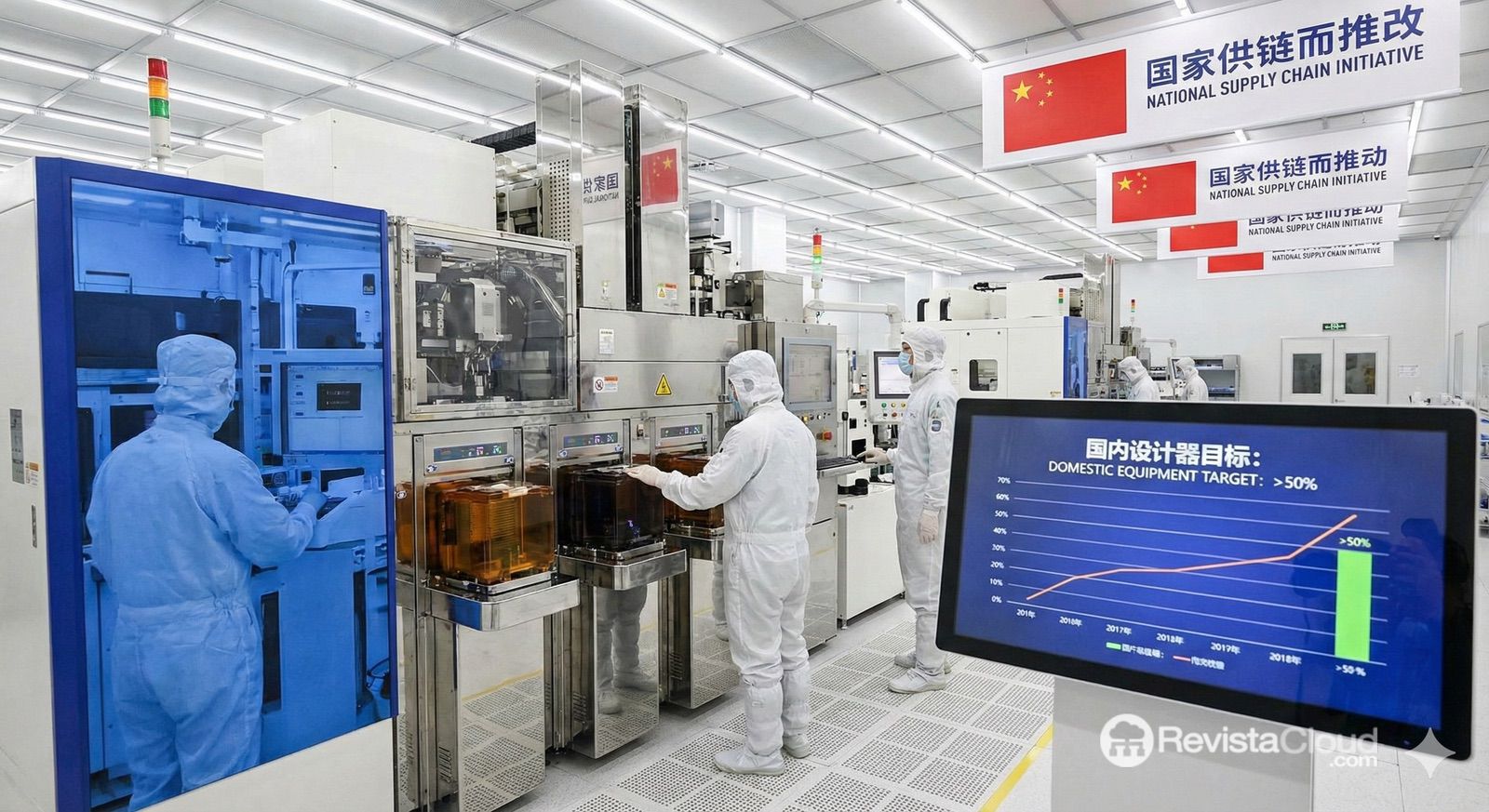
China is reviewing how much its state-controlled data centers rely on Broadcom switches, according to a report published by the Financial Times. The review is part of a broader campaign to increase the use of domestically made technology and reduce reliance on foreign suppliers in the infrastructure that underpins artificial intelligence.
Broadcom switches in China in 20 seconds
- The commission that oversees China’s state-owned enterprises reportedly reviewed the use of Broadcom switches.
- At some state-owned companies, they could account for up to 90% of networking equipment.
- The review comes as Beijing promotes domestic suppliers for AI infrastructure.
- Huawei, H3C, and Ruijie are among the Chinese manufacturers that could benefit from the shift.
- For now, this points to possible informal guidance, not an announced blanket ban.
The move touches a piece of infrastructure that often stays out of the AI headlines: the network that connects servers inside data centers. Switches interconnect accelerators, servers, and storage systems, and they become especially important when data centers pack in large amounts of compute capacity.
The Financial Times report says the State-owned Assets Supervision and Administration Commission (SASAC), the body that oversees China’s state-owned enterprises, carried out a survey in recent weeks to gauge how widely Broadcom equipment is used in state-controlled data centers. Reuters picked up the same report and said it could not independently verify it at the time of publication.
The preliminary findings point to heavy reliance at some companies. According to the Financial Times, Broadcom switches could account for up to 90% of the equipment used at certain state-owned firms. The figure comes from people familiar with the review and doesn’t represent an aggregate number across all of China’s data centers.
The switch becomes another piece of the self-sufficiency push
The review fits with China’s policy of increasing the use of domestic components and technology in sectors considered strategic. In recent years, US restrictions on advanced semiconductors have pushed Chinese companies to develop local alternatives across different parts of the technology chain.
The focus isn’t limited to AI processors. It also extends to memory, servers, interconnect systems, storage, and software. A data center’s internal network matters especially for AI workloads, because accelerators need to exchange large volumes of data with each other.
In this market, Broadcom supplies chips and switching platforms used by networking equipment makers. Its products compete with offerings from other vendors, including Nvidia and Huawei. Reuters notes that Chinese state-backed data centers already face restrictions on certain Nvidia products, while Broadcom switches continue to have a significant presence.
That difference matters, because the Broadcom review doesn’t amount to a ban, at least for now. According to the Financial Times, the findings could lead authorities to issue informal guidance for state-owned firms to gradually reduce their reliance on this equipment. Reuters also doesn’t report an official announcement establishing a blanket ban.
That leaves open what form any change might take. Companies could cut purchases of new foreign equipment, give domestic manufacturers a larger share of future expansions, or gradually replace certain installed components. The available sources don’t say which of these options will apply, or on what timeline.
Huawei, H3C, and Ruijie emerge as alternatives
A possible supplier shift carries industrial weight. If Chinese state-owned firms are instructed to increase their use of domestic technology, local network vendors would gain access to a larger share of a market that until now has also relied on foreign components.
Reuters identifies Huawei among the suppliers of high-end switches in China. Other domestic companies such as H3C Technologies and Ruijie Networks also appear as potential beneficiaries of a policy favoring domestic technology over foreign suppliers.
Huawei also holds a significant position in China’s AI infrastructure strategy. The company is developing Ascend accelerators, compute systems, and data center platforms, while US restrictions have limited Chinese firms’ access to certain advanced Nvidia processors — part of a wider push toward domestic AI chips that Beijing has already formalized for state-funded AI hardware. In September 2026, Huawei unveiled new AI computing platforms and announced future generations of Ascend chips.
This shows that technology substitution isn’t just about finding a direct equivalent for a processor. An AI data center needs a full chain of components working together. Swapping the accelerator without changing the rest of the infrastructure can leave dependencies elsewhere in the chain.
The Broadcom review points precisely at that layer. If it results in a reduced footprint at state data centers, the shift would affect the internal communication systems that connect computing resources, while also creating an opportunity for Chinese network equipment makers.
China is also strengthening other parts of its semiconductor supply chain. For example, ChangXin Memory Technologies, one of the country’s leading DRAM makers, is preparing to enter the NAND memory market as demand tied to AI servers grows. The stated goal behind these efforts is to expand domestic technological capacity across different segments.
The Broadcom review should be read within that broader process, though it’s still too early to talk about a complete replacement of foreign technology. The available information points to an assessment of the level of reliance and the possibility of future guidance to reduce it. The real scope will depend on the decisions authorities make and on Chinese suppliers’ ability to meet data centers’ technical needs.
For Broadcom, the episode also shows that competition in AI infrastructure doesn’t depend solely on the performance of its networking chips. Access to certain markets can be shaped by each country’s industrial and technology-supply policies.
FAQ
What is China reviewing about Broadcom?
Authorities are reportedly assessing how much state-owned data centers rely on Broadcom switches. The Financial Times has attributed the review to people familiar with the process.
What share of switches at some data centers comes from Broadcom?
According to the Financial Times, Broadcom equipment could account for up to 90% of networking gear at some state-owned firms. The figure does not represent all of China’s data centers.
Has China banned Broadcom switches?
The sources consulted don’t point to a blanket ban. The review could lead to informal guidance to reduce reliance on Broadcom, but no measure of that scale has been announced.
Which Chinese companies could benefit?
Huawei, H3C Technologies, and Ruijie Networks are among the domestic manufacturers that could gain ground if state-owned firms increase their purchases of Chinese technology.
