
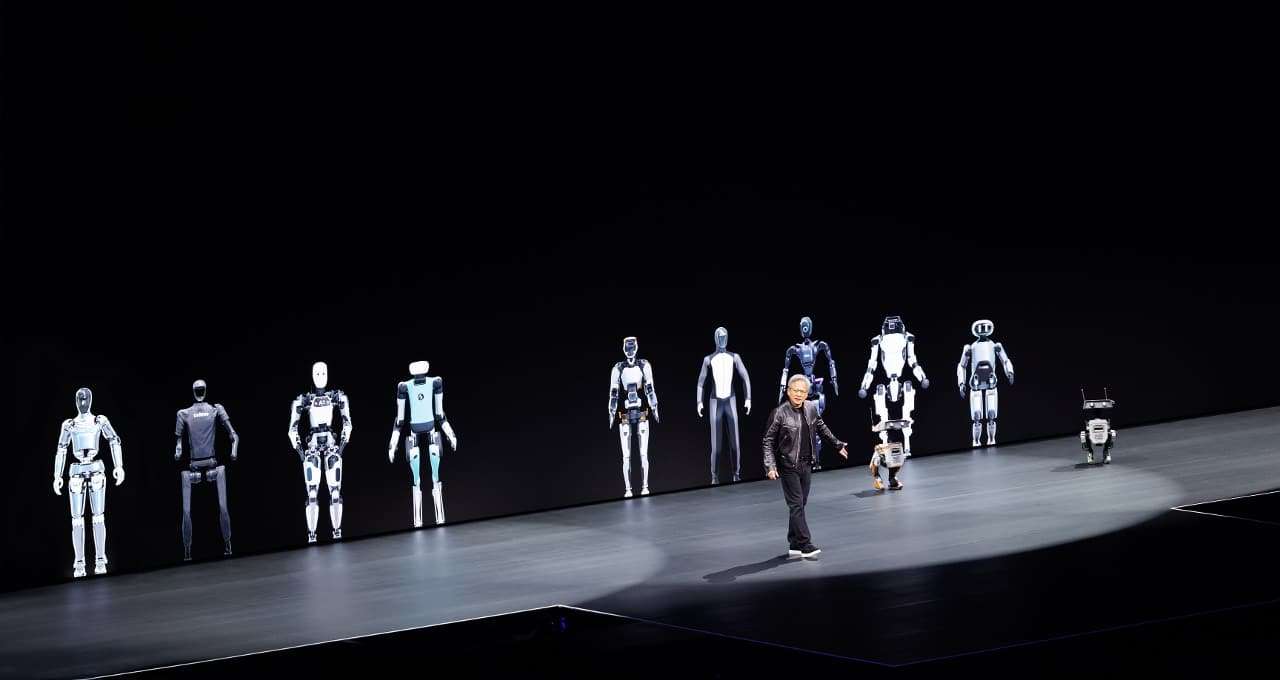
The global race for humanoid robots has moved beyond laboratory promises to increasingly resemble an industry seeking scale. And China aims to play that game from a dominant position. According to analysis firm TrendForce, the production of humanoid robots in the country will grow up to 94% through 2026, driven by a commercialization phase expected to accelerate in the second half of the year. This doesn’t mean humanoid robots will suddenly fill factories, warehouses, and homes, but it confirms that the sector is entering a different phase—much more industrial and less experimental.
The forecast is also accompanied by another important message: the Chinese market is beginning to focus around two names, Unitree Robotics and AgiBot, which, according to the same estimate, could together account for nearly 80% of the country’s shipments. This doesn’t mean there are no other competitors, as China has been building a very broad robotics ecosystem for years, but it does reflect that the race for volume production is starting to have clearer winners.
From Demonstration to Deployment
Until recently, much of the debate about humanoid robots revolved around spectacular videos, eye-catching demos, and prototypes that served more to showcase potential than to solve real tasks. The new scenario is somewhat different. TrendForce argues that the global sector will enter a critical commercialization phase in the second half of 2026, and that in China, manufacturers are better defining their use cases and ramping up production capacity.
This is important because the issue is no longer just whether a robot can walk, manipulate objects, or maintain balance. The question now is whether it can be produced at a reasonable scale, with costs decreasing over time, and whether it can be applied in ways that generate income outside the laboratory. In other words: the conversation is shifting from robotics as a technical demonstration to robotics as a business.
China seems particularly well-positioned for this leap for several reasons. It has manufacturing capacity, a highly integrated supply chain, investor support, and a tech ecosystem that has followed similar trajectories in sectors like electric vehicles or batteries. In humanoid robotics, this combination could give China an edge over competitors, who may have good prototypes but less industrial muscle.
Unitree and AgiBot Set the Pace
The case of Unitree is particularly revealing. The company became known mostly for its quadruped robots, but its business mix is changing rapidly. According to TrendForce’s analysis based on its IPO prospectus, Unitree’s revenue from humanoid robots surpassed that from quadrupeds for the first time in 2025 and represented over 51% of the total. This is significant because it indicates that the humanoid is no longer a secondary product within the company.
Additionally, various documents and analyses published after its listing approval on Shanghai’s STAR Market point to a very clear production ambition: Unitree plans to reach an annual capacity of 75,000 humanoids and 115,000 quadrupeds over the next five years. That’s not a small figure. It doesn’t mean it will sell all of them immediately or that the market is ready to absorb that volume, but it shows the company is preparing for a much larger industrial scale than today.
AgiBot is also accelerating strongly. The company announced at the end of March that it had reached 10,000 humanoid robots produced, with the Expedition A3 being unit number 10,000. The most remarkable thing was not just the milestone but the growth speed: going from 5,000 to 10,000 units took just three months, much faster than previous phases. The company framed this leap as a sign of maturity in its supply chain and its ability to standardize robot manufacturing processes.
This dual momentum helps explain why Unitree and AgiBot are now the leading references in the Chinese market. One provides a manufacturing backbone and aggressive capacity expansion; the other has demonstrated a particularly rapid production curve and increased commercial visibility across various sectors.
Not Everything Is Settled Yet
This does not mean the market is fully mature. In fact, there’s still a considerable gap between rising production and meaningful mass deployment. For Unitree, some industry analyses highlight that a significant part of its sales still relates to research, education, and development, not widespread factories replacing human tasks. Moreover, the entire sector still faces evident challenges: real autonomy, safety, fine manipulation, durability, maintenance, total cost of ownership, and economic return in work environments.
It’s also important not to conflate quadruped robots with humanoids as if they were the same market. While both benefit from advances in motors, sensors, computer vision, and AI models, their uses and commercial maturity do not always align. Still, Unitree’s push in both areas shows that China is building a diversified robotics base, not just a single product line.
Another notable name in this race is UBTech. Its Walker S2 has attracted attention for integrating an autonomous battery swapping system in about three minutes—especially relevant in industrial environments where operational continuity matters as much as mobility. That detail reminds us that in robotics, small, practical advances can be more decisive than viral big choreography moments.
What Are the U.S. and Europe Doing?
The difference with other markets isn’t that there isn’t activity outside China but that the focus appears more on pilots and industrial validation than on volume. In the U.S., Figure AI and Apptronik are among the most visible players. In February, BMW confirmed that the Figure 02 robot supported over 30,000 BMW X3 production units at its Spartanburg plant in South Carolina, moving over 90,000 components—a well-documented real-world case of humanoid use in automotive manufacturing.
Similarly, in February, Apptronik closed a funding round of $520 million, bringing its Series A to over $935 million. The company plans to use this capital to accelerate the production and deployment of Apollo, its industrial-oriented humanoid robot, backed by investors and partners such as Google, Mercedes-Benz, John Deere, and QIA.
Boston Dynamics has also made moves. In January, it announced the product version of Atlas and outlined deployments planned for 2026 with Hyundai and Google DeepMind, plus initial production at its Boston headquarters. In other words, the U.S. is not standing still, but its current narrative resembles more a race to validate technology, run pilots, and scale gradually than an aggressive product expansion like China’s.
Europe is active, though with less visible industrial volume. BMW announced its first humanoid pilot in Leipzig, Germany, in February, exploring integration into car, battery, and component manufacturing. Also in Germany, NEURA Robotics continues to aim to establish itself as a key European name in humanoids, although for now, the continent appears more focused on industrial testing and advanced automation ecosystems than on mass-producing tens of thousands of units in the near term.
An Emerging Market with a Strategic Industry Flavor
All this leads to a clear conclusion: China is not alone in the humanoid robot race, but it seems more determined than ever to move quickly into mass production. The U.S. retains powerful companies and top-tier technologies. Europe maintains a strong industrial base and relevant pilot projects. However, the country currently leading the push with clarity—combining manufacturing, scale, and speed—is China.
This doesn’t guarantee outright victory. In such a young sector, many things can still change: standards, software, costs, safety, regulation, and actual demand. Still, the projected 94% growth by 2026 indicates that the Asian giant is no longer viewing humanoid robots solely as a futuristic promise but as a new strategic industry.
Frequently Asked Questions
How much will humanoid robot production in China grow in 2026?
TrendForce forecasts a growth of up to 94% in Chinese humanoid robot production by 2026, especially as commercialization accelerates in the second half of the year.
Which companies are leading the Chinese humanoid robot market?
According to TrendForce, Unitree Robotics and AgiBot will be the two main players, potentially capturing around 80% of the country’s shipments together.
What is the U.S. doing in humanoid robots?
The U.S. continues to advance through industrial pilots and funding. Figure AI has tested its robots at BMW’s Spartanburg plant, Apptronik has boosted production through new funding, and Boston Dynamics has introduced the Atlas product version.
Does Europe have significant companies or projects in humanoid robots?
Yes, though at a smaller scale. BMW has launched a pilot in Leipzig, and companies like Germany’s NEURA Robotics are aiming to establish a presence in the European humanoid market, focusing currently on industrial testing and automation ecosystems rather than mass production.
