
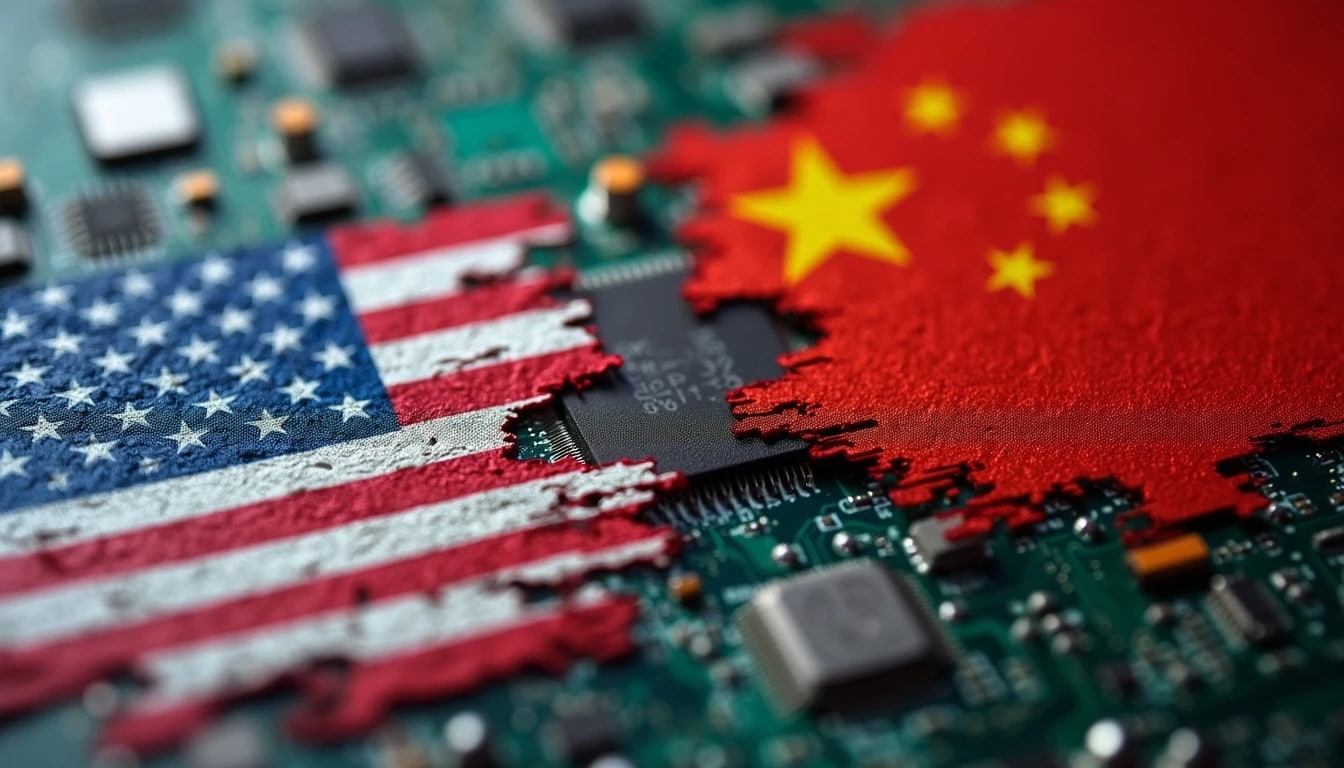
The image contrasting 19th-century China, weakened by opium, with a United States focused on industry, only to reverse roles in the 21st century, works as a visual provocation. There is a recognizable historical basis, but also an oversimplification that should be unpacked: today, China dominates much of global manufacturing; the U.S. is experiencing a serious opioid crisis, and major American tech companies are heavily investing in artificial intelligence infrastructure. None of these facts alone prove that one power has entirely replaced the other.
The key points of industrial change between China and the U.S. in 20 seconds
- China accounts for nearly one-third of global manufacturing output.
- The U.S. maintains a massive industry but has lost jobs and supply chains.
- The opioid crisis remains severe, despite recent declines in deaths.
- Tech giants have committed $1.65 trillion in future AI-related investments.
- Europe retains industrial capacity but depends on external technology and energy sources.
The comparison also requires historical precision. In the 19th century, China did not develop a spontaneous collective addiction that explained its decline. Opium trade was used by the British Empire to correct its trade deficit and ultimately led to two wars, forced port openings, and a series of unequal treaties. The U.S. participated in that trade, although the main driver was the UK.
Two centuries later, the American crisis has a different origin. Opioid consumption initially spread through prescribed medications and evolved into heroin and, especially, illegal fentanyl. Linking deindustrialization directly to each overdose mortality would be an oversimplification, but there is documented connection between economic decline, loss of stable jobs, health problems, and increased social vulnerability in certain communities.
China not only makes cheap products: it controls entire industrial supply chains
Years ago, China was described as the world’s low-cost workshop. That image is now incomplete. The country still manufactures toys, textiles, and consumer goods, but also produces batteries, electric vehicles, solar panels, telecommunications equipment, machinery, drones, electronics, and an increasing share of components needed for digital infrastructure.
Its advantage isn’t solely lower wages. Many companies find in China complete supply chains, extensive networks of suppliers, logistical capacity, skilled personnel, and factories capable of ramping up volume quickly.
OECD data show that China’s manufacturing output surpasses that of the next major industrial countries combined. Other estimates put its share at about 28% of global manufacturing value, compared to roughly 17% for the U.S.
That doesn’t mean the U.S. has stopped manufacturing. It remains the second-largest manufacturing power globally and maintains dominant positions in sectors such as aerospace, medical devices, industrial software, defense, semiconductor design, and certain high-precision machinery.
The difference becomes evident when looking at employment, installed capacity, and complete supply chains. The U.S. designs some of the world’s most valuable products, but a significant portion is manufactured, assembled, or packaged in Asia.
Apple exemplifies this well. The company controls its device design, operating system, distribution, and margins, but depends on Asian factories, chips produced by TSMC, and a broad network of international suppliers.
Washington is trying to reduce this vulnerability with the CHIPS Act, incentives for battery manufacturing, and new semiconductor plants. TSMC, Samsung, Intel, and Micron are developing multi-billion dollar projects on U.S. soil. Reindustrialization, however, requires more than just building facilities: it needs workers, suppliers, energy, water, permits, and customers who keep the lines running for years.
The opioid crisis doesn’t mean a country is simply anesthetized
The opioid epidemic remains one of the greatest social tragedies in the United States, but recent data show an evolution not captured by the typical image.
The CDC estimated that opioid-related overdose deaths declined from about 55,296 in 2024 to 44,564 in 2025. This marked the third consecutive year of decline and a significant improvement, though mortality remains above pre-pandemic levels.
The decline is linked to increased availability of naloxone, changes in the illegal drug market, addiction treatments, and harm reduction policies. The situation is uneven: many states improved, while others saw increases.
The relationship with deindustrialization is more complex than just factory closures leading to drug use. Regions in Pennsylvania, Ohio, West Virginia, and Kentucky faced industrial job losses, aging populations, deteriorating services, and reduced economic mobility. These conditions can exacerbate addiction issues, but do not fully explain them.
China also faces social tensions. Its industrial development has caused pollution, regional inequality, long working hours, housing pressure, and persistent youth unemployment. An insightful comparison should weigh the human costs of both models, rather than replacing a triumphant American narrative with a Chinese one.
The $1.65 trillion in AI investments isn’t exactly hidden debt
Another aspect of the debate concerns the financial exposure of Alphabet, Amazon, Meta, Microsoft, and Oracle. A study released in July 2026 estimated that these five companies had accumulated about $1.65 trillion in off-balance-sheet commitments, compared to roughly $1.35 trillion reflected as debt and recognized liabilities.
The figure is striking, but calling it merely “hidden debt” can be misleading.
Much of it relates to multi-year contracts for data centers, electrical capacity, cloud services, leases, chips, and other infrastructure that has not yet come into operation. Accounting rules do not require all such commitments to be immediately recorded as conventional debt.
That doesn’t make them irrelevant. Companies commit to paying for capacity over years and will need AI demand to generate sufficient revenue. If utilization falls short of expectations, some may find themselves with expensive data centers and hard-to-cancel contracts.
Risk has increased because spending is growing faster than cash flow. Reuters forecasts suggest that investment growth among major cloud providers could outpace their operating cash flow by 2027. Oracle has already increased debt and external financing, while others have seen free cash flow shrink or turn negative in some quarters.
However, this doesn’t automatically equate to imminent insolvency. Alphabet, Amazon, Meta, and Microsoft have profitable businesses, large cash reserves, and the capacity to fund projects under favorable conditions. The real question isn’t whether they can build the infrastructure, but whether future profitability justifies the volume of invested capital.
Chinese models are advancing, but 58% doesn’t represent all of global AI
The spread of models like DeepSeek, Qwen, Kimi, GLM, and MiniMax shows China can compete with U.S. systems using fewer resources, lower costs, and more open licensing.
Some measurements by OpenRouter indicate Chinese models account for about 58% or even 61% of tokens consumed among the top ten models on their platform during specific periods in 2026.
This number reflects rapid adoption but doesn’t mean that 58% of all tokens processed by U.S. companies are using Chinese models.
OpenRouter is a marketplace and interface that provides access to hundreds of models. Its users are largely price-sensitive developers, experimental projects, and applications seeking flexibility to switch providers. It does not represent the entire consumption of OpenAI, Anthropic, Google, Microsoft, AWS, or private deployments by large corporations.
The overall picture remains relevant. In 2025, Chinese open-weight models reached about 30% of weekly OpenRouter consumption at certain moments, climbing from below 2%. In 2026, their presence grew faster due to lower costs and increasingly competitive capabilities.
The U.S. maintains a strong position in frontier models, accelerator chip design, software, cloud services, and capital. China competes through open models, efficiency, industrial scale, and a large engineering base. The race isn’t simply country versus country—both are building and controlling different parts of the supply chain.
Europe maintains industry but risks being caught between two models
Europe isn’t starting from scratch. It has ASML in lithography, SAP in enterprise software, Siemens and Schneider Electric in automation, Airbus in aerospace, ABB in electrification, major industrial equipment manufacturers, and renowned research centers.
It also retains significant automotive, chemical, pharmaceutical, machinery, and telecommunications sectors. Its main challenges are market fragmentation, energy costs, slow permitting processes, limited growth capital, and reliance on foreign suppliers for cloud, advanced chips, and AI platforms.
Europe largely regulates services developed mainly in the U.S., manufactures with components from Asia, and depends on minerals processed in China. This position can hold as long as trade remains open, but becomes vulnerable if sanctions, trade wars, or supply disruptions occur.
The solution isn’t simply copying China or assuming the U.S. will continue supplying all necessary technology. Europe must decide which capabilities are strategic and which it can buy without compromising its autonomy.
The historical parallel prompts an uncomfortable question: power doesn’t only decline when manufacturing stops, nor does it rise solely by filling the world with products. Industrial capacity matters, but so do knowledge, energy, institutions, public health, capital, and the ability to turn innovation into useful infrastructure.
Frequently Asked Questions
Is China currently the largest manufacturing power?
Yes. China accounts for approximately 28% of global manufacturing and far surpasses the U.S., which is in second place. Its advantages include scale, supplier networks, logistics, and complete industrial chains.
Has the U.S. stopped manufacturing?
No. It remains a major industrial power and leads in high-value sectors. However, it has lost manufacturing jobs and relies on foreign sources for many stages of production and components.
Do the tech giants hold $1.65 trillion in hidden debt?
The figure mainly refers to future contractual commitments not recorded as conventional debt. They represent real financial exposure but aren’t exactly hidden loans.
Do Chinese models process most AI tokens?
They have exceeded 50%, and in some periods up to 58% or 61%, of the tokens used on OpenRouter among the top ten models. This reflects activity on that platform and doesn’t encompass the entire global AI market.
