
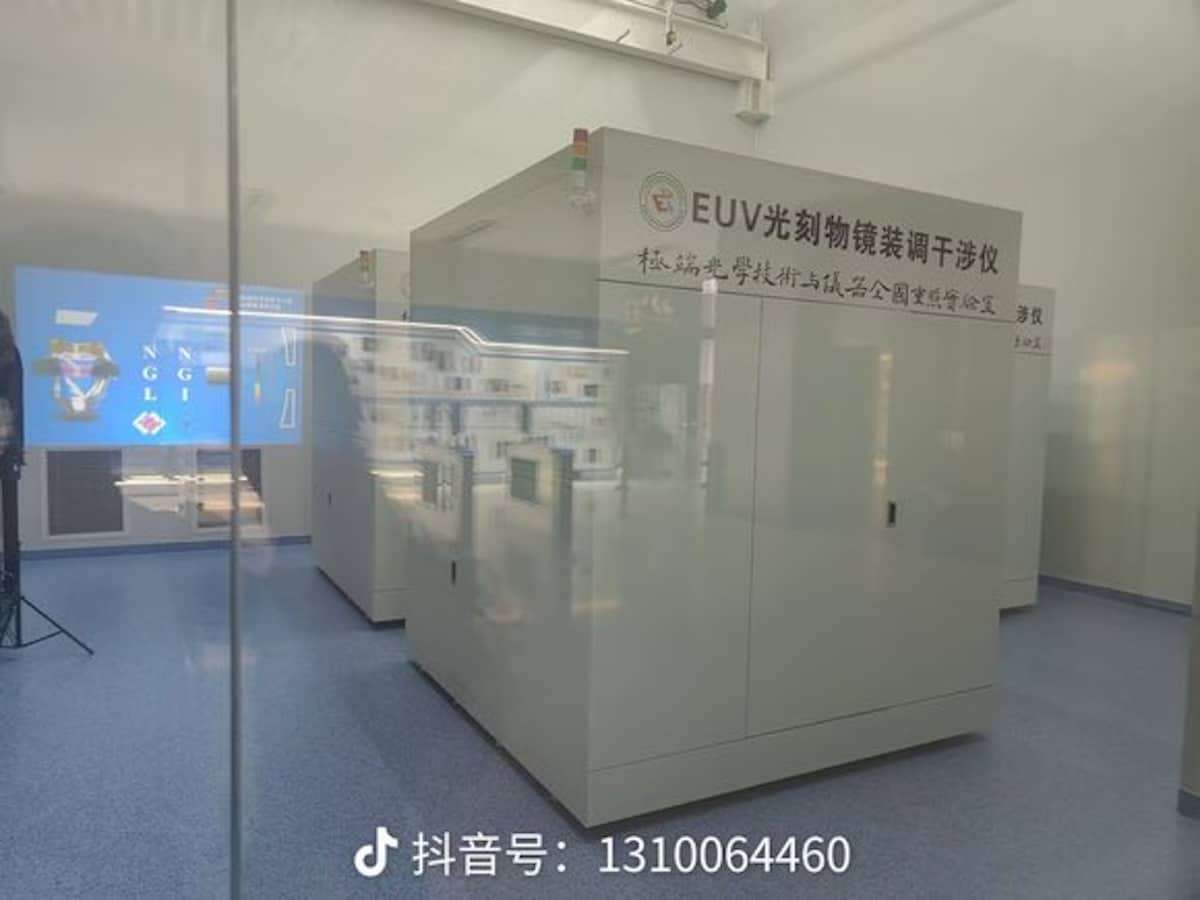
The global race for semiconductors has long lived with an unspoken but ever-present phrase in offices, laboratories, and markets: China cannot manufacture its own EUV. This idea—more mental than technical—supported much of the current balance, because extreme ultraviolet lithography (EUV) is the key that unlocks access to advanced manufacturing nodes.
Now, that framework is starting to shift.
In recent days, reports have gained strength indicating that China may have built a first functional EUV scanner in prototype phase. This milestone doesn’t mean “mass production tomorrow,” but it does change the tone of the conversation. If the prototype’s scope is fully confirmed, the important thing isn’t just that it competes with ASML’s equipment yet, but that the “impossible” frontier has fallen.
Why EUV was (and still is) the bottleneck
EUV isn’t “just another machine” in a chip factory. It is an extreme engineering feat: it produces light around 13.5 nm, operates in vacuums, uses precision reflective optics, and demands brutal control over vibrations, contamination, metrology, and alignment. It’s not enough to turn it on: it must be repeatable, stable, maintainable, and productive for thousands of hours.
Until now, public consensus has held that ASML is the only provider selling EUV systems for production, and this very fact made lithography a point where technological restrictions became truly asymmetrical.
In this context, China’s achievement of even a prototype with EUV—however preliminary—is significant for one very concrete reason: it allows for the planning of a domestic roadmap, even if many uncertainties remain.
Prototype is not production: the nuance that changes everything
It’s helpful to separate two levels:
- Technical-industrial level: a prototype can demonstrate patterns under controlled conditions, but that doesn’t mean it can sustain performance, yield, maintenance, and throughput compatible with a modern “fab.”
- Strategic level: the existence of the prototype alone reduces the psychological cost of committing to a gradual replacement, creates incentives for inward investments, and accelerates the learning curve of the local ecosystem.
Put simply: for China to “break into” the EUV market, it’s not enough to have “something that works.” It needs to develop a system that is profitable, scalable, and mass-producible. And that’s where timing becomes critical, as history shows.
Western industry is not standing still: the High NA EUV leap
While the true impact of the Chinese prototype is being debated, the Western bloc is pushing in another direction: High NA EUV, the next evolution of EUV aimed at better resolution and productivity on future nodes.
In this line, Intel and ASML have announced progress around the TWINSCAN EXE family, highlighting milestones in acceptance and metrics pointing toward industrialization: improvements in productivity (wafers per hour) and overlay accuracy (layer alignment) at sub-nanometric ranges. The core message is clear: it’s not just about “printing smaller,” but doing so with better control, fewer steps, and greater stability, which ultimately influences costs and yields.
This contrast is crucial: a prototype EUV opens a door; High NA aims to expand the highway. But High NA doesn’t completely eliminate strategic risks: if China enters the EUV lane—even late—the monopoly will gradually diminish over time.
Immediate effects: markets, narratives, and investment decisions
In deep tech, the first consequence of such a milestone isn’t always industrial. More often, it’s financial and political:
- Markets: introducing the possibility of local EUV shifts long-term valuation models across the entire Chinese supply chain (equipment, optics, metrology, materials, packaging, foundries).
- Industrial planning: domestic companies can now formulate strategies that were previously unthinkable, even if with cautious timelines.
- Tech policy: the debate shifts from “if they can” to “when and with what performance.”
Here’s an irony: even if the prototype is very far from competing in mass production, its mere existence forces Western powers to take it seriously, because applied engineering history often favors persistence and iteration.
What remains to be proven: components, stability, and productivity
To assess the real impact, industry will focus less on headlines and more on three key questions:
- What parts of the system are truly domestic? EUV involves an entire chain: source, optics, masks, resist, metrology, particle control, software, maintenance…
- What is the operational stability? A usable scanner in a fab must operate consistently, with repeatable process windows and ongoing technical support.
- What throughput does it achieve? Without throughput, EUV becomes an expensive experiment. With throughput, it’s an industrial tool.
Until there’s clear public data on these points, the event will be viewed more as a “strategic milestone” than an “immediate disruption.”
An era shift: from total dependence to negotiated dependence
If China has indeed achieved a functional prototype, it shifts conceptual maps because it introduces a new scenario: negotiated dependence. It doesn’t mean independence tomorrow, but it opens the possibility of gradually reducing reliance over time—altering the balance even before actual production begins.
For Europe and the U.S., the question isn’t whether ASML will lose its position in the short term (it doesn’t seem to be an immediate risk), but whether the industry enters a phase where advantage is defended year by year, with continuous innovation, excellent manufacturing, and a resilient supply chain.
In semiconductors, “peace” rarely arrives in one blow. It arrives through wear and persistence.
Frequently Asked Questions
Are EUV and High NA EUV the same?
No. High NA EUV is an evolution of EUV that seeks higher resolution and better process margins for future nodes, at the cost of increased complexity.
Does an EUV prototype enable immediate production of advanced commercial chips?
Not necessarily. A prototype can demonstrate feasibility, but manufacturing with good performance requires stability, repeatability, support, and industrial-scale productivity.
What impact would a Chinese EUV have on the global AI industry?
In the short term, more strategic and narrative than productive. Long-term, it could influence costs, node availability, and the geopolitical balance of the supply chain.
Why is EUV considered the greatest bottleneck?
Because it’s a critical technology for advanced nodes and extremely difficult to replicate: it combines physics, optics, materials, vacuum, metrology, and industrial control at the limit.