
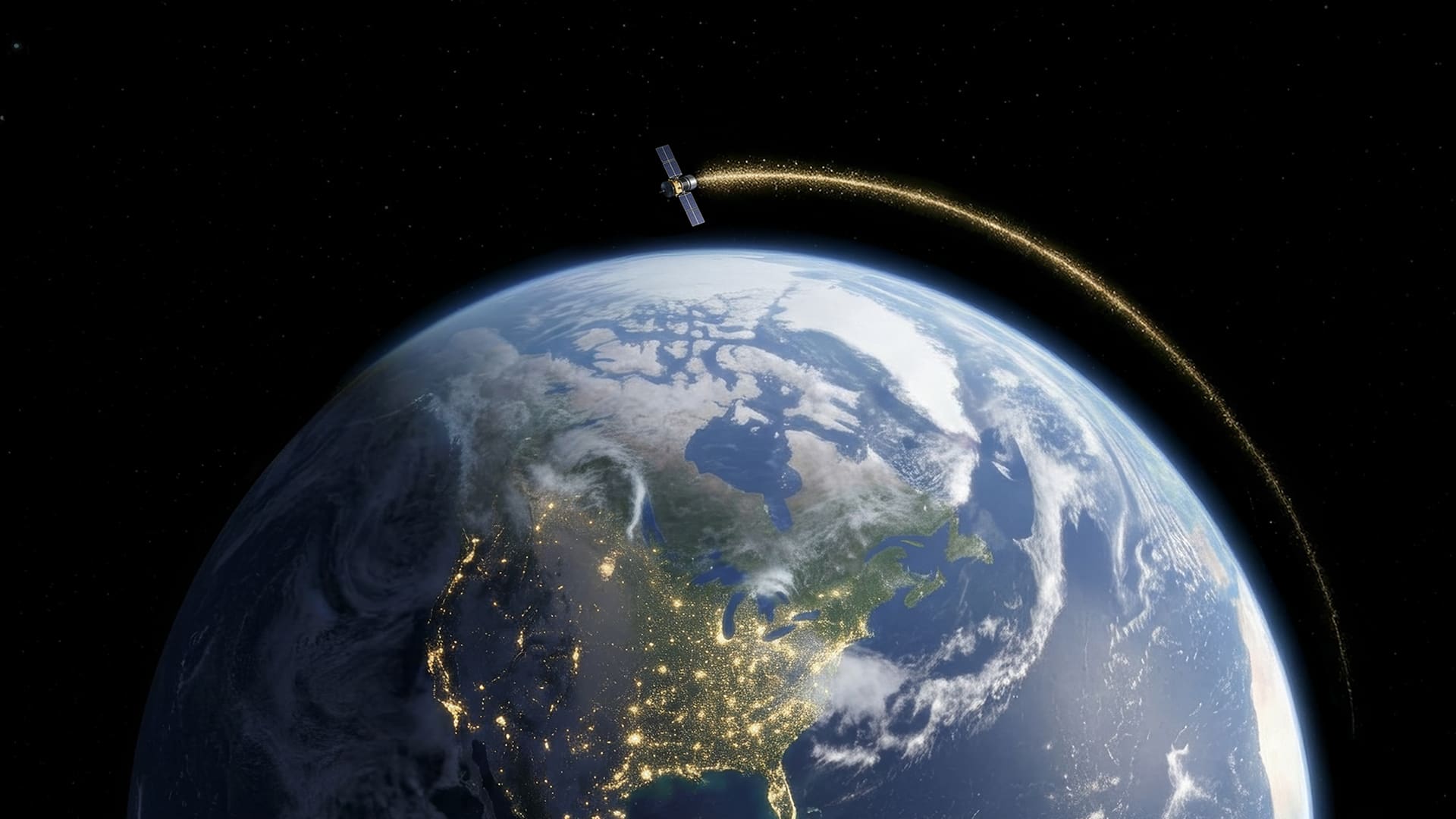
Shanghai wants to move part of the race for artificial intelligence from ground-based data centers into orbit. The Songjiang district hosted China’s first Space Computing Industry Development Forum and is reinforcing an industrial hub that brings together satellite and semiconductor manufacturers, AI specialists, cloud providers, researchers, and investors. The goal is to move toward systems capable of processing data directly in space instead of sending it to ground-based data centers first.
China’s space computing push in 30 seconds
- On August 30, Shanghai brought together satellite, chip, cloud, and AI companies at China’s first forum dedicated to space computing.
- Songjiang wants to build a new industrial chain around processing data in orbit.
- China already has 12 satellites testing a distributed space computing constellation.
- Orbital processing would let satellites analyze imagery and run AI models before transmitting results to Earth.
- The challenges include power, cooling, radiation, communications, and launch costs.
The idea might sound like a futuristic version of the data center, but there’s a practical reason for pushing computing power out to satellites: more and more data is being generated in space, and sending all of it down to Earth is inefficient.
Observation satellites can produce enormous amounts of imagery and measurements. The traditional approach is to capture that information, wait for a communication window with ground stations, download it, and process it afterward.
Space computing tries to change that path. The satellite analyzes the information first and transmits only the relevant results.
From sending data to Earth to processing it in orbit
Artificial intelligence makes this possibility especially attractive.
A satellite watching an area hit by flooding, wildfires, or landslides could use computer-vision models to identify relevant changes before sending any information to the ground.
Instead of downloading thousands of full images, it could transmit only the selected images, the identified objects, or an alert.
The same approach can be applied to agriculture, weather forecasting, environmental monitoring, mapping, astronomy, or infrastructure management.
Researchers at Zhejiang Lab have estimated that a single remote-sensing satellite can generate around 0.1 petabytes a day. If there were more than 3,000 satellites of this kind by 2032, they would together produce roughly 300 PB every day.
Available download capacity doesn’t necessarily grow at the same pace.
That’s where one of the main arguments for processing data close to where it’s generated comes in — a philosophy similar to ground-based edge computing, but moved hundreds of kilometers above the surface.
China is already experimenting with this model.
In May 2025, it launched the first 12 satellites of the Three-Body Computing Constellation, a project led by Zhejiang Lab aiming to build a network of more than 1,000 satellites with distributed computing power.
Subsequent tests have gone beyond simply running individual processors on each satellite.
In February 2026, reports described the execution of ten AI models in orbit and tests of communication between different satellites. Among them were models with around 8 billion parameters aimed at remote sensing and astronomy.
The ultimate goal is for satellites to be able to share tasks and function as a distributed infrastructure.
That doesn’t mean there’s currently an orbital data center comparable to large ground-based facilities. This is still a technology in the testing and validation stage, though China is trying to develop a good portion of the necessary industrial chain at the same time.
Shanghai wants to bring together satellites, chips, AI, and cloud
The gathering held on August 30 in Songjiang shows exactly that intent.
The forum brought together sectors that have traditionally worked fairly independently of one another: aerospace, semiconductors, artificial intelligence, and cloud computing.
More than 40 companies and organizations took part, including specialists in computing payloads, satellite platforms, chips for space-based AI, power, thermal control, laser communications, and large models.
The mix has a technical explanation.
Designing a ground-based server means you can count on continuous power supply, large-scale cooling systems, and relatively simple ways to swap out components.
A computer in orbit operates under completely different conditions.
Power consumption has to match the energy available on the satellite. The heat generated by processors is especially hard to dissipate in a vacuum. Electronics have to withstand radiation and strong temperature swings, while a failure can be extremely difficult or impossible to repair.
That’s why developing space computing requires coordinating many disciplines.
The chip maker needs to know the satellite’s power and thermal constraints. The platform designer needs to know how much power the accelerators will require. Communications specialists have to provide sufficiently fast links between satellites and with Earth.
Songjiang wants to bring those capabilities together.
The district already has a significant satellite-internet industry. Local authorities say their specialized cluster has more than 100 companies tied to different parts of this chain, while industrial output from the sector’s largest companies reached 23 billion yuan in 2025.
The area is also home to activity linked to SpaceSail and China’s Qianfan constellation, along with satellite and component manufacturers.
Shanghai’s intent is to leverage that concentration to now add space computing to the mix.
An orbital data center has problems Earth doesn’t
Processing inside satellites is only the first step. The more ambitious proposal is to build actual orbital computing infrastructure powered by solar energy.
In theory, there are interesting advantages.
Solar power can be harvested for long stretches, and an orbital facility doesn’t need to take up land or request a connection of hundreds of megawatts to a ground-based power grid.
But moving a data center into space doesn’t eliminate power and thermal problems either. It simply transforms them.
Cooling is one of the main obstacles. On Earth, data centers dump heat using air, water, and heat-exchange systems. In the vacuum of space, there’s no air to transfer that energy into directly, so conduction systems and radiators have to be used instead.
All of that infrastructure also has to be launched.
Every kilogram of servers, solar panels, batteries, communications equipment, and thermal systems has to reach orbit aboard a rocket. On top of that come radiation, space debris, and the difficulty of repairing or upgrading equipment.
Hardware lifespan raises another question. A ground-based data center can progressively refresh its servers and accelerators. Replacing processors on an orbital facility is far more complex.
For these reasons, the nearest-term scenario doesn’t appear to be moving conventional data centers into space en masse.
The immediate application is processing, close to the satellite itself, the information it already generates there.
China has advanced far enough in that direction that the sector is starting to shift from individual projects toward a broader industrial organization. One of the officials present at the Shanghai forum described 2026 as precisely the moment when space computing is moving from conceptual discussions to engineering and technology validation.
The new Songjiang hub is trying to speed up that transition by bringing together, in the same place, those who build the satellites, design the chips, develop the AI models, and construct the infrastructure needed to connect them.
The race for computing capacity still mostly plays out in enormous ground-based data centers. Shanghai is starting to prepare another possibility: that some of that computing happens directly above our heads.
Frequently asked questions
What is space computing?
It’s the use of computing power installed on satellites or other space platforms to process information directly in orbit. It can be used to analyze imagery, run artificial intelligence models, or distribute computation across multiple satellites.
Does China already have data centers operating in space?
China has experimental satellites capable of computing and running AI in orbit, but that’s not yet equivalent to large ground-based data centers. The Three-Body Computing Constellation began with 12 satellites launched in May 2025.
What’s the advantage of processing data directly on a satellite?
It reduces how much information has to be transmitted to ground stations. A satellite can analyze the data and send only selected images, results, or alerts.
Why is it hard to build an orbital data center?
Beyond the cost of launching the hardware, it requires solving problems around power supply, cooling in a vacuum, radiation, communications, and maintaining and replacing components.
