
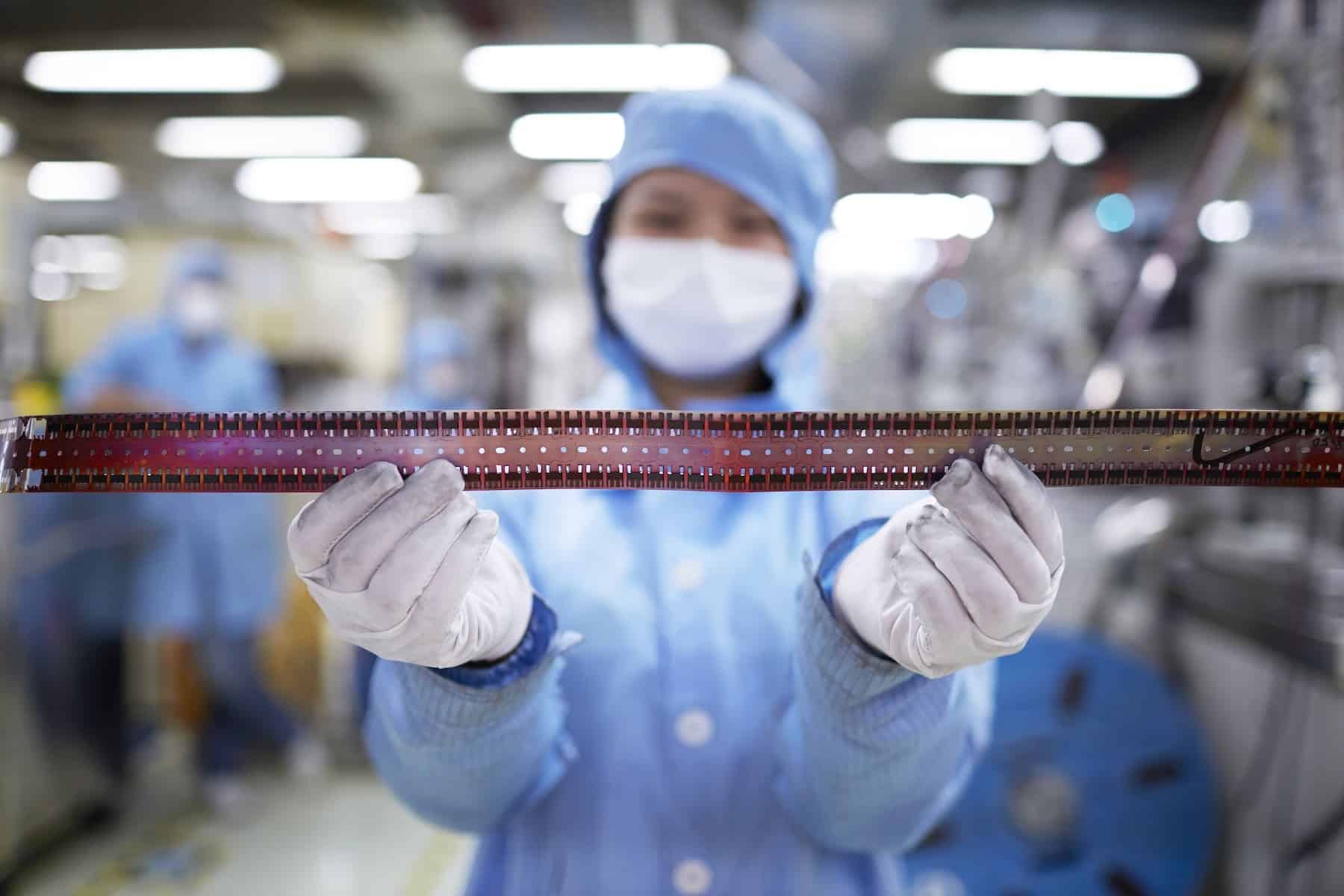
For years, when discussing the global race for semiconductors, the focus was almost exclusively on manufacturing nodes—nanometers—and lithography capability. However, the industry is now realizing that competitiveness is no longer decided solely on silicon. As heterogeneous integration and new-generation packaging advance, the battle shifts to less visible areas for the general public: material stability, mechanical precision, and the reliability of the equipment supporting the entire supply chain.
In this context, China has taken a step that goes beyond symbolism in industry. Several specialized media outlets have reported the growing interest from the advanced equipment and supply ecosystem in Chinese progress in high-performance carbon fiber, especially T1000-type grades, a material historically associated with the most demanding applications. The logic is clear: if chip manufacturing relies on machines capable of moving and positioning wafers with extreme precision, any improvement in rigidity, weight, and thermal stability of these machines’ frameworks directly impacts performance and reproducibility.
From mining region to strategic material
The milestone comes from Datong, in Shanxi province, a traditionally coal-linked area. Here, a project has been launched that, according to various reports published in January 2026, marks China’s first large-scale domestic production of T1000-grade carbon fiber. The initiative consists of a demonstration line producing about 200 tons annually and is part of a broader roadmap targeting a 1,000-ton capacity of high-performance fiber. Participants include a company established in 2023 (Huayang Carbon Material Technology), the Institute of Coal Chemistry at the Chinese Academy of Sciences, and local government support.
This move is driven by technical ambition: published data refer to filaments around 5 to 7 microns in diameter, with tensile strengths around 6,400–6,600 MPa, highlighting lightness (about 0.5 grams per meter) and capacity to bear high loads. Beyond the narrative, the key message is a qualitative leap: China aims not just to produce carbon fiber but to manufacture high-end carbon fiber with industrial consistency.
Why carbon fiber matters in chips
Carbon fiber isn’t new, nor is its use in advanced industrial environments. What is changing is the “why” and “who controls it” amid geopolitical tensions and technological restrictions. In precision equipment, CFRP (carbon fiber reinforced plastic) composites are valued for their combination of lightness, high stiffness, vibration damping, and low thermal expansion. This recipe suits equipment where minimal expansion or slight vibrations could degrade alignment, repeatability, or production performance.
Industrial manufacturers and catalogs already describe CFRP applications in equipment related to liquid crystal displays and semiconductor tools, including robot arms for substrate transportation and wafer handling parts. The industrial argument is straightforward: reducing mass and inertia enables faster, more controlled movements; maintaining dimensional stability helps meet tight tolerances; and vibration dampening enhances accuracy in demanding processes.
Meanwhile, advances in packaging (interposers, 2.5D/3D stacking, chiplet integration) increase the importance of “fine mechanics” and thermal control. The industry has become accustomed to measuring progress in transistors; now it also assesses microns of alignment, flatness, deformation control, and stability during thermal cycles.
A market historically dominated by a few players
The geopolitical dimension is difficult to ignore. Chinese sources have noted that the high-end carbon fiber segment has traditionally been highly concentrated, with strong contributions from U.S. and Japanese companies. In this context, corporate documents from Toray—one of the sector’s historic names—mention that the company developed its T1000 fiber in 1986, at the time presented as the strongest in the world.
This highlights the incentive for industrial sovereignty: producing T1000 (or equivalent) isn’t just about manufacturing a material. It involves mastering processes, quality control, and scaling—achieving consistency that allows acceptance in extremely demanding supply chains. In semiconductors, certification is relentless: it’s not enough to “reach” a resistance figure; it’s necessary to ensure repeatable batches, traceability, behavior under temperature, and compatibility with cleanroom environments.
From announcement to real impact: the challenge of industrialization
Having a demonstration line operational is progress, but it doesn’t automatically mean sector transformation. The critical leap for semiconductors is often measured over long timelines: material qualification, validation in actual parts, aging tests, and adaptation to cleanroom standards (particle control, resin behavior, chemical stability, etc.). Furthermore, using fiber in precision equipment depends not only on the fiber itself but also on the composite design, curing process, metallurgical and ceramic integrations, and the overall industrial ecosystem that turns fiber into reliable components.
Nevertheless, the message is clear: the chip supply chain is expanding. Competition isn’t limited to lithography tools or manufacturing capacity; it now also involves materials enabling those tools, suppliers capable of supporting multi-year programs, and an auxiliary industry resilient to geopolitical shocks.
Ultimately, China’s progress in T1000 is seen as another piece of the puzzle: reducing dependencies, strengthening local industrial fabric, and broadening the range of “critical” materials that enter the discussion on technological sovereignty. In the race for advanced computing, performance increasingly depends on unseen elements: frames, arms, supports, and materials that stabilize a world measured in microns.
Frequently Asked Questions
What is T1000 carbon fiber, and why is it considered “high-end”?
T1000 is commonly associated with fibers that have very high tensile strength within the high-performance industrial categories. It is used as a benchmark for materials capable of combining lightness with advanced mechanical properties, making it attractive for sectors where every gram and vibration counts.
Where in semiconductor equipment can CFRP or carbon fiber be used?
In components where low thermal expansion, vibration damping, and high stiffness with minimal weight are desired, such as structural elements and precision-moving parts. Industrial examples include CFRP used in semiconductor tooling and wafer handling systems.
Why do advanced packaging and 2.5D/3D integration make these materials more relevant?
Because they increase demands for alignment, dimensional stability, and thermal control. As the value shifts from the node to advanced assemblies, mechanical precision and material stability become critical factors for performance and reliability.
Does China’s domestic production of T1000 already impact the global supply chain?
It’s an important signal, but the real impact depends on scaling volume, maintaining consistency, and overcoming stringent certification processes. In semiconductors, adopting new materials often requires extensive validations.