
A large part of the digital power in the 21st century happens beneath the sea. Over 99% of international data flows travel through submarine cables, not satellites, and this infrastructure — as silent as it is critical — determines which routes are fast, which are resilient, and most importantly, who depends on whom during a crisis.
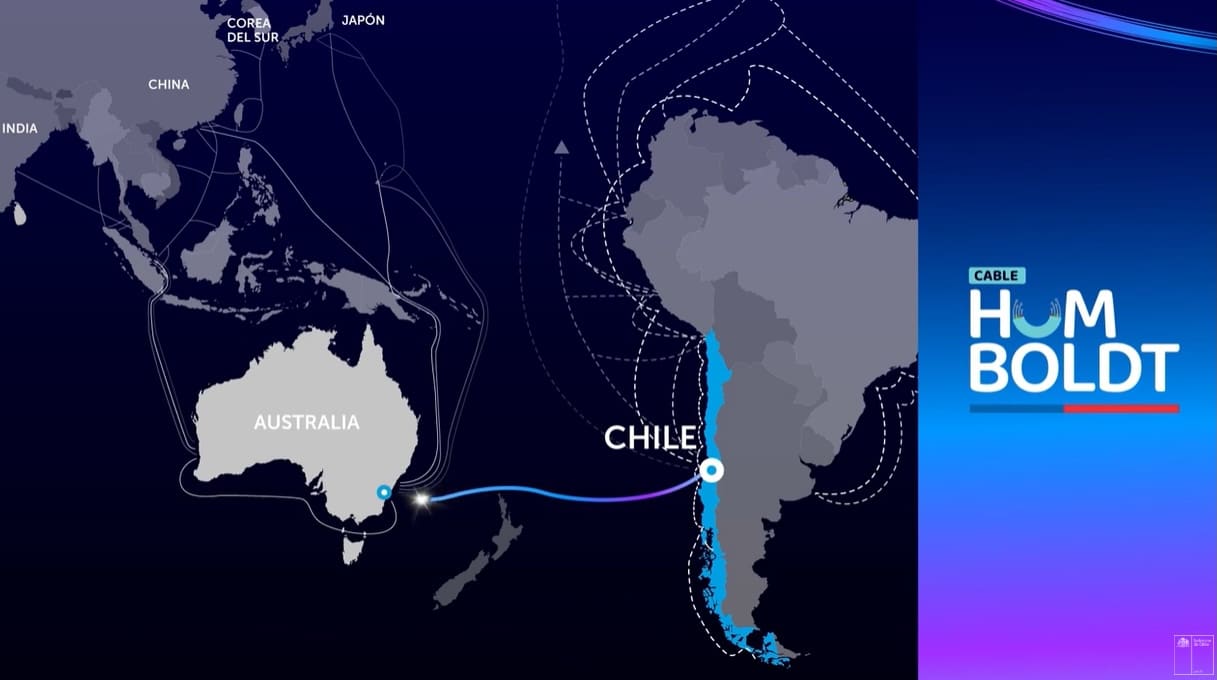
In this context, Chile has just taken a step forward with the Humboldt Project, a trans-Pacific cable that will connect South America with Oceania and Asia-Pacific via an unprecedented route in the South Pacific. The agreement between Google and Desarrollo País aims to deploy a route approximately 14,800 kilometers long, with commercial operation expected in 2027, with Valparaíso as the landing point and intermediate stops such as French Polynesia in some announced designs. The clear ambition is to transform Chile into a digital gateway to Asia-Pacific, reducing the historical dependence on routes that traditionally “went up” to the United States before crossing the ocean.
But while Humboldt represents a strategic leap, it raises an inconvenient question: is opening a new corridor enough, or is it necessary to redesign the entire connectivity architecture of the global south?
The “ring” of the Southern Hemisphere, beyond latency
Talking about “closing the digital ring of the southern hemisphere” is not just a metaphor. The concentration of high-traffic routes in the northern hemisphere — especially in certain chokepoints and high-risk zones — has implications beyond milliseconds of latency. The physical security of cables, geopolitical bottlenecks, and the ability to divert traffic during outages or diplomatic tensions are increasing concerns. Recent incidents in strategic areas such as the Red Sea have reminded us that a breakdown — accidental or not — can degrade connectivity across multiple countries and force rerouting through longer, more expensive paths.
In this context, diversifying routes is systemic resilience. And resilience in digital infrastructure is decision-making power: the ability to maintain services, economies, and communications even when a main corridor becomes fragile.
What already exists… and what doesn’t
The southern hemisphere is not starting from zero. For example, in the South Atlantic, the South Atlantic Cable System (SACS) connects Brazil (Fortaleza) with Angola (Luanda), with an announced design capacity of 40 Tbps, enabling direct connectivity between South America and Africa without necessarily passing through Europe or North America. Additionally, systems like Equiano have strengthened the Atlantic coast, connecting Portugal with South Africa and several intermediate points.
The problem is that these pieces, alone, do not “close” a robust south-south circuit that links South Pacific (Chile) with Southern Africa (South Africa) without relying on northern corridors or exposed land segments. Today, much of the traffic between South America, Africa, and Asia ends up “going up” — by design of interconnection patterns and transit economics — toward nodes and agreements dominated by the northern hemisphere.
This is where the missing piece comes into play: a dedicated submarine cable between southern Chile and South Africa.
Why a Chile–South Africa link changes the game
A Chile–South Africa axis would not be just a technical choice, but a geopolitical architecture decision with multiple interpretations:
- Direct south-south route: it would enable a more natural corridor between Latin America, Southern Africa, and by extension, Asia, through existing links from South Africa to the Indian Ocean.
- Less risk concentration: it would reduce exposure to hotspots in the northern hemisphere and routes where most global traffic is concentrated.
- True contingency redundancy: a “ring” works when traffic diversions can maintain capacity and SLA levels. If the alternative involves a patchwork of segments with different risk profiles, the network may still be “alive,” but not necessarily stable under stress.
- Chile as a structural node: Humboldt aims to position Chile as a hub toward Asia-Pacific; adding a link to Southern Africa would also make it a pivot point for intercontinental routes of the south.
“And isn’t crossing the Andes on land fiber enough?”
This is the common counterargument: connecting Chile with the Atlantic via terrestrial links, then connecting to cables like SACS. In theory, it works, but it’s a different solution from a dedicated submarine backbone. Overland trans-mountain infrastructure has operational and geographic constraints of its own, and most importantly, it was not designed as a homogeneous intercontinental corridor with high resilience and capacity. To talk about a “ring” with guarantees, submarine continuity — in terms of capacity, redundancy, and operational agreements — makes all the difference.
Quick comparison: how routing would change (practically)
| Intercontinental connection | Current typical route (simplified) | Common risk/limitation | With a Chile–South Africa cable |
|---|---|---|---|
| Chile ↔ Oceania/Asia-Pacific | Via routes to the U.S. + North Pacific | Dependence on northern nodes | Direct route via Humboldt |
| South America ↔ Africa | Often via Europe/North America (peering-dependent) | Longer, costlier paths | Direct route via SACS (existing) |
| Chile ↔ Southern Africa | Mixed terrestrial + Atlantic / or via Europe/U.S. | Heterogeneity of segments and dependencies | Direct south-south submarine route |
| Latin America ↔ Africa ↔ Asia (global south) | Very northern-centric corridors | Risk concentration | More diversified circuit in the south |
Digital sovereignty without isolation
Digital sovereignty doesn’t mean sealing off data borders, but gaining maneuvering space: deciding how critical connectivity is routed, where it’s hosted, and how it’s protected. A Chile–South Africa cable would be primarily an investment in strategic redundancy: less dependence on historic routes and more options when the map gets complicated.
Chile has geography. With Humboldt, it’s starting to have infrastructure leverage as well. The next leap — if genuine south-south integration is the goal — would require regional vision, financing, and agreements that look beyond immediate returns. Because, by 2026, structural influence is also measured by position in global data routes.
Frequently Asked Questions
What is the Humboldt cable, and why is it relevant for Chile?
It’s a trans-Pacific submarine cable project driven by Google and Desarrollo País to connect Chile with Oceania/Asia-Pacific via a direct route in the South Pacific, with operations slated for 2027. Its importance lies in route diversification and positioning Chile as a regional digital hub.
Is there currently a direct submarine cable between South America and Africa?
Yes. SACS connects Brazil (Fortaleza) with Angola (Luanda) and was designed to enable direct connectivity, reducing reliance on routes through Europe or North America.
Why would a Chile–South Africa cable differ from terrestrial fiber reaching the Atlantic?
Because a dedicated submarine link can offer more homogeneous capacity and operational continuity for intercontinental traffic, whereas terrestrial options often combine segments with different risks and constraints, complicating large-scale “redundancy.”
What benefits would a “digital ring” of the southern hemisphere bring to companies and governments?
Greater resilience to outages or geopolitical tensions, more routing alternatives, potential latency reductions in certain south-south flows, and better options for digital sovereignty strategies and business continuity.
via: LinkedIn