
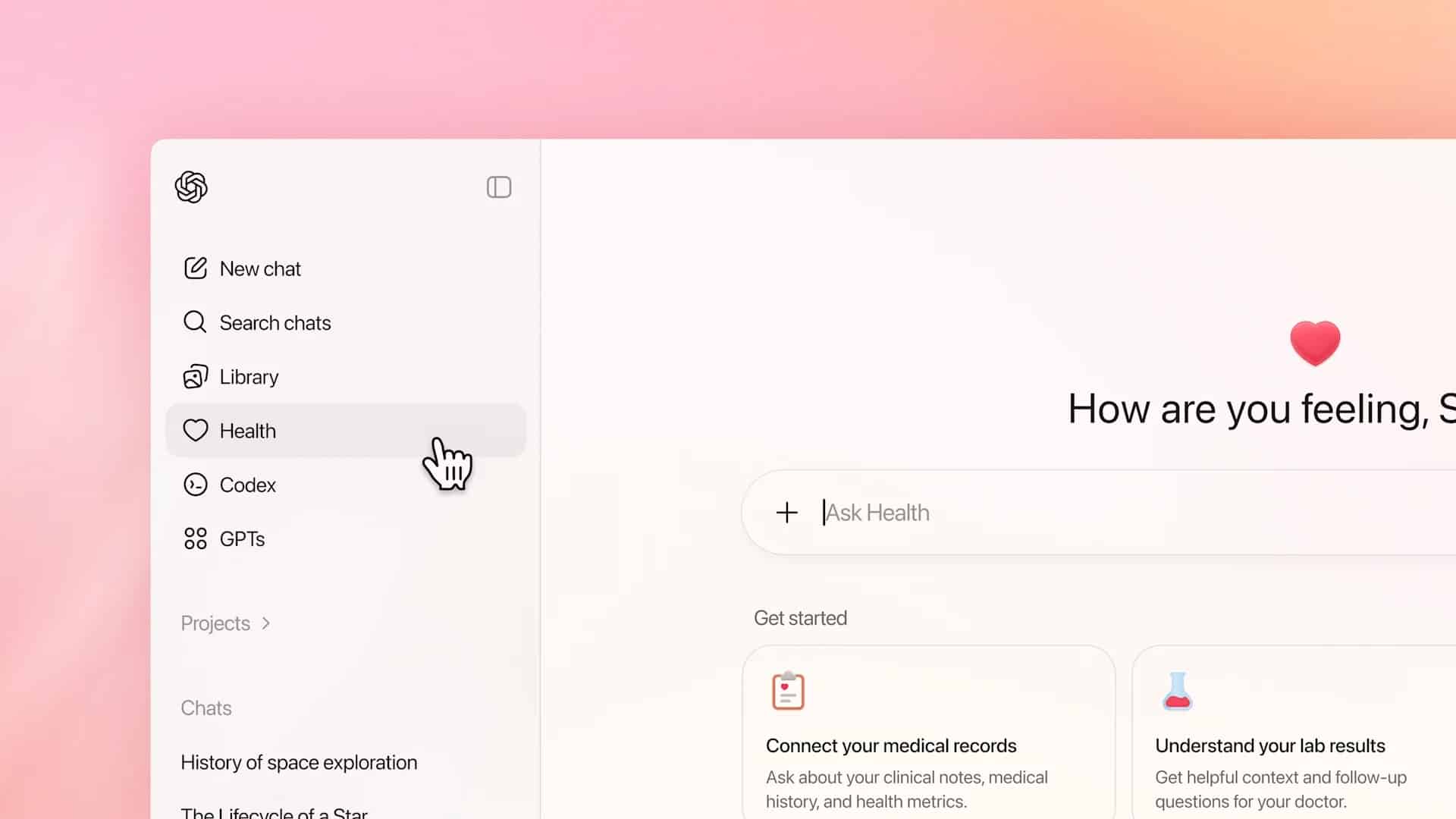
OpenAI has announced ChatGPT Health, a new experience within ChatGPT designed for a widely used yet sensitive purpose: inquiries about wellness, symptoms, lab results, and lifestyle habits. The company is building on a reality that was already happening organically: millions of people use AI conversations to better understand their health, prepare for doctor visits, or interpret scattered information. With this launch, OpenAI aims to organize that behavior with a solution that combines more context (connected data) and additional protections (isolation and specific controls), without crossing a line clearly defined by the company: it is not a diagnostic or treatment tool.
The announcement is accompanied by a figure that explains why this has become a priority: according to anonymized OpenAI data, over 230 million people worldwide ask questions about health and wellness each week. This volume makes any improvement—or failure—highly significant for users, regulators, and the healthcare ecosystem.
A “separate” design for a different type of data
The core idea behind ChatGPT Health is almost architectural: health information resides in an independent space, with conversations, files, and connected applications stored separately from other chats. OpenAI presents this as deliberate compartmentalization to avoid the main risk of everyday use: that a medical conversation could get mixed with other threads and be inappropriately reused.
Within this space, “memories” also function separately. The goal is for health-related context—due to its sensitive nature—to stay in Health, and for general chats not to access files, conversations, or memories created there. Users, however, maintain visibility: they can see their Health chats in their history to access later, but under the module’s isolation rules.
OpenAI also introduces an important asymmetry: ChatGPT can use non-health context (such as lifestyle changes or moving) to make health conversations more relevant; however, health information and its memories are not transferred to the main chats. In practice, this is an attempt to balance personalization with security limits.
From PDFs and portals to a conversation with its own context
The product targets a very specific problem: health information is often scattered across hospital portals, apps, wearables, PDFs of results, and medical notes. ChatGPT Health aims to act as an interpretive layer for tasks such as:
- Summarizing recent test results,
- Preparing questions for a medical appointment,
- Identifying patterns over time,
- Providing general guidance on diet and exercise based on supplied data,
- Understanding pros and cons of insurance options related to healthcare habits.
OpenAI emphasizes that the purpose is to support people in taking a more active role in their health care, not to replace professionals.
Integrations: EHR and wellness apps, with explicit and revocable permissions
The other key pillar is connectivity. ChatGPT Health allows users to connect, with explicit permission, their electronic health record (EHR) and wellness applications. EHR integrations and some apps are available only in the United States, and access to clinical records is limited to adults over 18. To enable healthcare provider access within the US, OpenAI supports b.well as a real-time health data network focused on consumers.
For wellness, the offering includes connection to Apple Health (requires iOS), as well as apps like Function and MyFitnessPal, plus other integrations focused on habits and activity. The company stresses that these applications only access health data with explicit consent, even if already connected to ChatGPT outside of the Health space. As a product rule, OpenAI reserves the right to impose privacy and security requirements: collecting only necessary data and conducting additional review before allowing an app to be part of ChatGPT Health.
Regarding control, OpenAI underscores a straightforward approach: users can revoke access and disconnect applications instantly, with permission revoked immediately.
Privacy and security: encryption, isolation, and a key commitment about training
The launch also aims to address an inevitable concern in technology: what happens to data when users discuss sensitive information like their medical history.
OpenAI details various layers. First, it recalls ChatGPT’s general controls: temporary chats, the option to delete chats from OpenAI systems within 30 days, and training designed to prevent models from retaining personal information from conversations. Second, it explains that chats and files are encrypted by default at rest and in transit. Third, it emphasizes special protections for Health: additional layered safeguards, with encryption and isolation designed to keep medical conversations secure and separate.
The most significant point for many users is what OpenAI states plainly: conversations in ChatGPT Health are not used to train the main models. In a market where trust provides a competitive advantage, this detail is almost part of the product itself.
“Built with doctors” and validated with a clinical framework
OpenAI asserts that ChatGPT Health was developed in collaboration with healthcare professionals, involving more than 260 doctors from 60 countries, with feedback from over 600,000 evaluations across 30 focus areas. This oversight, according to the company, influences the system’s tone and behavior: when to recommend follow-up with a professional, how to communicate risks, and ways to prioritize safety and clarity.
To assess quality, OpenAI mentions HealthBench, a framework with rubrics created by doctors that aim to reflect clinical quality criteria: safety, clarity, proper referral, and respect for context.
Gradual rollout: waitlist and upcoming web and iOS deployment
ChatGPT Health initially launches to a limited user group to learn and refine the experience. The company plans to expand access so that it is available to everyone on the web and iOS in the upcoming weeks, with a waitlist for signing up.
Frequently Asked Questions (FAQ)
What advantage does ChatGPT Health have over using regular ChatGPT for medical questions?
ChatGPT Health offers a separate, isolated space with independent memories and additional protections designed specifically for medical information, as well as the ability to connect with EHR and wellness apps.
Can I upload lab results and PDFs from my doctor to ChatGPT Health?
Yes. OpenAI allows file uploads and also data source connections so that the chat can base responses on user-provided health information.
Are there integrations limited to the US in ChatGPT Health?
Yes. OpenAI states that EHR integrations and certain applications are only available in the US, and Apple Health requires iOS.
What kind of “technical” tasks can ChatGPT Health assist with without replacing a doctor?
Use cases include interpreting recent results, summarizing instructions, preparing questions for appointments, identifying patterns in activity/sleep data, and better understanding habits and tracking options.