
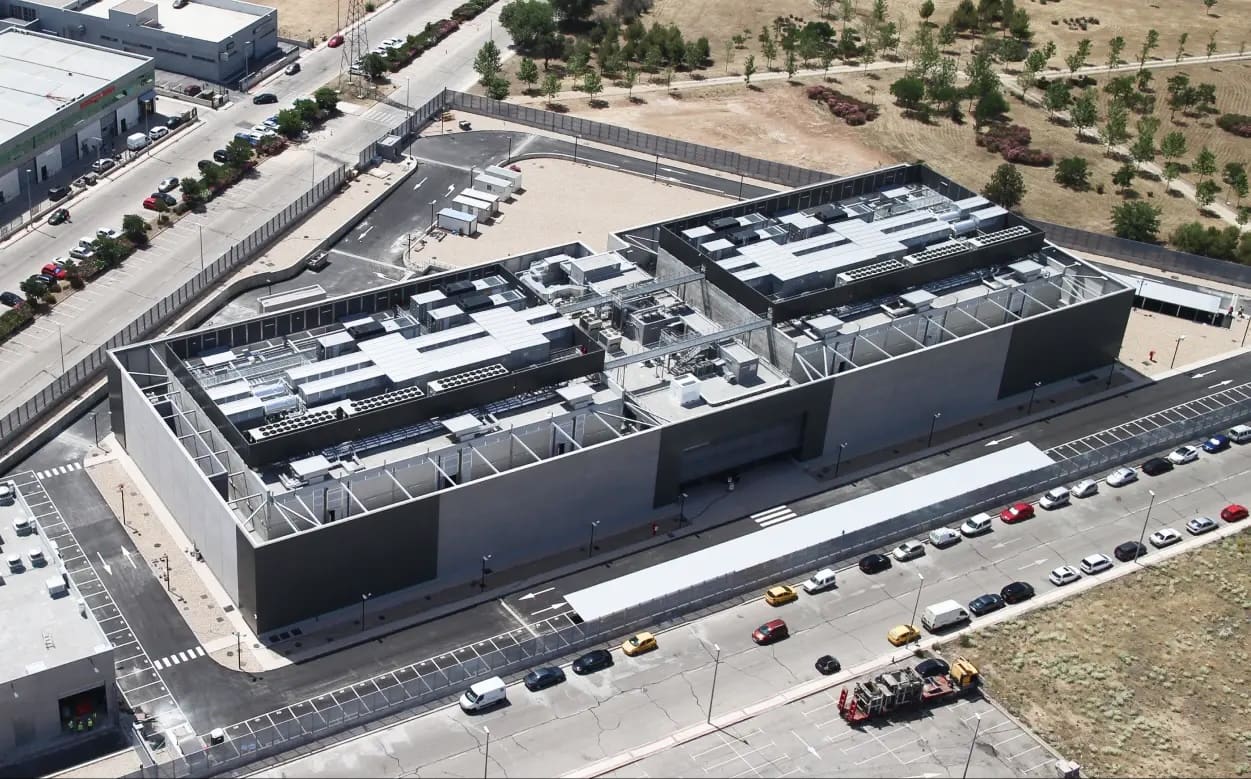
Ceuta finished 2025 with a project that, on its own, explains the direction of the digital economy: a data center. This is not a minor headline for an autonomous city with clear physical borders, but with a competitive advantage that cannot be shown on a map: its position as a European enclave in North Africa and its natural role as a communications gateway between continents.
The infrastructure is driven by Templus and is located in the port area, at La Puntilla Dock. On paper, the project is presented with figures and terms that often sound distant to the general public – square meters, electrical capacity, availability standards – but in practice, they translate into very common aspects: lower latency, greater resilience, and increased ability to attract digital services that today “live” in Madrid, Barcelona, or Frankfurt.
A building designed for “computing” and not just storing machines
The center encompasses a total area of 2,500 m², with 800 m² allocated for the IT room, starting with an initial power of 1.2 MW, expandable to 2.4 MW in a second phase. The target operational launch is set for the first half of 2026, aiming for “before summer” as the operational goal.
In the industry, these figures matter for a simple reason: data centers are not “office” buildings but availability factories. The size of the IT room indicates how much equipment can be housed (servers, storage, networks), while the available power sets the true growth ceiling. In an era where computing demand is accelerating due to artificial intelligence, electrical margin has become the real bottleneck.
Tier III and PUE: two acronyms that explain reliability (and cost)
The project aligns with a Tier III approach, a common standard for data centers seeking service continuity through concurrent maintenance (the ability to perform work without shutting down operations). Simultaneously, the PUE — a measure of energy efficiency — is publicly reported to be around 1.2–1.3, a competitive figure for a modern installation. The idea, in understandable terms, is that a very high portion of energy is dedicated to computing, with as little as possible going to “expenses” like cooling or building losses.
This is where one of the key debates arises: a data center no longer only competes for connectivity; efficiency also matters. The closer the PUE is to 1, the lower the “extra” energy cost per kilowatt dedicated to servers. And in a context of volatile electricity prices, this difference can determine the viability of certain services.
Ceuta as a “digital port”: connectivity, jurisdiction, and an opportunity for local talent
Templus fits a clear trend: the growth of regional data centers closer to users and companies, complementing traditional major hubs. In Ceuta’s case, the appeal relies on a unique combination: European territory (EU rules and legal security) and geographic proximity to Africa, along with submarine connectivity that already links the city to the mainland.
The ambition goes beyond “having a building with servers.” The project’s narrative emphasizes its economic impact: supporting SMEs, public administration, and sectors that are connectivity- and low-latency-intensive — such as gaming and digital services — as well as generating skilled employment (operation, maintenance, networks, security, systems).
The important nuance: a data center does not create an ecosystem by magic. It enables one. To complete the circle, local training, suppliers, integrators, and an enterprise demand that sees value in hosting services nearby are necessary. That is Ceuta’s real challenge: turning strategic infrastructure into sustained economic activity, preventing the data center from being just an isolated “milestone.”
Energy: more stability… and the inevitable debate over electrical capacity
The project benefits from an evolving energy context: Ceuta’s integration into the mainland electricity system via a submarine interconnection, aimed at improving supply stability and security, while also increasing the share of renewable generation in the mainland mix.
This element is more significant than it seems. In Europe, many data center plans stall due to grid limits, permits, or power availability in specific locations. Ceuta’s progression with a 1.2 MW project (with a doubling option) places the city on a map where, increasingly, those who ensure energy, efficiency, and connectivity simultaneously will gain an advantage.
A piece within a larger network
Templus describes itself as a regional operator with a clear network goal: to reach 20 data centers across Spain (and explore expansion) through acquisitions and investments, with Ceuta as a special case built “from scratch.” In this narrative, the Ceuta center isn’t a satellite but a node within a network of facilities in Southern Europe.
And this brings us to the final message: Ceuta as part of a “triangle” of connectivity and services with Málaga and Seville. In a world where digital traffic and computing are redistributing, regions that once seemed peripheral can gain relevance if they play their cards right: cabling, energy, regulation, and talent.
Frequently Asked Questions
When will Templus’s data center in Ceuta be operational?
Public planning indicates the first half of 2026, aiming to be operational before summer.
What does it mean that the center is Tier III, and why does it matter to users?
Tier III is generally associated with high availability and the ability to perform maintenance without stopping service. For companies and users, this translates to fewer interruptions and greater reliability in digital services.
What is PUE, and why is a PUE close to 1.2 so talked about?
The PUE measures how much additional energy the building needs to operate (cooling, losses, etc.) compared to what the IT equipment consumes. The lower the number, the more efficient, and usually, the more competitive in the long term.
What advantages can a data center in Ceuta offer to SMEs and digital services?
Proximity (lower latency) for certain uses, better options for continuity, and a location within the European regulatory framework, along with its role as a point of connection between European and North African markets.