
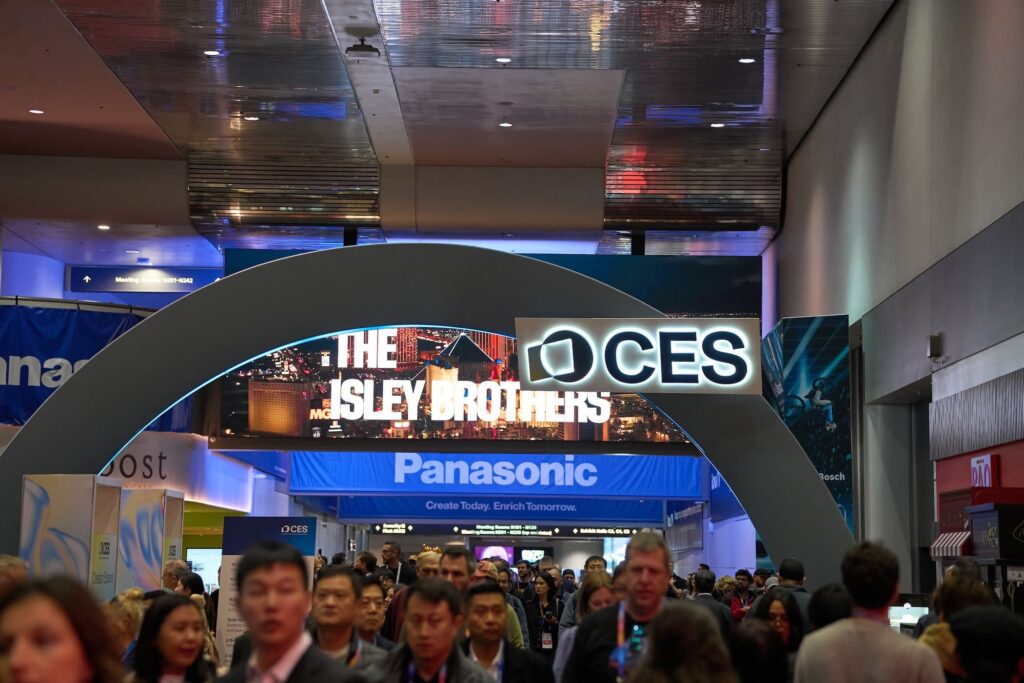
CES 2026 wrapped up in Las Vegas, reaffirming its role as a major global showcase for applied technology. Held over four days, the event brought together more than 148,000 attendees — including over 55,000 international visitors — and approximately 6,900 journalists and analysts, which the organizers describe as the largest post-pandemic CES by volume and activity.
The Consumer Technology Association (CTA), owner and producer of the event, estimates there were over 4,100 exhibitors, including around 1,200 startups, spread across about 2.6 million square feet of net exhibition space. The scale isn’t just a fair statistic: for the industry, it’s a thermometer of investment, corporate priorities, and where technology budgets are heading.
In its summary, CTA highlights a recurring message in hallways and auditoriums: technology is no longer presented as a promise but as part of everyday life. “The future is no longer arriving; it’s already here,” summarizes the statement, emphasizing CES’s role as a meeting point for business, community, and public policy.
From “Digital Transformation” to “Smart Transformation”
If there’s a common thread, CES 2026 makes it clear: the market is shifting from simply digitizing processes to layering them with intelligence, with AI as a cross-cutting driver. CTA openly speaks of a leap toward “smart transformation,” where AI permeates productivity tools, customer experience, healthcare, industry, and robotics.
Across different areas, the event focused on trends that are no longer marginal: agentic AI, digital twins, industrial AI, vertical AI, and what’s beginning to be called “physical AI” applied to robots capable of operating in real environments.
A Map of Topics: Accessibility, Health, Mobility, and Smart Homes
The CES 2026 program wasn’t solely about chips and gadgets. The organizers highlight the growing importance of accessibility technology, driven by wearables, real-time assistive tools, and functions integrated into smartphones for subtitling, object detection, and identification.
In digital health, the message was continuity with acceleration: increased monitoring, early detection, predictive capabilities, and hybrid services between clinics and homes, with AI gaining ground as a support layer (and in some cases, as an interface). In mobility, the focus ranged from autonomy and sensing to adaptive software and new transportation modes. And in smart homes, the concept of predictive automation was reinforced: systems that learn routines and optimize energy, comfort, and security.
Energy: The Elephant in the Room Also on Stage
As AI expands, energy is shifting from a “background” issue to a central topic. CTA reports advances in storage (large-scale and residential), home energy management, portable power solutions, and highlights emerging technologies like small modular reactors and fusion, in an increasingly important energy segment. The subtext is clear: without robust energy infrastructure and efficiency, the next wave of computing faces practical limits.
Keynotes and Spaces: Foundry, C Space, and the Business of Innovation
Beyond the show floor, CES 2026 adopted a format blending demonstrations and industry discourse. CTA reports more than 400 sessions featuring over 1,300 speakers, along with participation from public officials.
Among the highlights is CES Foundry, focused on AI and quantum technology, and C Space, a hub for marketing, media, and brands. The organization also reviews major conferences, appearances by leading companies such as AMD and Siemens, and collaborations aimed at bringing AI tools into industrial, business, and consumer scenarios.
Transparency and Auditing: Why the Numbers Matter
CTA emphasizes that CES maintains transparency through independent audits and adherence to industry exhibition standards, citing UFI as a benchmark for auditing standards in the event industry. UFI operates “approved” event programs as a quality seal for the global trade fair industry.
Practically, this point is significant because, at events the size of CES, figures aren’t just marketing; they impact business decisions, sponsorships, and positioning. CTA has announced that the CES 2026 audit will be published in spring with confirmed data.
As this edition closes, the organizers set the date for the next chapter: CES will celebrate its 60th anniversary in January 2027 in Las Vegas.
Frequently Asked Questions
What tech trends defined CES 2026 for the everyday user?
Primarily, AI integration into daily services (productivity, assistance, entertainment), the push for more useful wearables, and smart homes focused on automation and energy efficiency.
Why is energy a hot topic when talking about AI and data centers?
Because the growth of AI demands more computing power, which in turn requires more electricity and better infrastructure. Efficiency and new energy sources/strategies are critical to real scalability.
What is CES Foundry, and why is it considered an important novelty?
It’s a dedicated space at CES focused on emerging technologies—especially AI and quantum—that combines demonstrations, immersive scenarios, and networking opportunities with companies and investors.
How are attendance and exhibitor numbers validated at an event like CES?
CTA states they rely on independent audits and sector standards; UFI is one of the key organizations recognized worldwide in the fair and exhibition industry.