
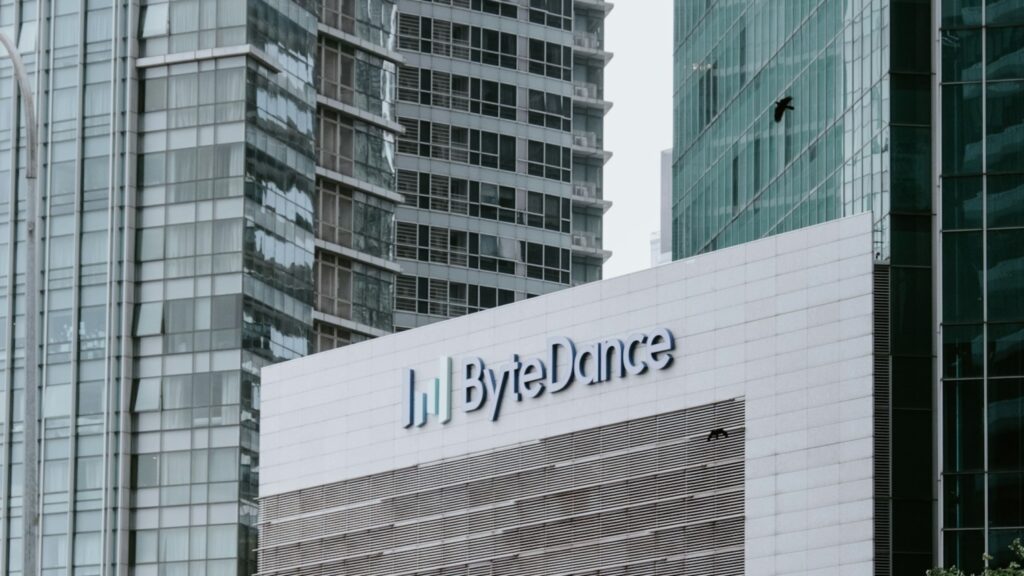
ByteDance, the parent company of TikTok and Douyin, is studying to increase its artificial intelligence capital expenditure up to around $70 billion this year, according to Bloomberg. The figure, still preliminary and subject to change, would place the Chinese company in a league much closer to the major American hyperscalers than to the usual investment pace of its local rivals.
This move isn’t just about data centers. It also concerns chips. ByteDance aims to reduce its dependency on NVIDIA, gain control over its own infrastructure, and accelerate the development of AI models, agents, and services in an increasingly competitive Chinese market. The company hasn’t publicly confirmed these plans, but available reports suggest a very aggressive leap: from about $25 billion in capital expenditures last year to a range that could be between 400 billion and 500 billion yuan, roughly $59 billion to $74 billion.
From TikTok to AI Infrastructure
ByteDance can no longer be understood only as a social media company. TikTok, Douyin, and its recommendation engine remain at the core of its power, but AI has become an industrial priority for the company. Doubao, its AI chatbot and assistant in China, has established itself as one of the country’s most-used applications, with 345 million monthly active users in March 2026, according to QuestMobile data cited by The Straits Times. This scale makes every model improvement an infrastructure issue.
Computing consumption grows with every user, multimodal query, agent, and integration into video, commerce, advertising, or productivity. ByteDance holds an advantage many AI startups lack: a huge user base, experience in consumer products, and a profit engine capable of funding much of its expansion. Bloomberg indicates that the company might cover much of its spending with nearly $50 billion in profit earned in 2025, according to sources familiar with private figures.
The comparison with the United States highlights the scale of the challenge. Amazon, Alphabet, Microsoft, and Meta have announced capital expenditure plans of up to $725 billion this year for data centers, chips, and AI models. Compared to this scale, China has been more cautious. Tencent declared 79.2 billion yuan of capex in 2025, and Alibaba 126 billion yuan in its fiscal year ending March—significant figures but still far from the average pace of U.S. giants.
| Company or Group | Spending or Quoted Plan | Summary |
|---|---|---|
| ByteDance | Up to $70 billion in 2026, according to Bloomberg | Bold move into data centers and AI chips |
| ByteDance, previous plan | 160 billion yuan, about $22.7 billion | Preliminary plan reported by FT and Reuters in 2025 |
| Tencent | 79.2 billion yuan in capex for 2025 | High investment, but more cautious |
| Alibaba | 126 billion yuan in FY ending March | Strong focus on cloud and AI |
| US hyperscalers | Up to $725 billion in 2026 | Much larger scale of the U.S. block |
Qualcomm, ASICs, and the Pursuit of Independence
The most interesting part lies in silicon. Reuters reported this week that Qualcomm had reached an agreement with ByteDance to supply ASICs for AI data centers, according to Bloomberg. This deal would make ByteDance one of Qualcomm’s early major clients in AI infrastructure, a market where the company aims to grow beyond mobile processors.
ASICs are chips designed for specific tasks. In AI, they may be less flexible than GPUs but more efficient for repetitive and large-scale workloads, especially inference. For ByteDance, this makes sense: not all its computing needs require a general-purpose GPU. An increasing portion can run on chips optimized for its own models, agents, and recommendation flows.
The company has also been linked to bulk purchases of NVIDIA chips. Reuters noted in late 2025 that ByteDance planned to spend about 100 billion yuan, roughly $14 billion, on NVIDIA AI chips in 2026, according to South China Morning Post. dependence remains relevant but has become politically sensitive due to U.S. export restrictions and Beijing’s push to use more domestic semiconductors.
This points to a mixed strategy: purchase what can be bought from NVIDIA, utilize domestic chips whenever possible, partner with companies like Qualcomm for ASICs, and progress in in-house or semi-custom designs. ByteDance isn’t seeking an immediate GPU substitute but a less vulnerable computing portfolio.
| Chip Type | Benefit for ByteDance | Limit or Risk |
|---|---|---|
| NVIDIA GPU | Performance, ecosystem, and mature training | Export restrictions and high cost |
| Qualcomm ASICs | Efficiency in specific AI workloads | Dependence on a new supplier and pending validation |
| Chinese domestic chips | Lower geopolitical risk and alignment with Beijing | Performance gap compared to global leaders |
| In-house or semi-custom design | Greater control over costs and architecture | High costs, complexity, and dependency on foundries |
China’s AI Enters an Era of Extreme Capex
Until now, much of the debate about AI in China focused on models like DeepSeek, Qwen, Hunyuan, or Doubao, on aggressive API pricing, and on doing more with less. While this narrative remains relevant, ByteDance is showing that efficiency doesn’t eliminate the need for capital. To serve hundreds of millions of users and compete in agents, video, search, recommendation, and productivity, data centers are essential.
The jump in capex also marks a transition. The first phase of generative AI was about products and models. The second is about infrastructure. Success depends on securing electricity, chips, memory, networking, cooling, and operational capacity over years. For a Chinese company, this race is also geopolitically constrained: limited access to NVIDIA’s most advanced chips, dependence on TSMC for certain designs, domestic push for Huawei Ascend, and regulatory scrutiny in both China and the U.S.
ByteDance has an asset few Chinese rivals do at the same scale: profits strong enough to fund a significant portion of the push without relying entirely on debt or external funding rounds. This doesn’t reduce risk; it amplifies it in another way. If the company allocates tens of billions to infrastructure, it must demonstrate that Doubao, TikTok, Douyin, advertising, commerce, and enterprise services can turn that computing into sustainable revenue.
The AI market is entering a phase where capital expenditure signifies ambition but also becomes a burden. Each data center needs utilization. Each chip purchased must be put to work. Each ASIC designed must justify its volume. ByteDance can afford to invest boldly but cannot afford underutilized infrastructure.
This news also impacts the broader industry. For Qualcomm, the deal with ByteDance could open a gateway into a market dominated by NVIDIA, Broadcom, and Marvell. For Chinese chip manufacturers, it signals increased pressure: if a local company of such scale is pursuing hybrid solutions, it indicates domestic offerings still don’t cover all needs. For U.S. hyperscalers, it reaffirms that capex advantage remains immense but that China is not standing still.
ByteDance aims to become more than just an app company. It wants control over the AI layer powering recommendations, videos, agents, advertising, search, content creation, and possibly connected hardware. To do so, it needs chips, not just models. That $70 billion, if it finally materializes, would be more than an accounting line; it would be an industrial declaration of war.
Frequently Asked Questions
Has ByteDance officially confirmed the $70 billion plan?
No. The figure comes from Bloomberg reports based on sources familiar with internal discussions. The plan is preliminary and could change quarterly.
Why does ByteDance need such heavy AI spending?
Because its AI products like Doubao have massive scale and require increasing compute for models, agents, video, recommendation, and enterprise services.
What role would Qualcomm play in this strategy?
Qualcomm has reportedly closed an agreement to supply AI ASICs to ByteDance, helping the Chinese company diversify its infrastructure beyond NVIDIA GPUs.
Can ByteDance compete with U.S. hyperscalers?
In total scale, Amazon, Microsoft, Alphabet, and Meta remain far ahead. But ByteDance could become the most aggressive Chinese investor in AI infrastructure if it executes this plan.
via: theedgemalaysia
