
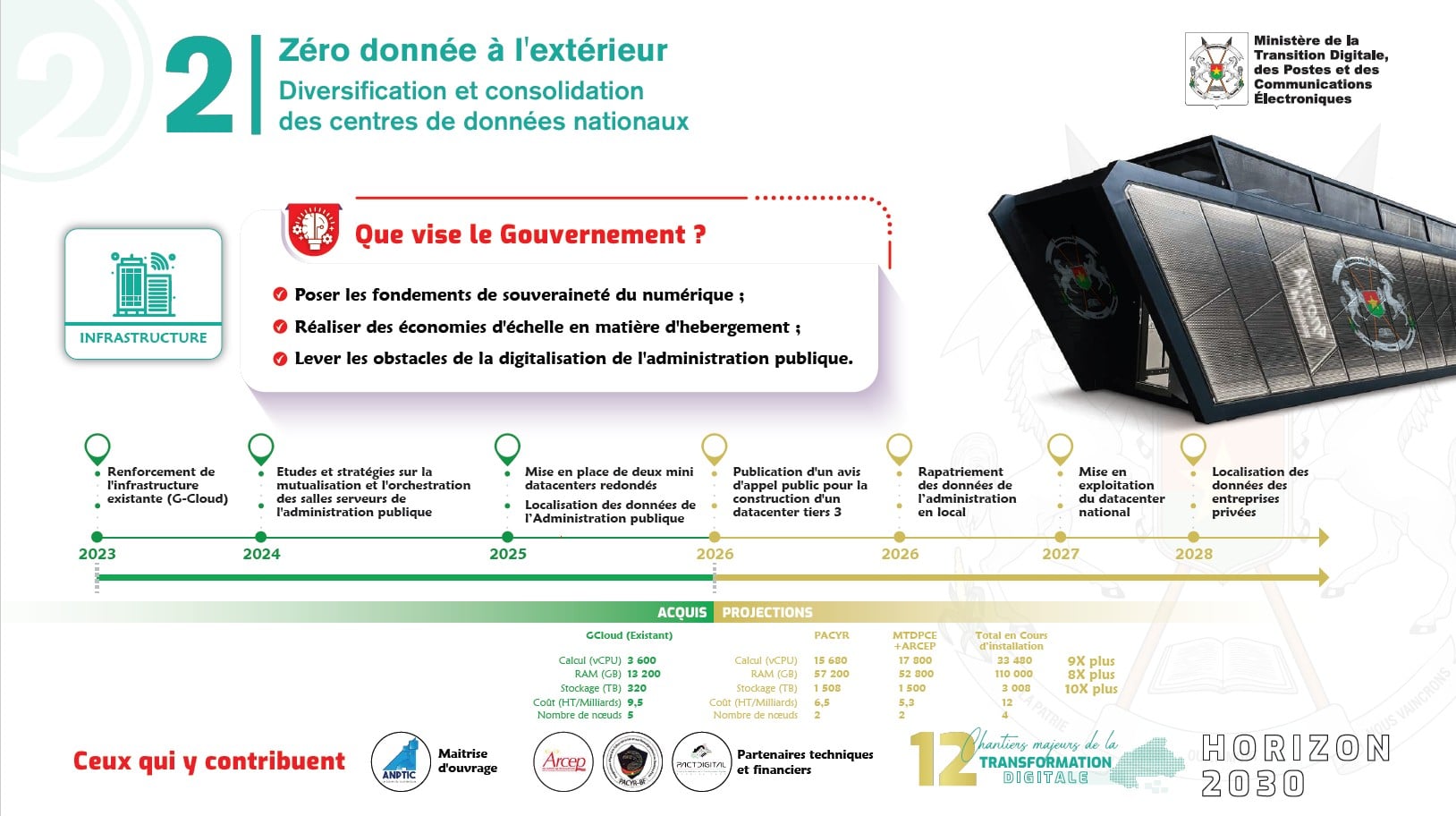
Burkina Faso has taken an unusual — and very symbolic — step in Africa’s race for digital sovereignty: the government has launched two micro data centers in Ouagadougou to host public sector workloads and reduce dependence on international infrastructure. The initiative delivers a clear political message: state data, within the State.
According to information released by the Ministry of Digital Transition, both centers would total 3 PB of storage, 105.6 TB of memory, and 28,800 CPU cores, capable of serving more than 7,000 virtual machines. In terms of administrative availability, the government depicts it as a scaling leap: “multiplying by ten” the previous national capacity dedicated to public platforms.
The goal: stop “renting sovereignty” outside the country
Beyond the technical muscle, the project relies on economic and control logic: the cost is estimated at around 16 billion CFA francs (about $29 million), and the government expects savings of 30 billion CFA francs (approximately $54.47 million) over five years by reducing dependency on international hosting for public platforms.
Prime Minister Rimtalba Jean Emmanuel Ouédraogo framed the move as a national decision: the inauguration would be “an act of sovereignty” and a milestone for building a modern state “master of its choices and tools.” He also urged these facilities to become the single backbone of public platforms, aiming to bring back data hosted abroad or in private infrastructures.
An “intermediate step” toward a larger national center
The government views these micro centers as a preliminary phase toward a larger-scale national data center, planned for 2028 (no public details about size). Additionally, the country is establishing an operational and security layer: the construction of a digital infrastructure monitoring center (core network, cybersecurity operations, data center management, and critical infrastructure protection), with an expected launch in October 2026.
Context: limited infrastructure, high ambitions
Burkina Faso has a small footprint of data centers, making the shift toward “sovereign cloud” for the public sector even more relevant. The movement is not isolated: in connectivity, the government had already announced plans for massive deployment — such as the goal of 800 telecommunications towers — to expand coverage and support the country’s digitalization.
Overall, the message is clear: without local infrastructure (computing, networking, operations, and cybersecurity), digital transformation ultimately depends on third parties. And by 2026, this dependency — whether due to cost, resilience, or geopolitics — has become a matter of national importance for many governments.
Frequently Asked Questions
What is “data sovereignty” in practice?
Ensuring that critical data and services (especially in the public sector) are hosted and managed under national jurisdiction, reducing exposure to legal, geopolitical, and operational risks.
Can a “mini” data center support AI, or is it only for basic public services?
It can support both, but usually prioritizes essential services (identity, procedures, portals, email, VMs) and scales later. AI typically requires more demanding energy, cooling, and operational resources.
What is the biggest challenge for projects like this?
Maintaining 24/7 operation, ensuring security, electrical continuity, and connectivity, as well as training and retaining local talent to operate critical infrastructure sustainably.
via: Facebook and datacenterdynamics