
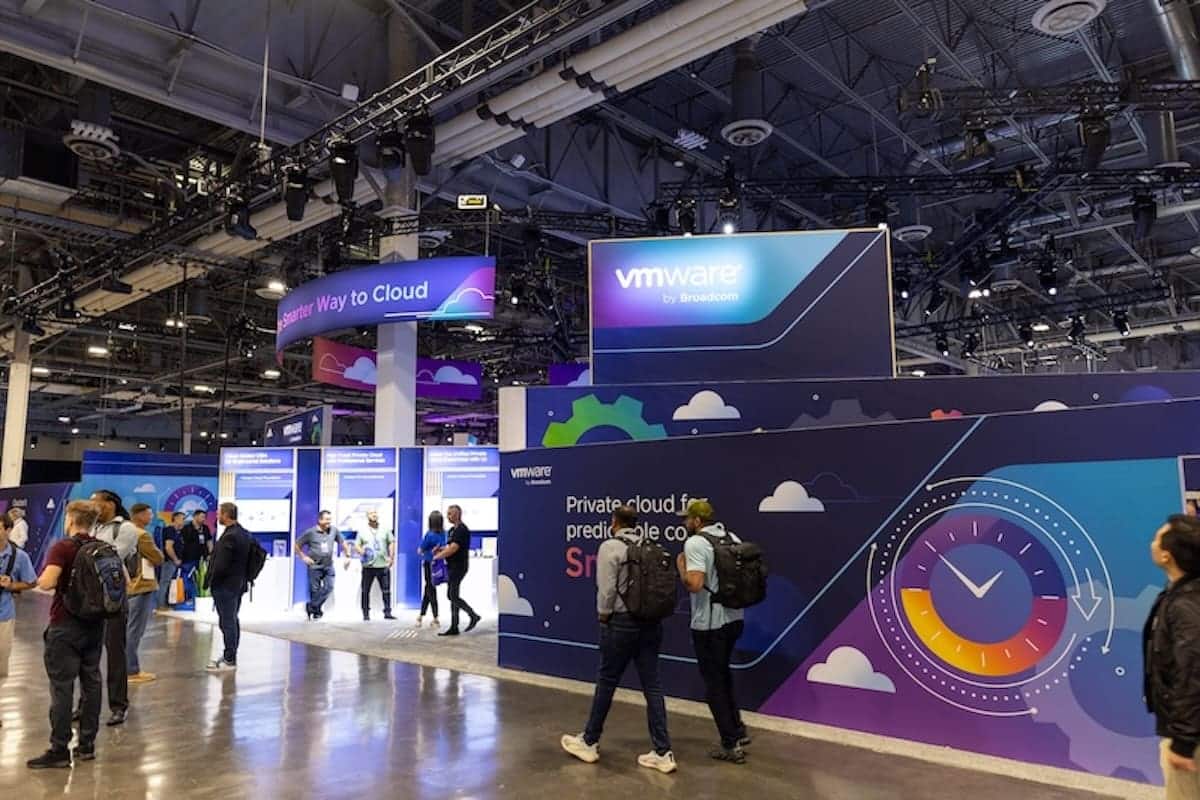
Broadcom has unveiled VMware AI Factory, a new layer of infrastructure and services built on top of VMware Cloud Foundation (VCF) designed to deploy artificial intelligence in private clouds. The offering automates everything from preparing physical servers to bringing inference models online, and adds tools for sharing GPUs, governing models, and measuring resource and token consumption. The company says the initial setup can shrink from weeks to hours, though that’s a vendor estimate that will depend on each infrastructure.
VMware AI Factory in 30 seconds
- VMware AI Factory automates deployment from the physical server all the way to inference services.
- VCF will let different departments share GPUs and models through isolated environments.
- A new AI Gateway will manage access, token consumption, authorization, and the choice between local or cloud models.
- Broadcom is preparing isolated environments to run code generated by AI agents in a controlled way.
- The platform supports more than 150 models and is expanding its hardware options with AMD Instinct and ROCm.
The announcement, made at VMware Explore 2026, spells out fairly clearly where Broadcom wants to take its private cloud business. VMware is no longer meant to just virtualize servers or provide Kubernetes: the company wants VCF to also manage the physical infrastructure, the accelerators, and the models that make up an enterprise AI platform.
The economics also take center stage. Broadcom uses the term AI tokenomics to describe the cost of producing tokens and running inference. Instead of the usual model of paying an outside provider by consumption, a company can buy infrastructure and split its capacity across different models and departments.
That doesn’t mean private infrastructure is automatically cheaper. Actual GPU utilization, hardware price, electricity, cooling, operations, and technology refresh cycles all determine the real cost. VMware AI Factory is specifically aimed at one of those variables: making the available infrastructure shareable and keeping it in more continuous use.
From installing the servers to serving the first model
Broadcom sums up one of the current problems in enterprise AI as the metal to model path: everything that happens between having a physical server and having an application that can send requests to a model running in production.
There’s quite a lot standing between those two points.
Servers and firmware need to be configured, virtualization infrastructure installed, networking and storage prepared, Kubernetes deployed where needed, GPU drivers configured, inference runtimes installed, and finally the models deployed and monitored.
VMware AI Factory is meant to turn a large chunk of that journey into an automated process.
Broadcom says VCF’s automation capabilities can cut the time from deploying bare-metal servers to serving the first model from weeks down to hours. The company doesn’t provide a detailed comparison covering every possible setup in the announcement, so the figure should be read as the goal its architecture is designed around, not a guaranteed time for any given project.
A new piece extending that automation down to the hardware comes from MetalSoft.
Broadcom has announced a collaboration to integrate MetalSoft’s physical-server provisioning technology with VCF. The goal is for administrators to be able to prepare or reimage servers from different manufacturers straight from the VMware console, rather than reaching for a different tool for each platform.
MetalSoft’s pitch is bringing certain bare-metal provisioning tasks down from weeks to minutes.
The approach is notable because much of traditional cloud automation only kicks in once the hardware is already prepared. VMware AI Factory tries to push the same operating model further down, all the way to the physical servers.
Sharing GPUs and models to improve the economics of inference
The other part of VMware AI Factory is about how GPUs get used.
Dedicating a full set of accelerators to each department or model can get expensive if the workloads don’t constantly use all of the available capacity.
VCF aims to pool and share GPU resources across different workloads.
Broadcom is also introducing Multi-tenant Model Sharing. Model Runtime will let models be shared across different departments or tenants through isolated namespaces.
The idea is simple: if five teams need to use the same model, there shouldn’t be a requirement to maintain five fully independent deployments, each eating up memory and GPU capacity.
A central service can host the model and serve it to different users while keeping logical separation between them.
This architecture fits with another concept Broadcom is building around VCF: Model as a Service.
The infrastructure team can offer models internally as a service. Developers consume inference endpoints while the organization keeps control over which models are available and what hardware they run on.
A unified gallery will let teams deploy and manage models and RAG (Retrieval-Augmented Generation) pipelines across virtual machines, containers, and GPU resources.
VCF will also provide observability into token throughput, latency, and compute and memory utilization.
Those metrics are needed to work out something that has often stayed hidden during the first phase of AI adoption: how much each application really costs once it starts being used at scale.
An AI Gateway to control local and external models
Broadcom is also building an AI Gateway.
Its job will be to provide a common consumption and governance interface for models running inside the infrastructure and services available in other environments.
The gateway will be able to include smart model routing, usage and token limits, and application authorization.
This layer could matter quite a bit if companies end up working with numerous models at the same time.
A simple application might use a small, inexpensive model. A complex query might get routed to a more capable one. Certain data might have to be processed exclusively on local models, while other requests could use external services.
The gateway could become the point where those policies get applied.
It also provides an abstraction layer for developers. Applications can consume a relatively stable interface even if the infrastructure team later swaps out the model running behind it.
That flexibility is becoming relevant because the model market is moving fast. Locking an enterprise application into a specific model for years can be awkward when new alternatives keep showing up every few months.
Agents that write code need a sandbox of their own
VMware AI Factory also gets ahead of a different problem: agents capable of generating and running code.
A chatbot that produces a wrong answer can cause problems. An agent that generates code and has the tools to execute it can have far more direct consequences for the infrastructure.
Broadcom is building Secure AI Sandboxes, virtualized and isolated spaces where that dynamic code can run.
The company is also planning a governance layer to define how agents get invoked, what tools they can use, and how their results are validated before anything acts on them.
These capabilities are announced as upcoming features, so they shouldn’t be mistaken for functionality that’s fully available at launch.
Virtualization finds a new use case here.
For decades it was mainly used to isolate operating systems and applications. AI agents now raise the need to create ephemeral environments where potentially unpredictable code can run without direct access to the rest of the infrastructure.
AMD Instinct and ROCm expand the options beyond a single GPU stack
One of the more technically interesting announcements is the collaboration with AMD.
Broadcom is working on a VMware AI Factory configuration that combines VCF with AMD Instinct GPUs and the open ROCm stack.
Automated provisioning will cover vSphere, vSAN, Kubernetes, and AMD’s GPU operator.
Broadcom also mentions AMD DVX, which will make it possible to attach GPUs to large virtual machines later used by VMware vSphere Kubernetes Service clusters.
Bringing AMD into the mix widens the options for companies that don’t want to build their entire AI infrastructure around a single accelerator vendor — a shift from the vendor’s earlier NVIDIA-centered push to bring AI to VMware Cloud Foundation.
VMware AI Factory also leans on certified Dell PowerEdge servers and on AI ReadyNodes from manufacturers such as Cisco, Lenovo, and Supermicro.
Broadcom’s proposal, then, is to provide a common operating layer on top of different hardware configurations.
Whether that abstraction actually delivers the same experience across architectures will depend on factors that go beyond VCF itself. The compatibility of each model, along with libraries, kernels, and runtimes, still has a major influence on which accelerator makes sense for a given job.
More than 150 models inside the private cloud
VMware AI Factory connects directly with another of the announcements Broadcom made at VMware Explore 2026.
The company says VCF can run more than 150 open and commercial models and has specifically validated several notable families.
Among them are NVIDIA Nemotron 3, Google DeepMind Gemma 4, NEC’s cotomi, Alibaba’s Qwen, and Z.ai’s GLM 5.2.
That means the AI factory doesn’t just stop at GPU-ready Kubernetes infrastructure. The goal is for it to deliver working models to internal users as well.
Broadcom wants an organization to be able to prepare servers, deploy the platform, allocate GPUs, pick a model, and serve inference all from the same operating environment.
The company also keeps the ability to switch models later without necessarily having to rebuild the entire infrastructure.
That separation between infrastructure, runtime, and model could end up mattering a great deal for companies that expect to keep their platforms running for far longer than the commercial lifespan of any one LLM version.
Token economics arrive in the private data center
Broadcom is especially insistent on token economics because comparing public and private AI needs a unit of measure that goes beyond the price of a GPU.
A commercial API turns infrastructure into a relatively easy cost to track: a given amount per million tokens processed.
With owned infrastructure, that calculation gets spread across many line items.
Servers and accelerators need to be amortized, power and cooling paid for, storage and networking maintained, and staff kept on to run the platform. In exchange, a well-utilized GPU can keep generating tokens continuously without a per-use fee charged by a model provider.
VMware AI Factory aims to provide metrics that make it possible to track tokens produced against resources consumed.
That also explains the interest in sharing GPUs and models. Buying more hardware doesn’t necessarily improve the economics if a large share of it sits idle waiting for work.
Infrastructure with fewer accelerators but high utilization can deliver a better cost per token than a much larger setup fragmented across departments.
The choice doesn’t have to be strictly public or private, either.
The AI Gateway points precisely toward hybrid scenarios where certain models stay in-house and others are consumed externally depending on cost, data sensitivity, capacity needs, or availability.
VMware AI Factory represents a significant evolution in what Broadcom means by private cloud. The infrastructure is no longer designed only to host virtual machines and containers; it now treats GPUs, models, tokens, and agents as manageable platform resources.
If enterprise AI ends up being deployed through a mix of local and external models, the competitive edge for these platforms could rest less on offering one specific model and more on making sure that switching hardware, model, or location doesn’t force a rebuild of the entire application.
Frequently Asked Questions
What is VMware AI Factory?
It’s a platform Broadcom unveiled on top of VMware Cloud Foundation to automate the deployment and operation of private infrastructure for artificial intelligence, from physical servers through to inference services.
Can VMware AI Factory use AMD GPUs?
Yes. Broadcom and AMD are working on a configuration that combines VCF with AMD Instinct accelerators and the ROCm stack, including automation to deploy the necessary components.
What does AI tokenomics mean for Broadcom?
It refers to analyzing and controlling the cost of running inference based on factors such as tokens processed and GPU, memory, and compute utilization. It doesn’t imply that private cloud is always cheaper than consuming an external API.
What models can VMware AI Factory run?
Broadcom says VCF supports more than 150 models and has announced specific validation for families such as NVIDIA Nemotron 3, Google DeepMind Gemma 4, NEC’s cotomi, Qwen, and GLM 5.2.
