Broadcom’s acquisition of VMware hasn’t suddenly broken the virtualization market, but it has changed the conversation within many infrastructure areas. What was once just a technical review, marked by renewal cycles, compatibility, and costs, has become a matter of operational continuity. For many companies, VMware remains a solid platform that’s hard to replace. The difference now is that it’s no longer assumed to be the only option.
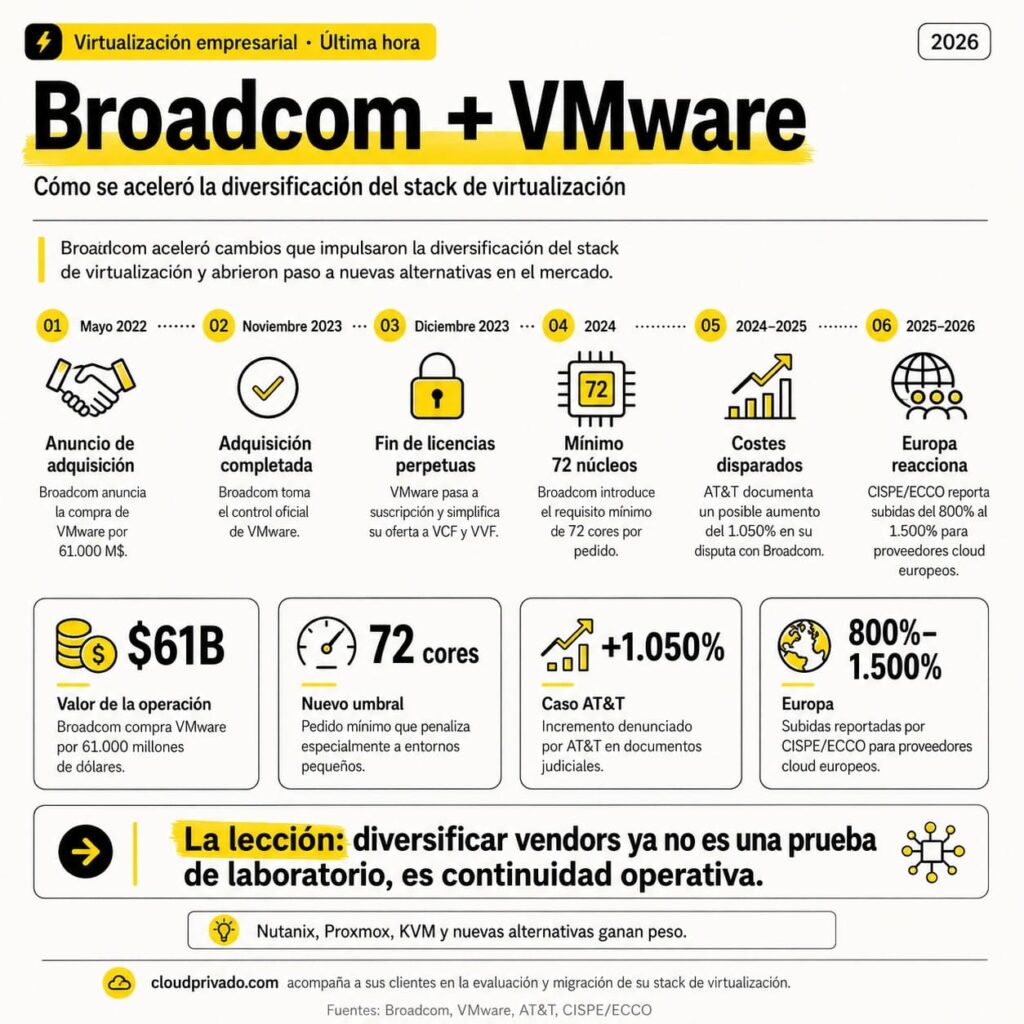
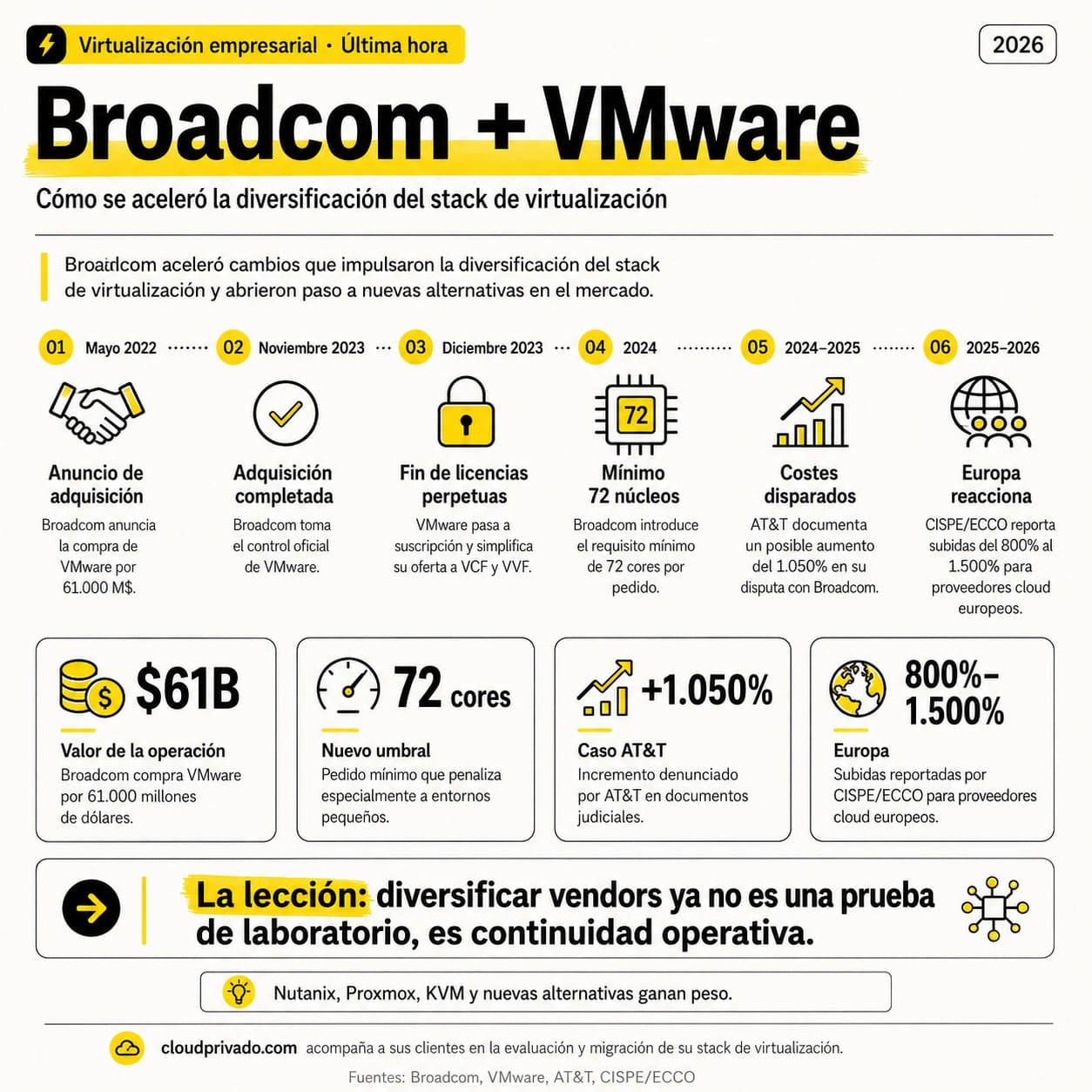
Broadcom completed its acquisition of VMware in November 2023, and just a few months later, confirmed the end of new perpetual licenses, shifting clearly toward a subscription model. This move aligned with the company’s strategy of simplifying its business offerings but also impacted budgets for clients, integrators, and cloud providers who had built their services around VMware’s stack for years.
The outcome hasn’t been a quick and massive migration, because virtualized environments aren’t changed like office applications. However, a structured exit is visible—phase by phase—with proof of concept tests, workload segmentation, and analysis of alternatives. Nutanix, Proxmox, KVM, Hyper-V, OpenStack, and more specialized options, such as Cisco’s new hypervisor for certain unified communications environments, have gained visibility in a market that seemed much more closed off for years.
From Price to Dependency Risks
The debate about VMware is no longer just about license costs. The fundamental issue is dependency. When an organization consolidates virtualization, automation, backup, software-defined networking, and parts of its daily operations on a single provider, any commercial change ceases to be a procedural matter and starts affecting its technological strategy.
Public figures have explained why this has become a concern for boards and financial committees. AT&T, in legal documents, claimed that Broadcom proposed increases of up to 1,050% in VMware-related costs. CISPE, the association representing European cloud infrastructure providers, has reported practices to European institutions that, according to them, could have led to increases of up to 1,500% for some European cloud providers.
There are also notable cases outside the telecom sector. Tesco sued Broadcom, VMware, and Computacenter in the UK over a dispute related to perpetual licenses and support. According to publicly available information, the retailer argued that the change exposed them to higher prices and operational risks for some 40,000 server workloads, including critical applications for stores and internal operations. The claim was valued at at least 100 million pounds.
This dispute was compounded by controversy over minimum purchase quantities. In 2025, a minimum of 72 cores per order was reported in certain channels and regions, though this measure was later clarified or reversed by different industry sources. Beyond the specifics, this episode left many customers feeling uncomfortable: the commercial framework could change quickly, prompting more cautious review of renewals than before.
Migration Is Planning, Not Escape
The most revealing data isn’t in the extreme cases but in the overall trend. A study by CloudBolt published in 2026, based on 302 IT managers from North American companies with over 1,000 employees, indicated that 86% of these organizations are actively reducing their VMware footprint. Only a portion have completed their exit, confirming that the market is not experiencing a stampede but a slower, more pragmatic transition.
This distinction is important. Migrating a virtualization platform affects hypervisors, storage, networking, backup, monitoring, automation, disaster recovery procedures, operating system licenses, and internal team skills. Many dependencies built over a decade complicate the process. Changing the hypervisor may be the easiest part; reworking surrounding processes is usually the delicate one.
Hence, many companies are opting for hybrid strategies. They keep VMware where it makes sense, move less critical workloads to other platforms, test Proxmox VE in controlled environments, evaluate Nutanix AHV for hyperconverged projects, review KVM in more open architectures, or leverage Hyper-V when Microsoft already has a significant presence. The goal isn’t always to shut down VMware but to reduce exposure to a single commercial policy.
Proxmox has been particularly benefiting from this moment because it combines KVM, LXC containers, clustering, high availability, Ceph, ZFS, and Proxmox Backup Server within an open, cost-effective package. It isn’t an automatic replacement for all enterprise scenarios, nor does it aim to be. It demands technical expertise, careful design, and extensive testing before production deployment. Still, it has moved from a popular lab and technical environment option to a serious topic on business tables.
Nutanix, on the other hand, is taking a different approach. Its offering focuses on simplifying hyperconverged infrastructure through more integrated solutions. For some organizations, it provides a way to replace parts of the VMware stack without undertaking the complexities of building a more open architecture. KVM and OpenStack continue to appeal in cloud providers, sovereign environments, and teams capable of operating highly customized platforms.
Operational Continuity and Negotiation Power
The lesson from the Broadcom-VMware case is uncomfortable but valuable. Virtualization no longer can be viewed solely as a technical layer; it’s now part of a technological governance layer. It determines how much negotiating margin a company has, how quickly it reacts to a provider change, and how well it can maintain operations if a renewal becomes unreasonable.
Diversifying vendors doesn’t mean indiscriminately filling the data center with different technologies. It involves designing an architecture with feasible exit strategies, clear documentation, reasonable portability, and contracts that don’t block future options. It also means understanding that not all workloads need to move to the same destination—some will remain on VMware, others are better suited for Proxmox, Nutanix, KVM, public cloud, or managed platforms.
In this context, cloudprivado.com supports companies in evaluating and migrating their virtualization stacks, with experience in Fortinet, Cisco, and Proxmox environments. The value isn’t just in choosing an alternative but in organizing the process—inventory, dependency analysis, architecture design, migration testing, rollback planning, backup, security, and ongoing management.
The virtualization market isn’t returning to the pre-Broadcom state. VMware retains a large installed base, mature technology, and a significant position in large corporations. But the balance has shifted. Customers no longer ask only about renewal costs; they now ask what would happen if the contract changed again in three years.
That question, more than any headline about price hikes, is reshaping the sector.
FAQs
What changed Broadcom in VMware after the acquisition?
Broadcom streamlined VMware’s product catalog and shifted sales toward subscription models, stopping the offering of new perpetual licenses. This change impacted costs and planning for many companies with traditional contracts.
Is Proxmox a direct alternative to VMware?
Proxmox can be a valid alternative in many environments, especially for organizations with strong technical teams and cost-control needs. However, it shouldn’t be seen as an automatic replacement: each migration requires analysis of storage, network, backup, high availability, support, and daily operations.
Why do some companies avoid completely abandoning VMware?
Because many critical workloads depend on processes, automations, and tools built over years around VMware. In such cases, phased transitions, starting with less critical environments or new projects, are common.
What should a company review before migrating its virtualization?
They should check their virtual machine inventory, application dependencies, performance, storage, networking, licenses, backup and disaster recovery plans, security measures, and internal team capabilities. Migration should include thorough testing and a rollback plan.