
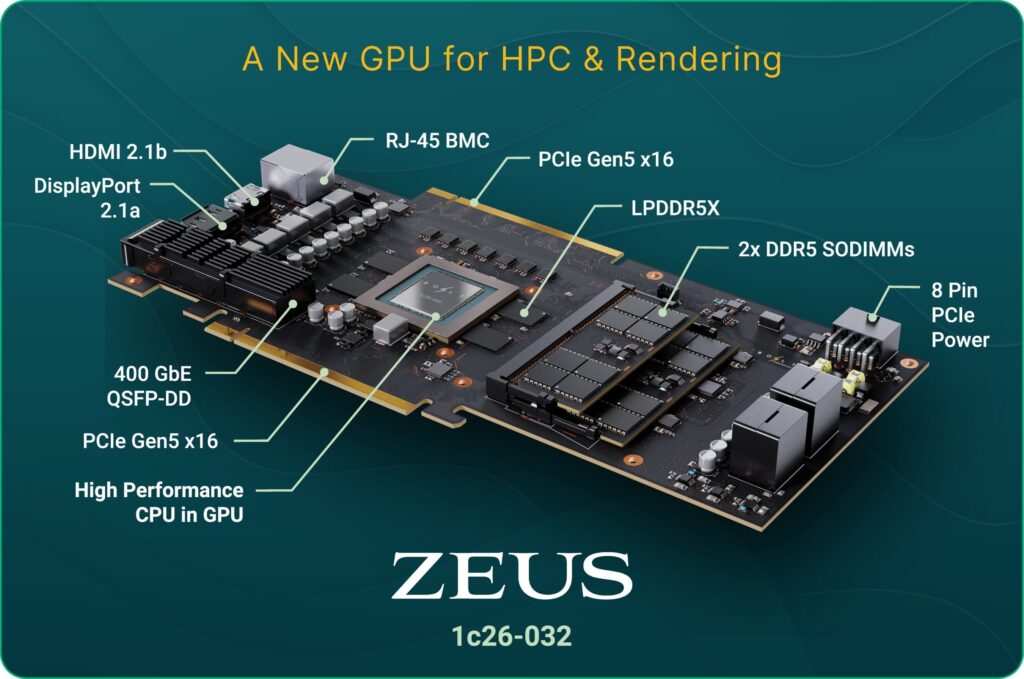
The American startup Bolt Graphics has announced that it has completed the tape-out of its test chip for Zeus, the graphics platform through which it aims to enter the high-performance computing, rendering, and other next-generation intensive workloads markets. The company presents this milestone as a decisive step prior to manufacturing and aims for Zeus to enter production in the fourth quarter of 2027.
The announcement comes with an ambitious promise: to reduce the total computing cost by 17 times compared to established architectures. This claim, at least for now, is from the company itself and has yet to be validated publicly and independently on a large scale. However, it helps to understand Bolt Graphics’ positioning: not as another competitor pursuing maximum raw performance, but as an alternative focused on performance per dollar and the overall system’s economic efficiency.
Zeus is not envisioned as an immediate consumer product nor as a direct response to the traditional gaming market at this initial stage. According to information provided by the company, its first offerings will target HPC and rendering, two segments that Bolt Graphics estimates to be a potential market exceeding $55 billion. In these areas, which they highlight, more than 90% of current computation is still performed on CPUs. The company’s subsequent roadmap does include expansion into gaming and Artificial Intelligence as the platform scales.
Aiming to lower computing costs, not just increase speed
Bolt Graphics’ core thesis is that the current major bottleneck is not only performance but also the cost of operating infrastructure for simulation, real-time graphics, or AI. Therefore, they emphasize that Zeus has been designed with a different logic compared to many current accelerators: prioritizing system-level economic efficiency. The company asserts this strategy could enable workloads that are currently unfeasible due to cost, though this hypothesis will need validation once the product is commercial and benchmarked outside corporate environments.
Technically, Bolt Graphics explains that the test chip is built on the TSMC 12FFC node, a well-known and mature process. The scalable architecture of Zeus also considers advanced nodes, including 5 nanometers. This choice suggests a pragmatic approach: starting with a more established manufacturing process to validate the design, while leaving the door open for future, more advanced versions.
The company also notes that Zeus is not just an isolated GPU but a platform that combines its own architecture with a complete software stack to operate across various computing markets. This positions them not just as a chip vendor but as an integrated system provider—something increasingly common in a market where silicon alone no longer suffices to compete.
Rendering, path tracing, and a domain where they want to stand out
One of the most prominent aspects of Bolt Graphics’ discourse remains their focus on path tracing and accelerated rendering. In the announcement, Ian Cutress from More Than Moore notes that shifting from rasterized pipelines to hardware-accelerated path tracing at scale is “not easy,” and that this test chip represents an initial step toward more cost-effective graphics acceleration for modern workloads. While favorable, this quote is part of the company’s promotional material, so it should be viewed as contextual support rather than a definitive market verdict.
On their website, Bolt Graphics describes itself as a developer of a graphics processor designed for creatives, researchers, and users needing high-performance rendering and simulation with lower energy consumption. They also emphasize sectors like film & television, HPC, architecture, and design—reinforcing their focus on professional markets before entering mainstream consumer segments.
The company further states that it has already gained meaningful initial traction even before production, citing a product pipeline exceeding $500 million and more than 14,000 members in its early access program, including companies, developers, and end-users. These figures are provided by Bolt Graphics and should be regarded as preliminary commercial indicators rather than confirmed revenues or orders.
A long timeline but a notable signal
Beyond promotional figures, reaching tape-out is a significant milestone because it indicates Zeus has passed a critical development phase and is entering an era where the gap between promise and product will begin to be measured. However, the timeline remains lengthy: Bolt Graphics does not expect production until late 2027, so there are still tests, validation, mass production, software development, and commercial deployment ahead.
In other words, there is not yet a revolutionary new GPU on the market. What exists is a startup attempting to carve out a niche with a different narrative: less obsessing over peak performance and more focusing on total cost of computation. If Zeus manages to materialize even a significant part of its promises, Bolt Graphics could emerge as one of those companies worth watching in the professional space. Otherwise, it might be just another attempt to break into one of the most challenging segments of the tech industry.
via: prnewswire
