
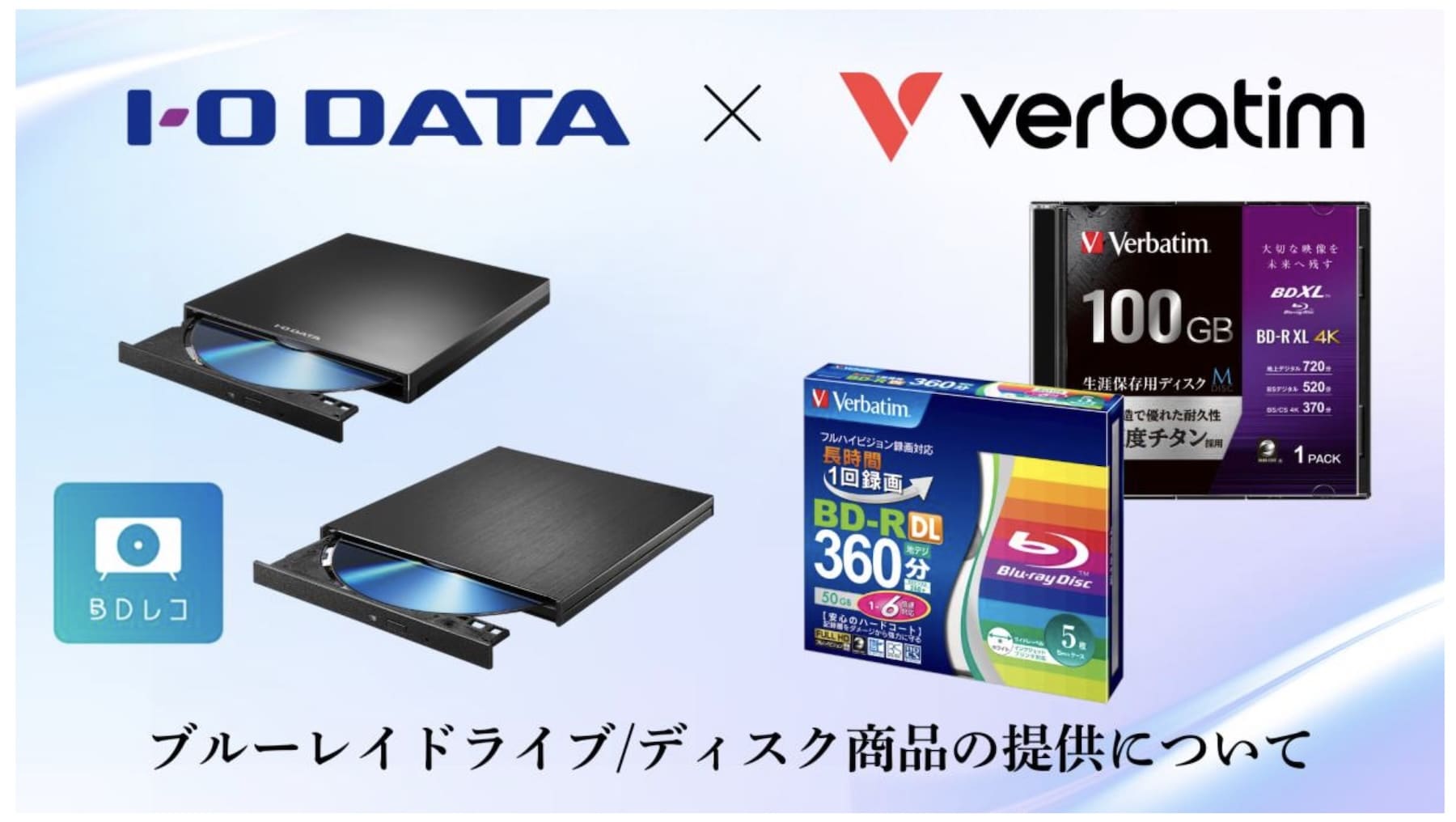
When almost the entire market considers Blu-ray data storage obsolete, two Japanese companies have decided to go against the trend. I-O Data and Verbatim Japan have announced they are strengthening their partnership to continue providing Blu-ray units and recordable discs in the Japanese market, aiming to ensure that users still relying on this format can continue recording, archiving, and reproducing content with some peace of mind. This decision comes at a time when several historic manufacturers are abandoning this business, and the real bottleneck is no longer just discs but also the hardware needed to read and record them.
The move carries more depth than it appears. It’s not about a comeback of Blu-ray for mass consumption nor a resurrection of the format in the streaming era. What I-O Data and Verbatim are saying is more concrete: there remains a real customer base in Japan that still needs physical support for backup copies, long-term data preservation, and certain professional uses. In their official statement, both companies speak about maintaining a stable environment for customers who require Blu-ray products, reinforcing component supply, and continuing to develop new products tailored to this residual demand.
A small market, but not dead
This nuance is important. Blu-ray is no longer a mass-market technology, but it has not disappeared entirely. The Japan Electronics and Information Technology Industries Association (JEITA) projects domestic shipments of Blu-ray recorders to reach 623,000 units in 2025, a figure that shows a clear decline compared to the era of the format’s peak, yet also demonstrates that a sufficiently relevant market persists for some companies not to want to abandon it completely.
Official data do not support a nostalgic fantasy nor the idea of an immediate death. The segment survives because it addresses very specific needs that other media cannot fully replace for certain user profiles. In Japan, where recording television broadcasts on physical media has historically been more prevalent than in other markets, there is still an audience that sees value in storing content, documentation, and local copies outside the cloud.
Table of actual market data and Blu-ray retreat in Japan
| Data | Figure or measure | Source |
|---|---|---|
| Domestic shipments of Blu-ray recorders in Japan in 2025 | 623,000 units | JEITA |
| Sony’s end of production for recordable Blu-ray discs | February 2025 | Sony |
| Sony’s cessation of all Blu-ray recorder shipments | From February 2026, no successor | Sony |
| End of sales for Buffalo Blu-ray units | July 2026 (planned) | Buffalo |
| End of sales for current external Elecom Blu-ray units | Until stock runs out / June 30, 2026, for announced models | Elecom |
| Increased production of Panasonic DMR-ZR1 | Yes, due to higher-than-expected demand | Panasonic |
These figures come from official statements from JEITA, Sony, Buffalo, Elecom, Panasonic, and I-O Data.
The problem is no longer just discs but who manufactures readers and recorders
The decision by I-O Data and Verbatim becomes even more relevant in context. Sony announced in January 2025 that it would cease production of all its Blu-ray recordable discs, along with other physical recording formats. A year later, in February 2026, it also announced the end of all Blu-ray recorder shipments, clarifying that there would be no successor models.
Other players have joined this retreat. Buffalo announced on February 26, 2026 that it will stop selling its Blu-ray units in July 2026, also without successors. Elecom, in turn, announced on March 17, 2026 that it will end sales of several of its external Blu-ray model units as stock runs out, setting June 30, 2026 as the closing date for affected products.
This significantly alters market perspective. Until now, the survival debate focused heavily on recordable discs. But the real challenge is now hardware. It’s of little use that discs remain available if readers, recorders, or sufficient components to sustain the ecosystem are scarce. That’s why the announcement from I-O Data and Verbatim carries more weight than it seems: they’re not just talking about continuing to sell discs, but also about supporting units and related products so the format doesn’t collapse due to lack of equipment.
Panasonic is almost alone on the domestic recorder side
Meanwhile, Panasonic has become one of the last major Japanese companies still supporting this category of recorders. The case of the DMR-ZR1 has been particularly revealing. The company itself released on March 6, 2026 a notice and apology to customers, acknowledging that this model received a volume of orders significantly above expectations, forcing them to boost production and warn of possible delivery delays.
This detail helps explain why I-O Data and Verbatim still see potential in this niche. When multiple competitors withdraw simultaneously, the remaining demand doesn’t disappear instantly; it concentrates. And that can make viable niches that, from outside, might seem doomed. It’s not a Blu-ray renaissance, but a sign that the technology still serves specific purposes for local archiving, backups, and content preservation in certain environments.
Ultimately, Blu-ray will not regain the prominent role it held a decade ago, but Japan continues to demonstrate that physical formats don’t vanish solely because newer technology arrives. Sometimes they persist because they solve very specific problems. As long as users need to record, store, and reproduce data locally for years, there will always be someone willing to fill the gap left when giants exit the market.
Frequently Asked Questions
Will Verbatim and I-O Data continue manufacturing Blu-ray in Japan?
They have confirmed they will strengthen their collaboration to keep offering Blu-ray discs and units to customers in Japan. They haven’t mentioned a widespread market expansion, but rather ensuring supply continuity.
Has Sony abandoned Blu-ray?
Yes, at least in two key areas. Sony announced the end of production for its recordable Blu-ray discs in February 2025, and later confirmed the conclusion of its Blu-ray recorder shipments from February 2026, with no successor models.
Is there still a market for Blu-ray recorders in Japan?
Yes, though much smaller than before. JEITA recorded 623,000 units shipped in 2025, confirming ongoing demand, albeit far from the format’s golden age.
Why is Blu-ray still useful for some people?
Because it’s still used for backup copies, long-term archiving, information preservation, and certain professional or domestic uses where local physical copies remain valuable. I-O Data and Verbatim explicitly mention these use cases in their official communication.
Source: IOdata