
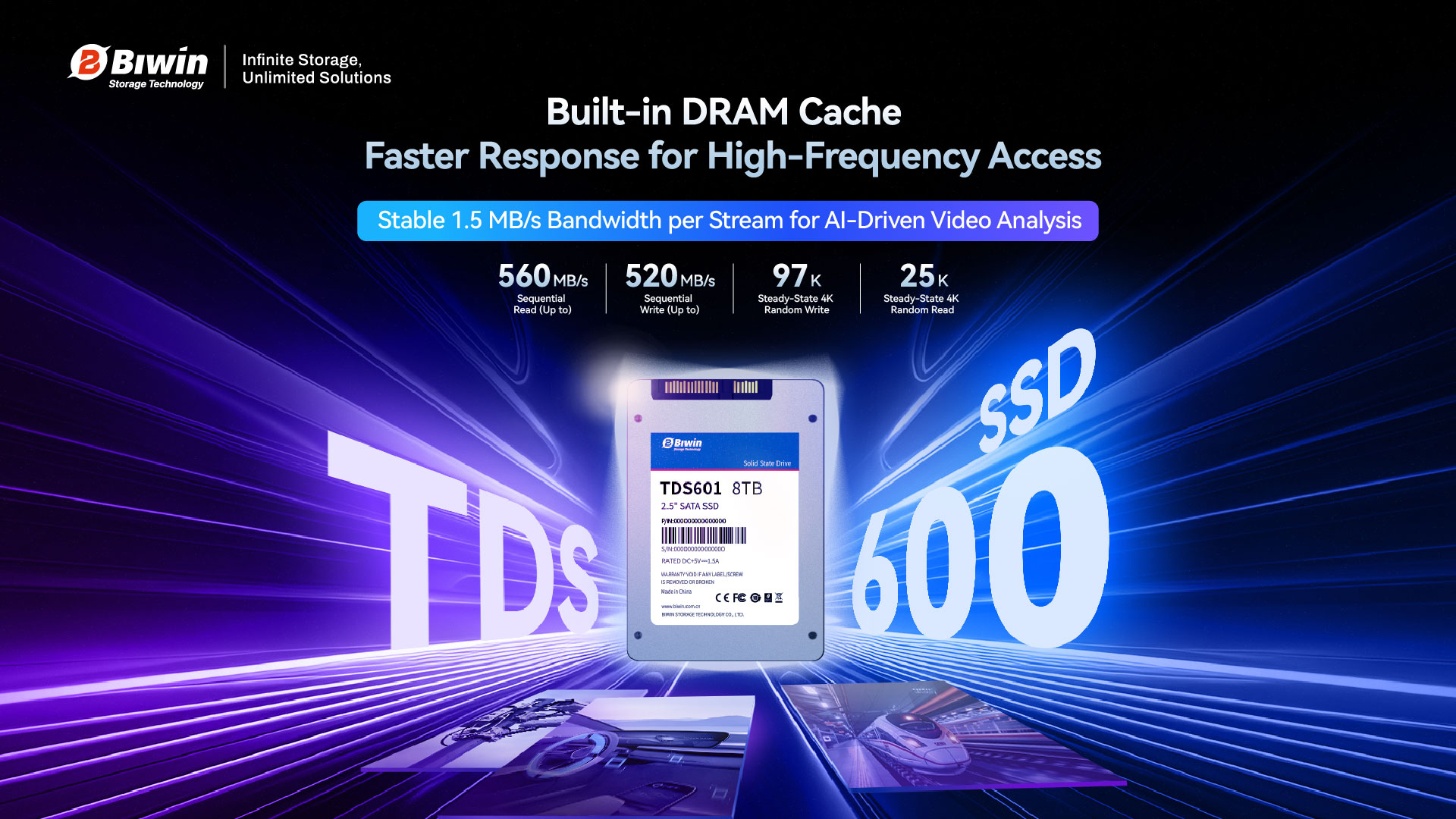
BIWIN has expanded its industrial storage catalog with a 2.5-inch SATA SSD up to 8 TB, aimed at surveillance systems, vehicle-installed recorders, rail transport, industrial servers, and video analysis via artificial intelligence. The manufacturer initially presented the product as TDS600, but its updated catalog now identifies it as TDS601, updating some of the specifications announced in May.
The key features of BIWIN’s industrial SSD in 20 seconds
- BIWIN has introduced an industrial SATA 3.2 SSD with capacities of 4 and 8 TB.
- Achieves 560 MB/s read and 520 MB/s sequential write speeds.
- Designed for continuous video surveillance, edge computing, and industrial servers.
- The current datasheet differs from the initial announcement in channels, IOPS, and power-loss protection.
The device isn’t designed to compete with NVMe units used for training large models or powering GPU clusters. Its focus is different: sustaining consistent writes, operating over long periods, and preserving data in environments where temperatures, vibrations, or power outages are more common than in typical computers.
The mention of AI also needs context. The SSD does not accelerate model inference by itself. Its role is to store videos, databases, logs, and caches used by analysis systems installed near cameras. In such deployments, a stable drive can be more useful than one with much higher maximum speeds but designed for consumer workloads.
SATA prioritizes compatibility and sustained writes
The TDS601 uses the SATA 3.2 interface at 6 Gbit/s. BIWIN states sequential speeds up to 560 MB/s read and 520 MB/s write, close to the typical practical maximum for this connection. SATA-IO specifies link speeds up to 6 Gbit/s for SATA 3.x revisions, so an SSD of this type cannot approach several gigabytes per second like modern PCIe drives.
This limitation does not make SATA a poor choice for video surveillance. Many DVRs, NVRs, industrial equipment, and embedded servers still use 2.5-inch SATA bays. Upgrading a drive doesn’t require changing the motherboard, controller, or entire system.
The current specifications highlight these features:
| Specification | BIWIN TDS601 |
|---|---|
| Form factor | 2.5-inch SATA |
| Capacities | 4 TB and 8 TB |
| NAND memory | 3D TLC |
| Sequential read | Up to 560 MB/s |
| Sequential write | Up to 520 MB/s |
| Random 4K read | Up to 97,000 IOPS |
| Random 4K write | Up to 20,000 IOPS |
| Operating temperature | −20°C to 75°C |
| Declared endurance | Up to 16,000 TBW |
| MTBF | Over 2.5 million hours |
| Warranty | Three years |
BIWIN uses 3D TLC memory with firmware that writes directly over TLC. It also states that the unit incorporates DRAM, though it doesn’t specify capacity. The company refers to “full-capacity DRAM cache,” but this does not imply several terabytes of volatile memory. The available documentation does not specify how the cache is dimensioned or how much is dedicated to address translation.
The manufacturer claims the SSD can sustain up to 24 video streams at 1.5 MB/s per channel, totaling 36 MB/s. This is well below the device’s maximum sequential performance, but continuous recordings require stable latencies, wear leveling, and recovery capabilities in case of power faults.
At that rate, 24 cameras would generate around 3.1 TB daily. An 8 TB unit could store approximately two and a half days of footage before considering reserved space, metadata, filesystem, and redundancy. Actual retention depends on resolution, codec, frames per second, scene movement, and compression settings.
The initial announcement of the TDS600 mentioned 32 channels at the same bandwidth, corresponding to about 4.15 TB per day. The updated TDS601 datasheet, as of 07/10/2026, reduces that to 24 channels. BIWIN does not clarify if the TDS601 replaces the TDS600, if it’s a commercial revision, or if both names refer to different variants.
Reported random write performance has also changed. The launch note mentioned up to 25,000 IOPS, while the current page limits this to 20,000 IOPS. For a system mainly recording sequential video, this reduction isn’t crucial, but it underscores the importance of verifying specifications based on the final part number, not just the initial announcement.
Data protection for outages and industrial environments
The main difference from a typical consumer SSD is in its data integrity features. BIWIN lists error correction in RAM, end-to-end protection, 4K LDPC codes, internal RAID-like redundancy, wear leveling, garbage collection, and periodic health checks.
End-to-end protection aims to detect errors during data transfer between the host, controller, cache, and NAND. LDPC codes can identify and correct certain read errors, while internal RAID can rebuild information if parts of the memory encounter issues.
The TDS601 also claims to include power-loss protection (PLP). This feature is critical for cameras in vehicles, electrical equipment, or remote systems where sudden power loss could leave data in caches or cause corruption.
Official documentation presents a contradiction here. The TDS600 press release and general TDS601 description mention hardware protection. However, the current model’s order code specifies firmware-based protection for capacities of 4 and 8 TB. These are not equivalent: hardware-based solutions often use capacitors to power the SSD temporarily during writes, providing more robust protection. Firmware-based protection may reduce damage but depends on design and does not necessarily offer the same coverage.
System integrators requiring protection against power outages should request the specific datasheet for the part number and verify which data is protected—only internal tables, already confirmed host writes, or also temporary data in DRAM.
The SSD supports operating temperatures from −20°C to 75°C, with storage temperatures extending from −40°C to 85°C. It does not reach the broader range of some industrial drives that operate down to −40°C, but it better covers challenging environments than typical commercial SSDs limited to around 0°C to 70°C.
BIWIN specifies 3,000 program/erase cycles and endurance of up to 16,000 TBW. This TBW indicates the total data volume that can be written over the device’s lifespan, not the usable capacity nor a guarantee that all devices will fail upon reaching that amount.
The mean time between failures (MTBF) exceeds 2.5 million hours, but this doesn’t mean a single unit will operate for centuries. It’s a statistical measure based on testing conditions. BIWIN notes this figure is derived from internal stress testing based on the Telcordia method.
Final specifications matter more than initial announcements
The TDS601 fits into a niche that doesn’t always receive as much attention as data center NVMe SSDs. Surveillance and industrial control systems require high capacities, long availability, and stable components to maintain deployment over years.
BIWIN claims control over the controller design, firmware, NAND selection, assembly, and testing. For OEMs, maintaining a stable configuration can be as critical as performance, since changing NAND or controllers may require re-validation of the entire system.
These claims are from the manufacturer and do not constitute an independent supply chain audit. BIWIN has not yet published pricing, regional availability, guaranteed supply periods, or detailed vibration and shock specifications.
Before choosing the drive for a project, it’s advisable to confirm at least:
- The exact relationship between TDS600 and TDS601 numbering.
- The type of power-loss protection.
- The TBW endurance for each capacity.
- The size of the DRAM and caching policies.
- Steady performance after full capacity utilization.
- Maximum latency and variation during prolonged writes.
- Power consumption during write, idle, and peak activity.
- The consistency of bill of materials throughout the project lifespan.
- The warranty conditions for continuous video surveillance loads.
The TDS601’s speed isn’t groundbreaking. Its main value lies in combining 8 TB, SATA compatibility, continuous writing, and data integrity features within a familiar format. For recorders in trains, vehicles, power grids, or edge computing racks, this balance might be more practical than adopting a PCIe NVMe SSD that would require redesigning hardware.
However, the difference between the initial announcement and the current datasheet suggests reviewing commercial documentation before finalizing a purchase. In industrial storage, changing channel count, 5,000 IOPS, or a different power protection mode is significant.
Frequently Asked Questions
What is the difference between BIWIN TDS600 and TDS601?
BIWIN announced the TDS600 in May, but its current catalog shows the TDS601 with similar features. The company has not clarified publicly whether this is a name change, a revision, or a different model.
Why use SATA instead of NVMe?
SATA offers lower speed but maintains broad compatibility with existing recorders, servers, and industrial equipment. For video recording, the stability of continuous writing can be more important than maximum throughput.
How many cameras can one drive record?
The initial release mentioned 32 streams at 1.5 MB/s, but the updated TDS601 datasheet reduces this to 24 streams. This latest figure should be used to size systems more conservatively.
Does the SSD protect data if power is lost?
BIWIN states it offers power-loss protection, but official documentation is inconsistent on whether it relies on hardware or firmware. Buyers should verify this feature for their specific part number.
via: biwintechnology
