
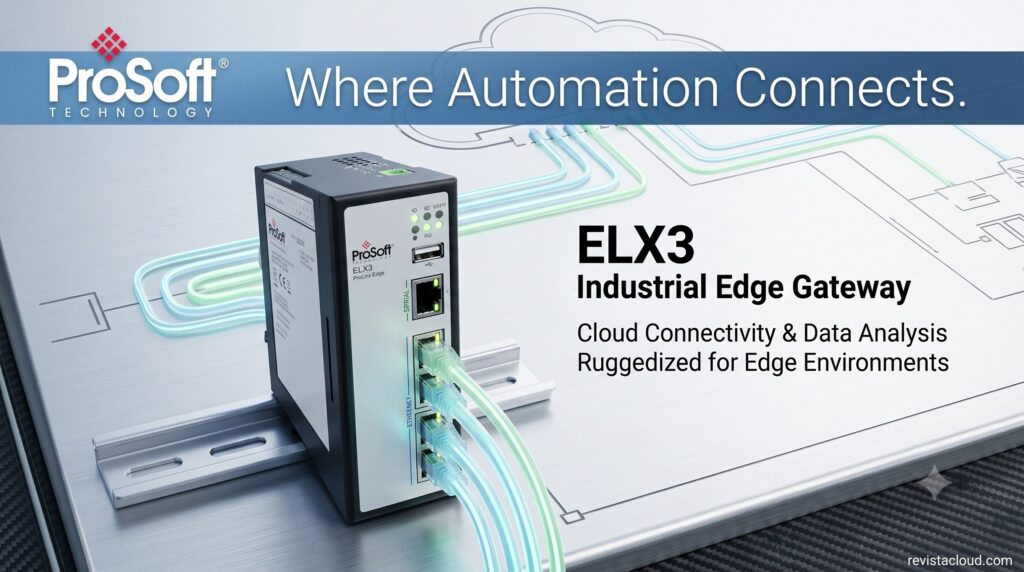
Belden has introduced the ProSoft Technology ELX3 ProLinx Edge Gateway, an industrial device that combines OT protocol conversion with containerized application execution using Docker. Its goal is to bring small loads of analysis, integration, and artificial intelligence directly to the machine, without relying on an external server for each operation.
The device can exchange data between EtherNet/IP and Modbus TCP/IP equipment while running user-defined containers. Belden targets applications such as data acquisition, predictive maintenance, digital twin connectivity, asset monitoring, and near-real-time analysis in factories, warehouses, energy facilities, and other demanding environments.
Key features of the ProLinx Edge ELX3 in 20 seconds
- Combines an industrial protocol gateway and edge computing.
- Translates communications between EtherNet/IP and Modbus TCP/IP.
- Enables running custom applications via Docker containers.
- Powered by a quad-core ARM Cortex-A53 processor at 1.6 GHz.
- Has 4 GB of LPDDR4 RAM and 64 GB of eMMC storage.
- Includes four Gigabit Ethernet ports and one USB 2.0 port.
- Mounts on a DIN rail and supports redundant 12–24 V power input.
- Maximum power consumption is 12 watts.
- Operates between -40°C and 70°C, with Class I, Division 2 certification.
- Designed for lightweight inference and local analysis, not for running large AI models.
This launch reflects a clear trend in industrial automation: gateways are evolving from simple protocol translators to compact computing nodes. The same device that collects data from a PLC can clean, analyze, detect anomalies, and send only the necessary information to the cloud.
An OT gateway that also runs containers
Industrial plants often have equipment from various manufacturers and generations. A PLC may communicate via EtherNet/IP, while a meter, drive, or remote unit uses Modbus TCP/IP. To exchange data, a gateway capable of interpreting both protocols is required.
The ELX3 maintains traditional functionality through the ProSoft container ELX-EIP-MBTCP, certified by ODVA for EtherNet/IP. The innovation lies in the hardware’s ability to run multiple user-defined Docker containers simultaneously.
This setup allows deploying code without converting each change into a dedicated firmware project. An integrator could install an agent to send data to a digital twin platform, an application to calculate machine KPIs, or a service to normalize labels from multiple devices.
Local rules can also be implemented—if, for example, motor vibration exceeds a threshold, the gateway can trigger an alert before sending data to the central system. Decisions are made close to the machine, reducing dependence on a connection to data centers or the cloud.
Using containers adds a reasonable separation between applications. The protocol converter can operate in a container managed by ProSoft, while the customer installs their own services in other containers. This model simplifies updating individual applications without replacing the entire device image.
| Function | ELX3 Role |
|---|---|
| OT conversion | Communication between EtherNet/IP and Modbus TCP/IP |
| Data acquisition | Reading variables from PLCs, sensors, and other equipment |
| Local processing | Filtering, aggregation, and transformation of data |
| Analytics | Rules, basic anomaly detection, and KPI calculations |
| Digital twin | Running agents to synchronize physical assets |
| Predictive maintenance | Signal analysis and alert generation |
| IT integration | Sending data to central systems or cloud platforms |
| Custom applications | Deploying code via Docker containers |
Belden plans to expand the platform with new protocol containers. This approach can help prevent the need to replace hardware when connecting different equipment types, although the actual utility will depend on the protocol catalog that ProSoft maintains over the product’s lifespan.
What can you really do with AI?
Commercial messaging mentions the ability to run compact inference models. It’s important to assess the hardware to understand this capability.
The ELX3 features an NXP i.MX 8M Mini with four ARM Cortex-A53 cores at 1.6 GHz, 4 GB of LPDDR4 RAM, and 64 GB of eMMC storage—approximately 15 GB of which is available to the user. The datasheet does not indicate the presence of a general-purpose GPU, NPU, or dedicated AI accelerator.
Therefore, it’s not designed for training models or running large generative systems. Its domain is small algorithms that can run on a CPU with limited memory: signal classification, anomaly detection, statistical models, decision trees, or small pre-trained neural networks.
A reasonable example might be analyzing temperature, pressure, and vibration data to estimate if a machine is deviating from normal behavior. Another could be classifying operational states based on a few PLC variables.
Advanced visual inference is less clear. The device could process low-frequency images or run very simplified models, but its specs do not put it in the same category as industrial computers with GPUs, Nvidia Jetson modules, or edge servers for artificial vision.
This limitation doesn’t necessarily diminish its value. Many industrial processes don’t require large models. A well-constructed rule or lightweight algorithm can deliver sufficient responses with low power consumption and without continuously transmitting all data off-site.
Local processing offers other benefits: reducing traffic to central systems, maintaining operation during connectivity loss, and preventing each sample from leaving the OT network. It can also improve response times when actions must be taken in seconds or milliseconds, although Belden has not published specific latency figures for containerized loads.
Hardware suited for electrical panels and demanding zones
Measuring 48 × 137 × 105 millimeters and weighing 613 grams, the device features an aluminum enclosure with 35mm DIN rail mounting. It includes four RJ45 Gigabit Ethernet ports and one USB 2.0 port.
Power input supports two redundant sources from 12 to 24 V DC. The maximum power consumption is rated at 12 watts—relatively modest compared to a typical industrial PC and suitable for distributed installations with multiple devices per cabinet.
The ELX3 is rated for operation between -40°C and 70°C, with a relative humidity range of 5% to 95% non-condensing, and a mean time between failures (MTBF) of approximately 387,288 hours at 25°C. Its IP30 protection level prevents direct access to certain parts but does not make it sealed against dust or water—installation inside an appropriate cabinet is typically recommended.
Class I, Division 2 certification allows for use in zones with potentially flammable gases or vapors under abnormal conditions. Final certification adherence depends on the specific requirements, cabinet design, and applicable standards.
A local web interface supports configuration, diagnostics, and maintenance. Supported services include HTTPS, SNMPv3, NTP, DNS, DHCP, and other common network gateway functions.
Docker in OT enhances flexibility but introduces new responsibilities
Running custom code brings a gateway closer to IT-style operational models. Devices can package applications with dependencies, test them in compatible environments, and deploy as containers.
However, this increases the attack surface. A traditional gateway runs a fixed set of functions, while a container host can host images from multiple providers, third-party libraries, and network services.
Security management over time is crucial: hardware must support Docker, but organizations need controls over image deployment, registry sources, permissions, and vulnerability patching.
In OT environments, use minimal images, pin versions, verify provenance, and avoid containers with unnecessary privileges. Limiting CPU, memory, and storage prevents a container from exhausting resources or impacting protocol conversion.
Network segmentation remains vital. Ethernet ports enable connection separation, but the architecture must prevent analytical containers from becoming uncontrolled bridges between automation networks and corporate systems.
The product datasheet does not detail aspects like image signing, secure boot, storage encryption, secret management, or update schedules—these are questions a technical manager should review carefully before deploying in sensitive processes.
Container resource limits should be understood: the 4 GB of RAM is shared between the OS, protocol gateway, and customer applications. Approximately 15 GB of available storage constrains the number of images, logs, and temporary data stored locally.
A middle ground between gateway and industrial PC
The ProLinx Edge ELX3 offers an intermediate solution. It maintains the simplicity and form factor of an OT gateway but includes enough capacity to run services that previously needed an additional computer.
This combination can reduce the number of devices inside control cabinets and simplify some machine-to-platform connection projects—one device translating protocols, preparing data, and executing local logic.
It will not replace an edge server requiring multiple VMs, heavy storage, artificial vision, or complex models. Nor does it substitute a PLC as a deterministic process controller or safety system.
Its utility lies in limited tasks: collecting data from legacy equipment, adding analysis layers near the machine, and connecting automation with modern applications without redesigning entire systems.
Belden’s approach reflects a convergence of OT and IT, while avoiding turning each industrial cabinet into a mini data center. The proposal is modest: run necessary software locally at data sources, keeping consumption, size, and industrial robustness in check.
Frequently Asked Questions
What protocols does the ProLinx Edge ELX3 convert?
Initially, it uses a ProSoft container to exchange data between EtherNet/IP and Modbus TCP/IP.
Can it run custom applications?
Yes. The device supports user-defined Docker containers within available CPU, memory, and storage limits.
Is it suitable for running generative AI models?
Not intended for that purpose. It’s geared toward small inference models and CPU-based analytics—not training or large generative models.
Can it be deployed outdoors?
Its IP30 rated enclosure typically requires an appropriate cabinet. It’s rated for -40°C to 70°C and suitable for certain Zone 1/Division 2 locations.
via: belden
