
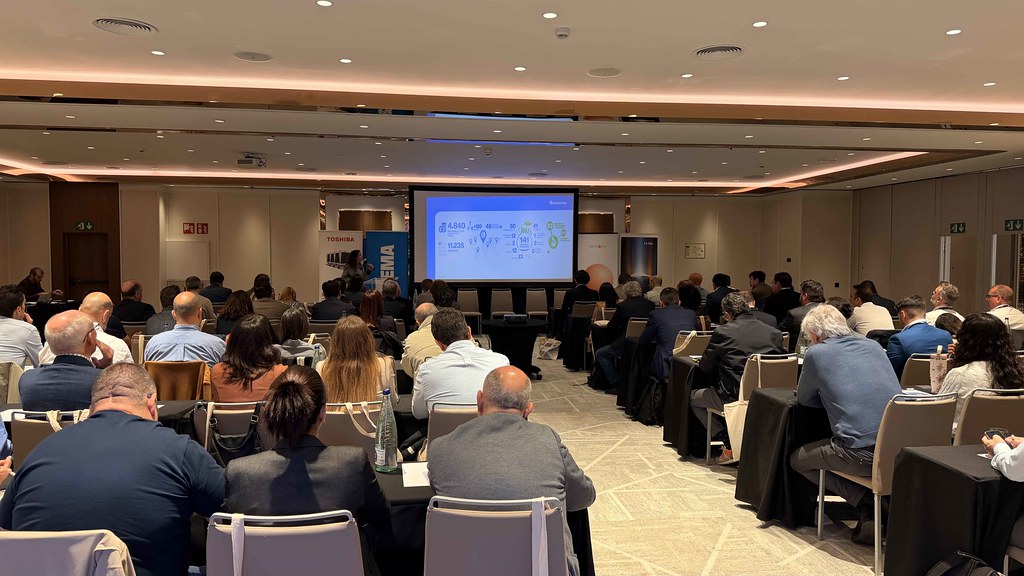
Barcelona once again brought together the data center industry for an event marked by a common idea: the Catalan capital is no longer just an alternative to Madrid, but a hub with its own reasons to attract digital projects, industrial investment, and critical new capacity for the data economy. The second edition of Construction Data Centers – Barcelona, organized by Grupo Vía on May 6, 2026, at the InterContinental Barcelona by IHG, gathered over 100 professionals and featured representatives from ADAM, Torrella, Socotec, Oxigen Data Center, Vopi 4, Inserty Tech Solutions, and PGI Data Centers.
The event comes at a time of strong activity in the sector. The demand for cloud services, artificial intelligence, connectivity, edge computing, and digital services has positioned data centers at the heart of real estate, energy, and industrial planning. In Catalonia, the discussion no longer revolves solely around megawatts announced but extends to how they are built, where they are located, their electrical consumption, territorial impact, and the potential role of Barcelona within the European digital map.
More investment, greater capacity, and increased pressure on the territory
The data managed by the sector helps understand the scale of this phenomenon. Grupo Vía reports that total investment in Catalan data centers exceeded €7 billion in 2025, according to a report by Digital Realty and DE-CIX. It also cites figures from Spain DC indicating that direct investment in Catalonia’s data centers reached €1.32 billion, with indirect investment at €2.2 billion. The projection included in the program suggests that installed capacity in Barcelona will grow by 52%, reaching 124 MW by 2026.
Recent reports push these ambitions even higher. The study “Barcelona, Digital Port of the Mediterranean,” produced by Foundry for Digital Realty and DE-CIX with support from the Barcelona Chamber of Commerce, estimated that installed capacity around Barcelona could increase from 49 MW to 173 MW by 2025, with planned investments of €1,047 million and an economic impact exceeding €7 billion.
Figures vary depending on methodology, geographic perimeter, and project phase, but all point in the same direction: Barcelona has moved from a secondary market in data center discussions. Its strategic location, international connectivity, vibrant business ecosystem, proximity to technological talent, and the role of its port and telecom networks are reinforcing its appeal as a digital hub of Southern Europe.
The Generalitat has also heightened its institutional stance. According to reports published in March 2026, Catalonia is working to facilitate the installation of 26 new data centers considered strategic or of higher general interest, with projects totaling over 2,000 MW of capacity. The autonomous government has proposed support through permits, supplies, and urban planning adjustments, though these plans have sparked debates over energy consumption, water use, and social impact.
Construction becomes more complex
Grupo Vía’s event highlighted a less visible but critical part of this boom: construction. Building a data center involves more than land and electrical power; it requires engineering, specialized architecture, climate control systems, fire protection, electrical redundancy, technical floors, efficient enclosures, physical security, commissioning, industrial suppliers, and very precise coordination among developers, operators, builders, and clients.
This is why the diversity of profiles present at the event is significant. ADAM provided the operator perspective with experience in digital infrastructure in Barcelona. Torrella and Socotec represented technical and engineering dimensions. Oxigen Data Center, Vopi 4, Inserty, and PGI Data Centers painted a broader picture of the market—covering development, construction, operation, and associated services. Sponsors like Tarkett, Soprema, Toshiba, and Zumtobel also illustrate how the sector pulls in material producers, energy specialists, lighting, insulation, climate control, and solutions for critical buildings.
One of the major tensions is the pressure to shorten construction timelines. Clients demand capacity availability quickly, but data center projects still depend on permits, energy access, network connections, land availability, and industrial supply chains. Artificial intelligence has added urgency: training and inference loads drive up power demand, rack density, and advanced cooling needs, all while operators strive to maintain energy efficiency and sustainability commitments.
Barcelona has a clear advantage in connectivity and demand, but also faces common urban challenges: high land costs, competition for industrial use, neighborhood opposition, environmental restrictions, and the need to coordinate with overburdened electrical networks. Achieving a balance will be decisive. A digital hub is not built solely through investment announcements; it requires reliable energy, streamlined permitting, legal certainty, talent, and social acceptance.
Barcelona versus Madrid-Aragón axis
Spain is experiencing a notable expansion of its data center sector. Spain DC estimates that investments in the country’s data centers could reach around €66.9 billion by 2030, driven by AI, digitalization, and cloud services. The report cited by Cinco Días indicates that installed power in Spain was 439 MW in 2025—up 24% from 2024—and could reach 2,537 MW by 2030. Madrid remains the main node, while Barcelona, Aragón, and the Valencian Community strengthen their roles as strategic hubs.
In this context, Barcelona needs to differentiate itself. Madrid dominates much of the market due to its financial, business, and connectivity advantages. Aragón has gained prominence thanks to land availability, energy, and large-scale hyper-scale projects. Barcelona can leverage its Mediterranean position, technological ecosystem, dense cable and connectivity network, and its ability to attract hybrid projects involving cloud, interconnection, edge, and enterprise services.
The challenge is to prevent growth from being measured only in megawatts. Data centers generate direct and indirect employment, investment, and local supply chain demand, but also consume energy, require water in certain cooling models, and compete for industrial land. The sector’s evolving conversation must go beyond announcing new projects; it should focus on efficiency, heat reuse, renewable energy, certifications, urban integration, electrical planning, and transparency with local territories.
The second edition of Grupo Vía’s forum in Barcelona arrives at a stage where the market is shifting from expectation to realization. Projects need to be built, connected, certified, and operated. It’s in this phase that Barcelona’s potential as a Mediterranean digital hub will be confirmed—or hindered by bottlenecks.
For the real estate, construction, and engineering sectors, data centers represent a clear opportunity. For authorities, they are a test of coordination. For the public, they prompt a debate about the infrastructure needed for an increasingly digital economy. Barcelona is already part of this race. Now it must prove that it can grow thoughtfully and sustainably, not just quickly.
Frequently Asked Questions
What data center event was held in Barcelona?
Grupo Vía organized the second edition of Construction Data Centers – Barcelona on May 6, 2026, with over 100 professionals and speakers from companies like ADAM, Torrella, Socotec, Oxigen Data Center, Vopi 4, Inserty, and PGI Data Centers.
Why is Barcelona attracting data center projects?
Because of its connectivity, Mediterranean location, tech ecosystem, business demand, and capacity to serve as a digital node in southern Europe.
How much investment is expected in Catalonia’s data centers?
Estimates vary; Grupo Vía reports impacts exceeding €7 billion in 2025, while Spain DC indicates direct investment of €1.32 billion and indirect at €2.2 billion.
What are the main challenges for data center growth in Barcelona?
Key challenges include energy access, permitting processes, land availability, energy efficiency, water use in certain cooling methods, sustainability, and social acceptance.
