
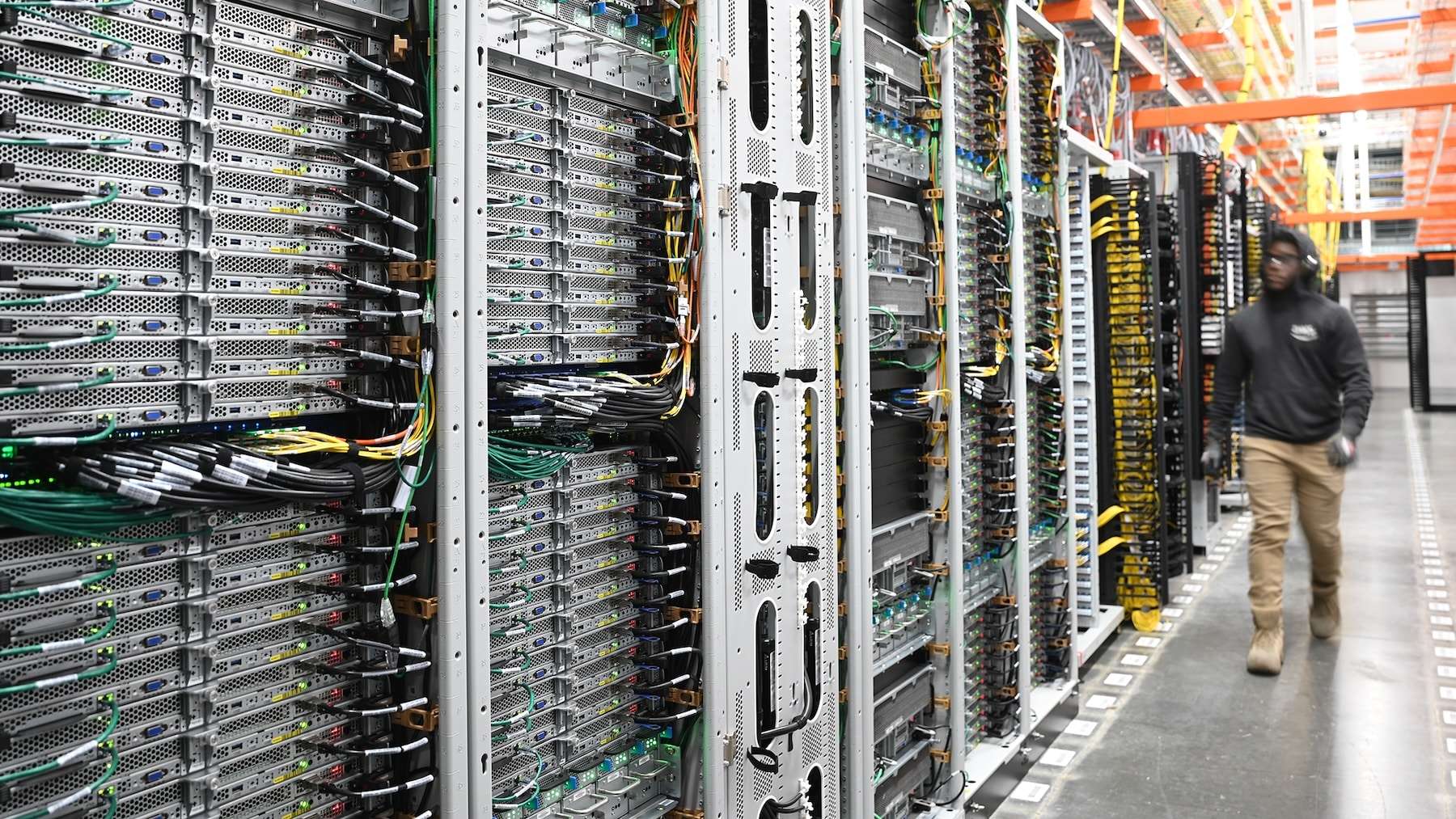
Aragon has been steadily establishing itself as one of the most sought-after hubs for hyperscale cloud providers. The combination of available land, connectivity, a growing industrial ecosystem, and above all, access to large-scale energy has turned the region into an attractive location for critical infrastructure. In this context, Amazon Web Services (AWS) has been strengthening its presence through a multi-billion dollar investment plan and a promise to expand capacity further to meet European demand for cloud services and Artificial Intelligence.
The latest development is geographic… and symbolic: La Puebla de Híjar (Teruel) is emerging as the next major site within this expansion. According to information leaked by Spanish media, the company is working with a purchase option over approximately 70 hectares near the N-232 highway, in the vicinity of the Venta del Barro industrial park, and would have guaranteed 100 MW of electrical power, with plans to begin construction in fall 2027. The site is also envisioned as a complex geared toward intensive workloads—those typically associated with the new wave of generative AI and massive data analysis—and would be the first AWS data center in Teruel province.
Why Teruel Matters (More Than It Seems)
The choice of Teruel isn’t just seen as a “decentralization” of investment. It has an underlying message: the map of data centers no longer centers exclusively around major capital cities, but around three key factors: energy, land, and growth capacity.
In recent years, pressure on the electric grid—and on connection permits—has become one of the main bottlenecks for establishing new digital campuses. It’s no coincidence that, while projects in more saturated environments face friction, municipalities capable of offering more straightforward technical integration are becoming more attractive. In La Puebla de Híjar’s case, the appeal lies in their availability of large contiguous plots and good logistical accessibility—critical factors when envisioning a data center as a large-scale industrial project.
100 MW: What It Means in Practice
When we talk about 100 MW, it’s not just describing a “bigger” building—it’s about power capacity to operate 24/7 computing equipment, networks, and cooling systems. Simply put, this figure indicates the maximum (or significant portion) of what the center can sustainively power at any given time.
In an era where the market favors denser racks, AI accelerators, and power consumption per rack far exceeds traditional IT, available power has become the true “square meter” metric of the sector. Land is important, but energy is paramount.
Aragon as a “Cloud Region”: The Full Picture
This initiative aligns with a clear trend: AWS has been betting on Aragón as a strategic hub for years. In 2024, Reuters reported AWS’s plan to invest €15.7 billion in data centers across the region until 2033. This represents a significant leap compared to previous plans and has been defended by the regional government as one of the key factors attracting technological investment to southern Europe.
The narrative isn’t based solely on announcements: outlets like El País have described how, since 2022, AWS has been deploying infrastructure in Aragón and linking its presence to training initiatives and the creation of a local ecosystem of providers and indirect employment.
The message is clear: Teruel will become part of an ongoing expansion, not as an isolated project, but as a key piece within a broader capacity strategy.
The Inevitable Tension: Opportunities, Dependency, and the “Country Cost”
Such a data center typically promises three things: investment, highly skilled jobs (though not necessarily large in number), and the attraction of tech companies. For a province historically impacted by depopulation and economic concentration elsewhere, simply entering the critical infrastructure circuit marks a change in status.
However, it also raises uncomfortable questions already discussed publicly: How is the real value shared between the territory and the multinational? What happens as competition for energy intensifies? How can growth be sustainable without conflicting with other industrial or social needs?
In the medium term, the battle for Spain’s (and Europe’s) digital competitiveness increasingly looks like this: who can ensure reliable energy, who can accelerate permitting without losing control, and who can build an attractive environment to retain talent. With this move, Teruel shifts from mere observer to active participant in this debate.
Frequently Asked Questions
Why does AWS choose locations like La Puebla de Híjar for large-scale data centers?
Because the key factors are usually the availability of electrical power, broad industrial land, and the ability to grow in phases without being constrained by urban saturation or network limitations.
What does having 100 MW of guaranteed power mean for a data center?
It means being able to continuously operate high-demand IT and cooling infrastructure, essential for cloud services and AI workloads that require enormous capacity.
Does a data center create many direct jobs locally?
In operation, direct employment is typically limited and highly specialized (operations, maintenance, security, networking). Most of the impact comes during construction, auxiliary services, and the surrounding ecosystem of suppliers and companies.
What are the implications of the center’s focus on AI workloads?
It may require higher power per rack, more demanding cooling designs, and stricter planning for energy and infrastructure since modern AI systems consume and generate more heat than traditional IT equipment.