
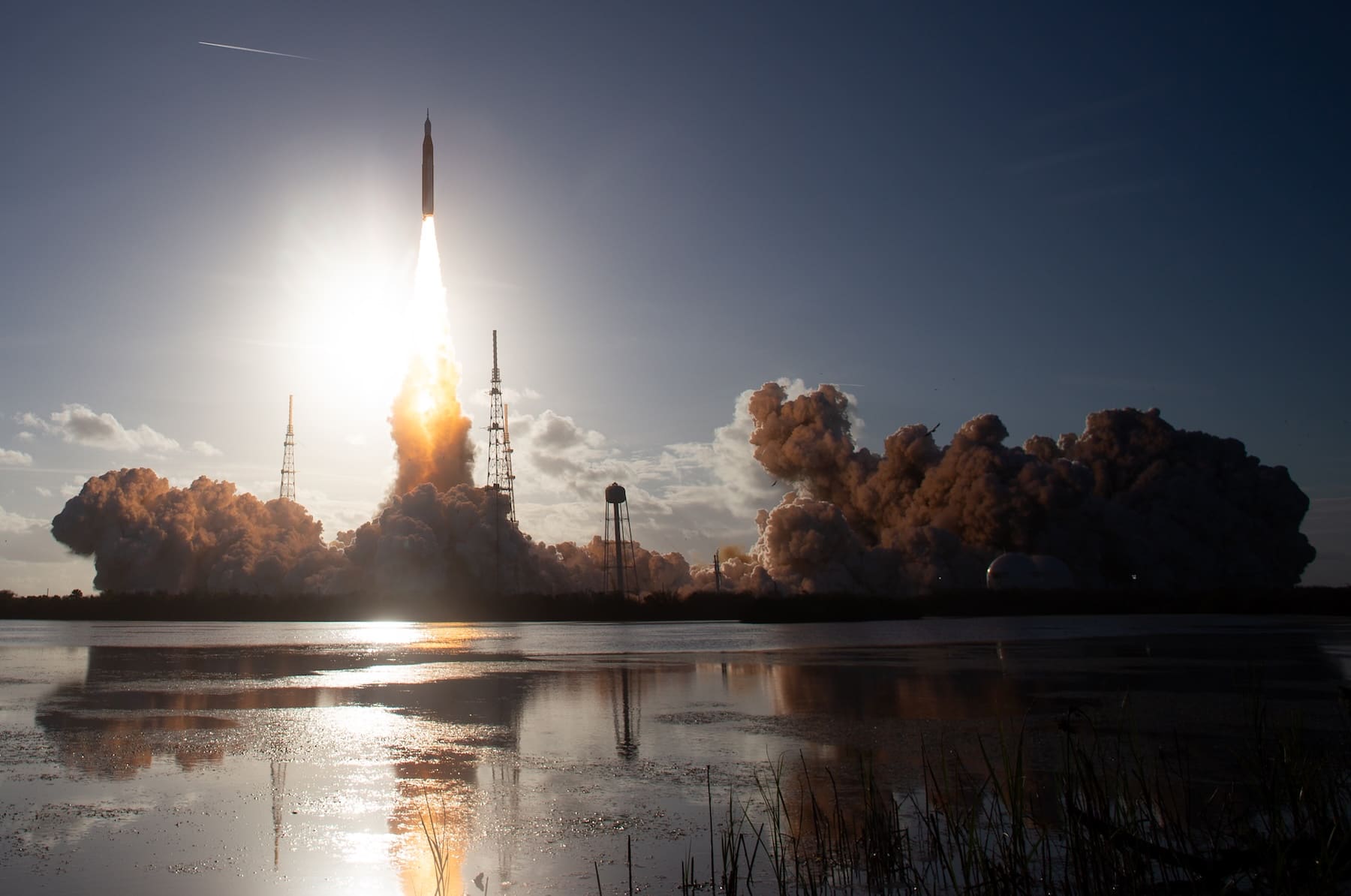
AT&T has announced that it is providing connectivity and technical support to NASA for the Artemis II mission, the first crewed flight of the Artemis program and the first Moon orbiting mission with astronauts since the Apollo era. According to NASA itself, Artemis II launched on April 1, 2026, has an expected duration of 10 days, and crew includes Reid Wiseman, Victor Glover, Christina Koch, and Jeremy Hansen.
The U.S. operator presents its role as a critical connectivity layer to keep control teams, NASA centers, and ground infrastructure aligned during the mission. AT&T explains that it has collaborated with NASA to understand its network needs, connect sites and stations worldwide, and deploy personnel in Dallas, Chantilly, and other international locations to monitor the service throughout the mission.
However, it’s important to clarify what that precisely entails. Direct communication with the Orion spacecraft when it leaves low Earth orbit does not depend on AT&T but on NASA’s own infrastructure. The official Artemis II press kit makes clear that the mission’s communications and navigation rely on the Near Space Network and, primarily, on the Deep Space Network, with antennas in California, Madrid, and Canberra. These are the systems that maintain the link with the spacecraft when it travels toward the Moon and orbits its far side.
This situates AT&T in a less visible but very important role: supporting the ground communications that enable the global operation of the mission. The company notes that it carried out pre-launch technical enhancements, specific testing, and coordination with several NASA facilities, including the Goddard Space Flight Center and the Kennedy Space Center, where it had on-site personnel deployed.
In parallel, FirstNet, the first responders’ network built by AT&T in the U.S., has taken on the safety and emergency component during the Florida launch. AT&T details that FirstNet worked with NASA Protective Services and Emergency Management Operations teams to ensure reliable communications in the large Kennedy Kennedy Space Center complex, as thousands gathered there for the launch.
To achieve this, FirstNet deployed part of its mobile network equipment fleet, including a SatCOLT (Satellite Cell on Light Truck) and a CRD (Compact Rapid Deployable). Additionally, the company supported the event with a LEO Cell Trailer from its commercial fleet to boost temporary capacity and reduce congestion, and improved indoor coverage at the Kennedy Space Center Visitor Complex using a Cell Booster Pro. A NDR Connect and Care Trailer was also positioned in the press area to provide device charging for attendees.
This strategic collaboration goes beyond simple sponsorship or occasional logistical support. AT&T is leveraging Artemis II as a showcase of its ability to operate resilient networks in high-demand environments, while FirstNet continues to expand its critical mission profile. It’s no coincidence that the operator also notes that FirstNet plans to begin beta testing satellite connectivity later this year with AST SpaceMobile and its BlueBird satellites, aimed at public safety services.
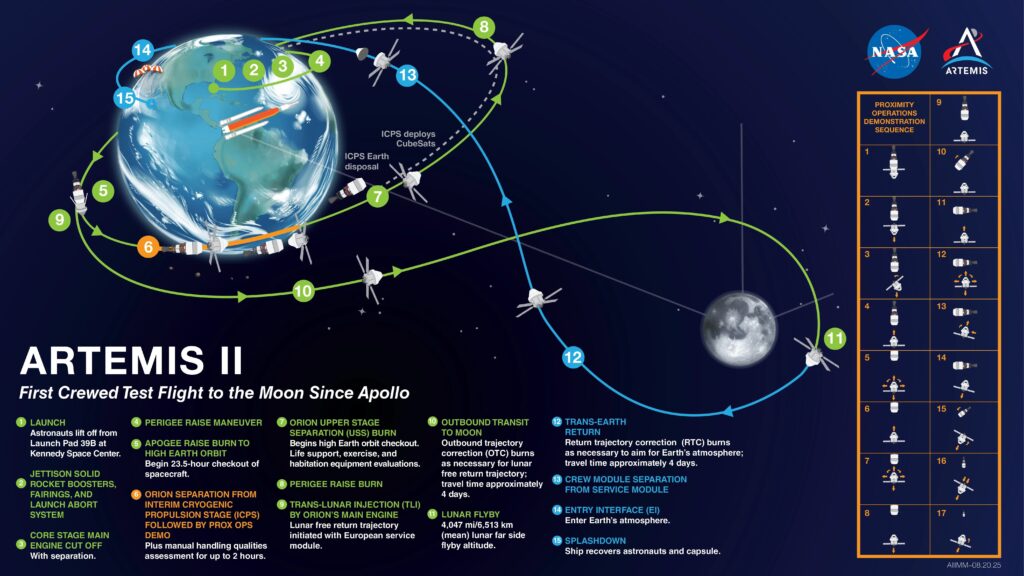
For NASA, the significance is also clear. Artemis II is not a landing mission, but a crucial test of all systems that will support Artemis III and subsequent phases of the program. The mission involves initial orbits around Earth, a translunar injection maneuver, a lunar flyby, and a return using a free return trajectory, with final splashdown in the Pacific. Throughout this journey, coordination between centers, networks, controllers, and ground links remains as critical as the space infrastructure itself.
In this context, AT&T’s announcement does not mean a commercial telecom carries the deep space communications for Artemis II, but it highlights an often-overlooked aspect: behind every major lunar mission, there is a vast terrestrial network of fiber, data centers, nodes, stations, emergency units, and support personnel without which the journey would be impossible. In this invisible network, AT&T and FirstNet want to affirm that they are also part of America’s return to the crewed Moon environment.
Frequently Asked Questions
Is AT&T the one directly communicating with the Orion spacecraft in deep space?
No. Communication with Orion when it heads toward the Moon relies on NASA’s infrastructure, especially the Deep Space Network. AT&T supports ground connectivity and the surrounding control centers and facilities.
What role does FirstNet play in Artemis II?
FirstNet primarily handles communication support for public safety and emergency response during the launch, especially at the Kennedy Space Center, through mobile network equipment and temporary coverage enhancements.
Will Artemis II land on the Moon?
No. NASA defines Artemis II as a crewed test flight around the Moon. The mission does not include lunar landing; its goal is to validate systems and operations for Artemis III and beyond.
When was Artemis II launched and how long will it last?
According to NASA’s official fact sheet, Artemis II launched on April 1, 2026, and is expected to last 10 days.