
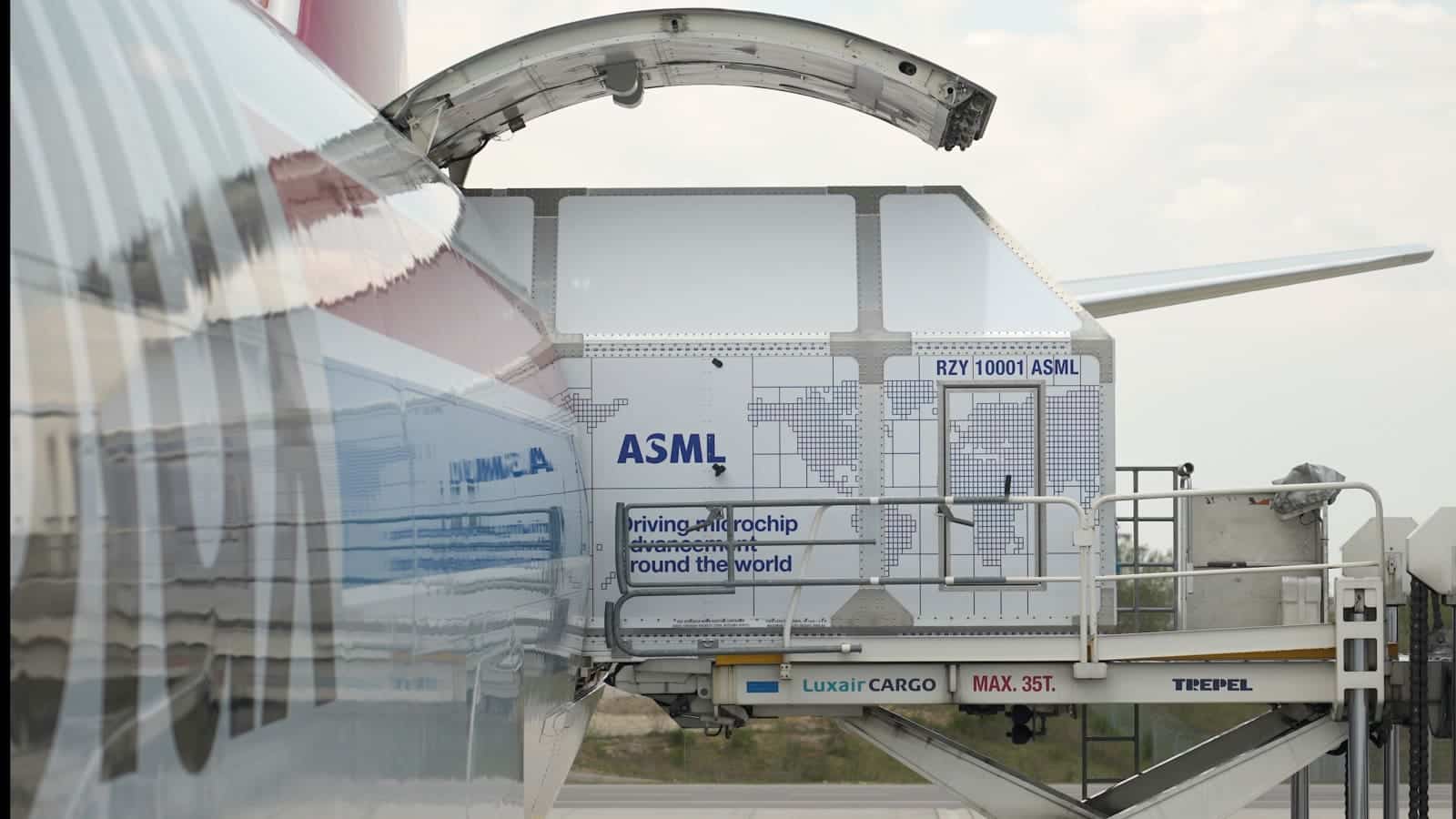
ASML, the Dutch giant that dominates the global market for lithography equipment used in chip manufacturing, is once again at the center of the technological tension between the West and China. A report by Dutch public television (Nieuwsuur) has revealed that among its clients in China is at least one company with ties to the People’s Liberation Army, as well as a leading institute in quantum technologies.
The company admits to selling machinery to several Chinese clients but claims that all shipments have been made in strict compliance with export control laws: either with explicit licenses or using equipment that was not subject to restrictions. However, the case reopens the debate over whether so-called “legacy technology”—the DUV systems, older than the more advanced EUV—can continue to bolster Beijing’s technological and military advancements.
Non-restricted DUV, but highly sensitive politically
According to Nieuwsuur, ASML has sold equipment and parts to a subsidiary of China Electronics Technology Group (CETC), a state conglomerate considered one of China’s major technology providers for the military. It has also supplied machinery to the Shenzhen International Quantum Academy and to manufacturers like SiEn (Qingdao) and SMBC, a subsidiary of the Chinese giant SMIC.
ASML responds that these are deep ultraviolet (DUV) lithography systems, not its extreme ultraviolet (EUV) machines, which are truly critical for leading-edge nodes (5 nm and below). These DUV systems are older and, in theory, do not enable the production of the “state-of-the-art” chips fueling cutting-edge AI today.
The problem is that, in practice, the lines between “old” and “new” are much less clear:
- With advanced immersion DUV, SMIC has already produced chips at 7 nm, partially bypassing international restrictions.
- For many military, 5G, edge computing, or embedded system applications, mature nodes (28 nm, 40 nm, etc.) remain more than sufficient.
- In quantum technologies, the key isn’t always the smallest node but the ability to reliably manufacture, iterate, and scale specialized designs.
In other words: although ASML isn’t shipping EUV to China, its DUV machines remain strategic components of the semiconductor ecosystem… and, by extension, the country’s military and intelligence capabilities.
China, ASML’s main customer
China has become ASML’s primary market: in 2024, it accounted for approximately 36% of its sales, around €10 billion, according to data cited by Dutch media and reported by Reuters.
This places the Dutch manufacturer in a highly delicate position:
- Geopolitical pressure: the US has been pressuring the Netherlands for years to cut China’s access to advanced manufacturing technologies. It successfully persuaded The Hague to block EUV system exports and, more recently, certain high-end DUV models.
- Revenue dependence: China is also one of ASML’s main growth sources. Completely shutting down that market would directly impact its financials and the entire European supply chain associated with it.
- Internal scrutiny: The case follows other sensitive episodes, such as the controversy over Nexperia—another Dutch firm with strong Chinese ties—and reinforces the perception that the semiconductor sector has become a matter of national security for the Dutch government.
ASML emphasizes that it cannot disclose who its clients are but reiterates that it complies with all export laws and that any equipment delivered to Chinese companies was either licensed or considered outside the scope of controls.
Fear that “legacy technology” fuels Beijing’s quantum race
The most striking element of the Dutch report is the mention of the Shenzhen International Quantum Academy, an institution focused on quantum technologies. Although there is no public evidence of illegal activity, several analysts are concerned that a key actor like ASML is contributing, even indirectly, to the hardware infrastructure that could underpin future Chinese quantum advances.
Why does it matter?
- Quantum computing has direct implications for cryptography, defense, secure communications, and complex system simulation.
- Even with “not cutting-edge” nodes, China could develop specialized processors for quantum control, cryogenic electronics, or critical auxiliary systems.
- In the context of a technology war with the US, any significant quantum advance is perceived as a shift in strategic balance.
This is why some experts argue that the “legacy technology” argument is insufficient: what matters isn’t just what can be produced today with these systems but what industrial and design capabilities are being built for the future.
Between market interests and national security
The ASML case exemplifies the dilemma facing Europe:
- On one side, aims to protect its industrial champions and remain relevant in the global semiconductor supply chain.
- On the other, cannot ignore the national security concerns of itself and its allies, especially the US, regarding the end use of this technology in China.
The pressure to tighten controls will likely increase, especially if ties to entities linked to the Chinese military-industrial complex are confirmed. For now, ASML maintains it has followed regulations to the letter; the decision now rests with governments, which will have to determine whether current rules are sufficient or if it’s time to tighten restrictions further.
What seems clear is that the line between business and geopolitics has completely blurred in the chip world. With its de facto monopoly on some critical manufacturing machinery, ASML will continue to be in the spotlight whenever shipments to China are involved.
via: NOS.nl and tomshardware