
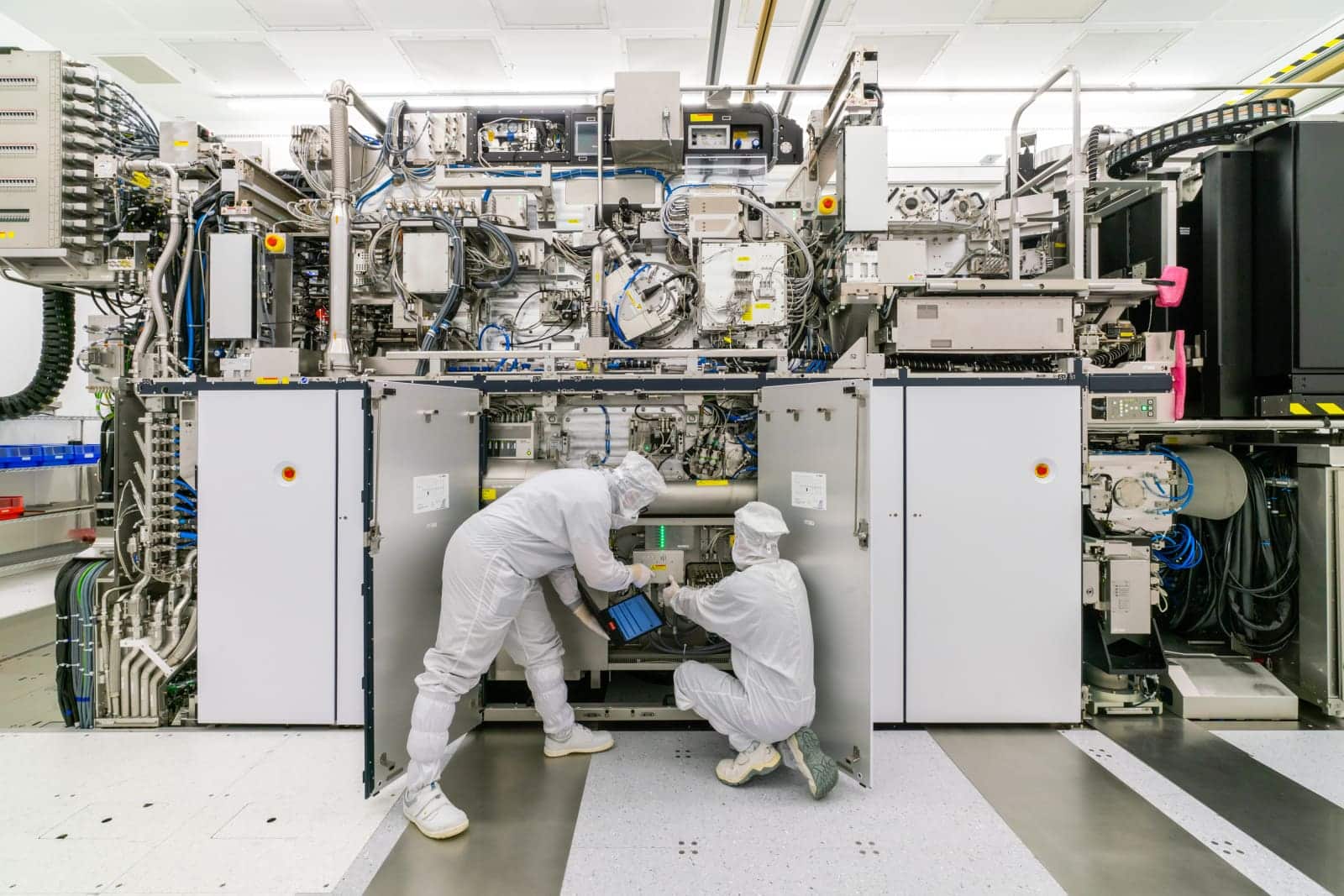
The accusation is so striking that it seems designed to shake the entire semiconductor industry: the United States allegedly transferred its concern about the possibility that an EUV machine, the most advanced lithography technology in the world, might have reached China. The Dutch company firmly denies this. It claims they have never shipped an EUV system, components, modules, or equipment specifically designed for these machines to China.
This episode once again places ASML at the center of the technological rivalry between Washington and Beijing. The European company, based in Veldhoven, is the only commercial manufacturer of extreme ultraviolet lithography, the technology needed to produce some of the most advanced chips on the market. Without their machines, the manufacturing of cutting-edge processors for Artificial Intelligence, servers, high-end mobile devices, or accelerators would be much more difficult.
The question raised by this case is significant: if EUV systems are subject to strict controls and are enormous, expensive, complex, and dependent on ASML’s maintenance, how could one end up in China without leaving a trace? The short answer is that, based on publicly available information, there is no proof that this has happened. The longer answer is more interesting: although transporting a complete EUV machine seems extremely difficult, the technological war is no longer solely about entire machines but also about components, knowledge, personnel, services, prototypes, and supply chains.
What is known and what is not
What is known so far is that Howard Lutnick, the U.S. Secretary of Commerce, reportedly expressed to ASML executives his concern about a possible presence of EUV technology in China. This information comes from sources familiar with those conversations, not from a publicly documented accusation with technical evidence.
ASML has responded with a clear denial. According to the company, it has never shipped an EUV machine to China, nor exported components, modules, or equipment specifically designed for EUV systems there. It also insists that it complies with export regulations and adapts its processes to regulatory changes.
| Point | Known situation |
|---|---|
| Formal public accusation | No detailed public proof exists |
| US concern | Attributed to conversations with ASML |
| ASML’s response | Denies having sent EUV or EUV components to China |
| EU/US export restrictions on EUV to China | Restrictive for years |
| Advanced DUV exports | Also affected by newer controls |
| Main risk | Increased scrutiny on ASML and supply chain |
This nuance is important. One thing is to assert that China has obtained an operational EUV machine from ASML. Another is to suspect that China might possess EUV-related technology, knowledge, or components. The first hypothesis would be much harder to sustain without very solid evidence. The second aligns better with the current reality of the technological race.
Why an EUV machine does not go unnoticed
ASML’s EUV machines are not equipment that can be moved like servers or GPUs. They are gigantic systems, extremely expensive, composed of tens of thousands of components, and require a highly specialized installation and maintenance chain. They are often compared to the size of a bus and require complex logistics for transportation, installation, calibration, and operation.
Furthermore, having the machine is not enough. An EUV system needs ultra-precise optics, EUV light sources, metrological control, integration with manufacturing lines, appropriate materials, masks, photoresists, software, maintenance, and highly qualified personnel. Such equipment is not bought on the secondary market nor installed discreetly in an industrial warehouse.
| Barrier | Why it hinders covert transfer |
|---|---|
| Size and weight | Requires specialized industrial logistics |
| Number of components | Depends on a tightly controlled supply chain |
| Installation | Requires technical experts |
| Maintenance | Requires ongoing support and critical spare parts |
| Advanced optics | Depends on very specific suppliers |
| Commercial traceability | Each system is associated with a customer, delivery, and service record |
| Factory integration | It doesn’t operate in isolation |
That’s why the case is so peculiar. If there were indeed an ASML EUV machine in China, it wouldn’t be a matter of a small diversion of goods. It would represent a major failure in export controls, logistics, service, traceability, and compliance. It would also have serious diplomatic and commercial consequences for ASML and the Netherlands.
EUV versus DUV: the key difference
Part of the public confusion stems from mixing two technologies: EUV and DUV. ASML sells different types of lithography equipment. EUV machines are the most advanced and used for leading-node production. DUV, especially ArF immersion, remains essential for many manufacturing layers and less advanced chips, but can also be used in sophisticated multi-step exposure processes.
China has historically purchased DUV equipment from ASML under licenses and changing restrictions. What it has not been able to buy are EUV machines. In recent years, the US has pressured the Netherlands and Japan to tighten controls on advanced tools, including certain DUV systems and related services.
| Technology | Main use | Situation regarding China |
|---|---|---|
| EUV | Advanced next-generation chips | Heavily restricted for years |
| High-NA EUV | Futures nodes, more advanced production | Out of Chinese reach due to controls |
| DUV ArF immersion | Advanced layers and mature production | Sujeto a licencias y restricciones crecientes |
| Less advanced DUV | Mature chips and general production | Less restricted but under increased surveillance |
| Services and maintenance | Maintain installed equipment | Seeking greater export controls |
This distinction is crucial. When considering China as a major customer for ASML, much of that business has come from non-EUV equipment. ASML anticipated that updated restrictions would reduce its Chinese sales to about 20% of total sales by 2025, down from years when China represented a much larger share.
China does not need a full EUV to worry Washington
US concerns are not limited to the possibility of a physical machine being diverted. China has been trying for years to reduce its dependence on foreign semiconductor technology. This strategy includes local manufacturers, public investment, reverse engineering, talent recruitment, developing domestic alternatives, and legally or indirectly purchasing equipment when possible.
In recent months, reports have circulated about Chinese projects to develop EUV lithography prototypes involving former engineers linked to the sector. These reports do not prove that China has an operational EUV machine comparable to those of ASML. But they do show that Beijing considers this technology a strategic priority.
| Chinese approach | Implications |
|---|---|
| Purchasing DUV under license | Maintaining mature manufacturing capacity |
| Multipatterning with DUV | Extending existing technology to more advanced nodes |
| Local development of equipment | Reducing dependence on ASML |
| Reverse engineering | Learning from foreign designs and components |
| Talent acquisition | Gaining specialized knowledge |
| National EUV prototypes | Advancing toward an independent alternative |
| Integration with AI and HPC | Supporting a race in advanced chips |
For Washington, even a non-functional prototype can be relevant. EUV lithography is not mastered overnight, but each technical advance shortens the gap. Export control aims precisely to slow down that process.
ASML, caught between the US, Europe, and China
ASML finds itself in a difficult position. It is a Dutch company operating under European and Dutch regulations, but its technology has become a strategic piece for the US. Washington sees ASML’s machines as a critical bottleneck to limit China’s access to advanced chips. Beijing views them as an obstacle that must be overcome.
The company cannot ignore the US because part of its supply chain, clients, and commercial relations depend on the American market and allies. Nor can it dismiss China, which has been an important market for less advanced equipment. At the same time, it must respond to the Dutch government and European export rules.
| Actor | Main interest |
|---|---|
| United States | Limiting China’s progress in cutting-edge chips |
| Netherlands | Protecting national security without destroying a technological champion |
| European Union | Maintaining regulatory sovereignty and industrial influence |
| ASML | Complying with regulations and preserving the global market |
| China | Access or develop advanced lithography technology |
| TSMC, Samsung, and Intel | Maintaining access to EUV for leading nodes |
This tension is unlikely to disappear. ASML is too important to stay out of the geopolitical game. Its machinery is one of the few European technologies considered strategically critical by both the US and China.
An accusation that may also serve as political pressure
The US suspicion arrives at a time when Washington continues trying to align its allies with tighter controls. The debate over new restrictions doesn’t just involve EUV, where restrictions have been in place for years, but also DUV, maintenance, parts, software, updates, and services for already installed equipment.
Raising the possibility that China has accessed EUV technology can be a way to increase pressure on ASML and the Dutch government. Even without conclusive public evidence, the political message is strong: the US calls for greater oversight and less room for commercial interpretations.
| Possible target of pressure | Effect |
|---|---|
| Strengthening licensing controls | Fewer sensitive sales to China |
| Controlling maintenance | Limiting the lifespan of installed equipment |
| Reviewing components | Avoiding partial diversion |
| Aligning allies | Reducing differences between US, Netherlands, and Japan |
| Enhancing traceability | Better tracking of parts, software, and services |
| Blocking Chinese prototypes | Making technological learning more difficult |
For ASML, the reputational risk is clear. Even if the company denies any misconduct, being associated with a possible EUV technology leak is enough to spark doubts among markets, governments, and investors.
Why this matters for Artificial Intelligence
The lithography battle isn’t an isolated industrial issue. It is directly connected to Artificial Intelligence. The most advanced models require GPUs, accelerators, HBM memory, high-speed networks, and chips produced on nodes at the forefront. Without advanced lithography, manufacturing these chips is much more difficult.
ASML is a physical foundation of AI development. Its machines enable TSMC, Samsung, and Intel to produce processors and accelerators for companies like NVIDIA, Apple, AMD, Google, Amazon, and Microsoft. The AI model pipeline begins long before, with lithography equipment that prints tiny patterns on silicon wafers.
| AI layer | Technological dependence |
|---|---|
| Models | Require large-scale training and inference |
| GPUs and accelerators | Depend on advanced chips |
| HBM and memory | Depend on sophisticated processes and packaging |
| Foundries | Require advanced lithography |
| ASML EUV | Enables leading nodes |
| Export controls | Determine who can access this capacity |
| Energy and data centers | Support final deployment |
That’s why a rumor about an EUV machine is not just industrial news. It signals how much control over physical infrastructure influences the digital economy.
The most likely hypothesis: not a machine but a battle for control
Based on public data, the idea of a fully operational ASML EUV machine in China is hard to support. Its size, traceability, installation, and maintenance complexity make covert transfer unlikely without extraordinary proof. ASML explicitly denies such an event.
Most probably, US concerns stem from broader issues: possible access to knowledge, components, designs, talent, or reverse engineering efforts. It may also be a way to increase diplomatic pressure on the Netherlands and ASML amid expanding export controls.
This does not mean the issue is irrelevant. Quite the opposite. If Washington is raising this concern to ASML, it considers EUV lithography one of the most sensitive points in the entire global tech supply chain.
The question “was it impossible?” has a nuanced answer. Receiving an EUV machine from ASML in China appears extremely unlikely under current controls. But China trying to absorb EUV technology via other means is not only possible but to be expected. The chip war is no longer solely about buying or not buying — it involves learning, copying, replacing, maintaining, restricting, and foreseeing.
ASML will continue denying any violations as long as there is no public proof. the US will keep pressing to close any gaps. And China will keep trying to build its own alternatives. Meanwhile, Europe is caught in the middle, with a company that has become one of its biggest technological assets and also one of its main sources of geopolitical pressure.
Frequently Asked Questions
What is an ASML EUV machine?
It is an extreme ultraviolet lithography system used to manufacture advanced chips. ASML is the only commercial provider of this technology at an industrial scale.
Has ASML sold EUV machines to China?
ASML denies having shipped EUV machines or components specifically designed for EUV systems to China.
Why is the US concerned?
Because EUV technology is key for producing advanced chips, including those needed for AI, supercomputing, and military systems. Washington wants to prevent China from access to this capability.
Can China manufacture chips without EUV?
Yes, many chips can be made with DUV technologies and mature processes. But producing cutting-edge chips without EUV is much more difficult, expensive, and slow.
What’s the difference between EUV and DUV?
EUV uses much shorter wavelength light, allowing for smaller patterns with fewer steps. DUV is older, still essential, but with more limitations for advanced nodes.
Is it possible to hide a full EUV machine in China?
With publicly available information, it seems extremely unlikely given the size, complexity, installation, traceability, and maintenance requirements. The possible access to knowledge, components, or prototypes related to EUV remains another matter.
