
STMicroelectronics has announced a unified platform for its STM32 microcontrollers and a new family, STM32A, that brings those chips into automotive and high-safety systems, such as robotics and industrial automation. Arm, which designs the Cortex-M cores they are built on, frames it as a step in its physical AI strategy, the one that brings intelligence to machines that move and act in the real world. The first three STM32A lines are already in samples, with broader availability planned for 2027.
STM32A and physical AI in 20 seconds
- ST unifies its STM32 microcontrollers for industrial, automotive and robotics use.
- The STM32A family launches with three lines, STM32A4, A5 and A9, already in samples.
- General availability will start in 2027.
The announcement was made at ST’s STM32 Summit in early November, and Arm dedicated a blog post to it, signed by Shardul Brahmbhatt, senior director of physical AI products and platforms. ST’s idea is that a developer can reuse code, tools and experience when moving from a home appliance to a robot or a car, instead of starting from scratch with each chip family. “Embedded innovation shouldn’t force developers to start over with every product,” says Rémi El-Ouazzane, president of ST’s microcontrollers, digital ICs and RF products group.
Three STM32A lines for safety and automotive
According to ST’s press release, the STM32A family extends the platform to high-safety and automotive systems, allowing software reuse while meeting each sector’s qualification requirements. The first wave has three lines. STM32A4 targets local input control nodes in cars and safety systems. STM32A5 is aimed at mid-range safety-critical uses in industrial automation, robotics, energy systems and automotive. STM32A9, the most ambitious, is designed for critical multi-domain control with real-time performance, low latency, Ethernet and deterministic communication.
The release doesn’t detail which Cortex-M cores each line uses, their memory, functional safety levels or pricing, nor does it give per-model dates beyond 2027. ST does mention the platform’s manufacturing technologies: 40nm Flash, 18nm FD-SOI with embedded phase-change memory, and TSMC non-volatile memory technologies. In a highly contested market, zonal microcontrollers for cars, ST competes with rivals such as NXP and Infineon, and its pitch is continuity with the STM32 ecosystem.
Physical AI according to Arm
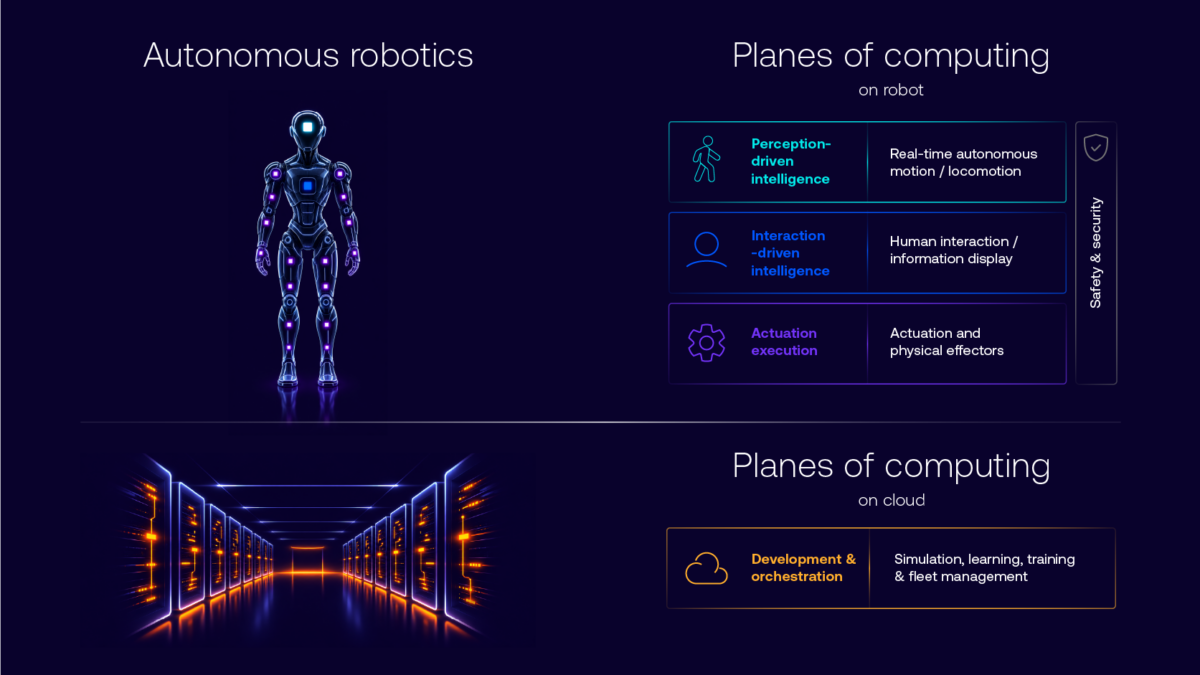
Arm uses the announcement to explain how it sees computing in robots and autonomous machines. It splits the work into three planes — perception, interaction and actuation — backed by the cloud and cut across by security. The example it gives is a robot picking up a glass: it has to recognize the object, plan the movement and control grip force. In a humanoid, the actuation layer handles reading sensors, making local decisions, moving each joint precisely and controlling individual functions, and that’s where Arm places the Cortex-M. For Brahmbhatt, the future of physical AI won’t depend on increasingly smart models alone.
Arm estimates that physical industries represent a $200 billion annual computing opportunity by the next decade, a forecast of its own that should be read as such. Drew Henry, Arm’s executive vice president of physical AI, adds in ST’s release that the next big frontier in computing is bringing intelligence to machines that move, manufacture and operate in the physical world. The move coincides with Arm’s launch of the Cortex-M42, which brings Helium technology to cheaper microcontrollers, and with other industry announcements such as Intel and Altera’s alliance to connect sensors in physical AI.
Frequently Asked Questions
What is the STM32A family?
A new family of STM32 microcontrollers from STMicroelectronics for automotive and high-safety systems, such as robotics or industrial automation.
Which models does it include?
Three lines: STM32A4 for input nodes, STM32A5 for mid-range safety-critical uses, and STM32A9 for multi-domain control with Ethernet and real-time performance.
When will they be available?
Samples for customers are already available, and ST expects broader availability in 2027.
Sources:
- Arm Newsroom: From photon to actuation, how physical AI is redefining embedded compute
- STMicroelectronics: unified STM32 platform
- STMicroelectronics press release (11/04/2026)
This article is also available in Spanish: «Arm y STMicroelectronics llevan los STM32 a la IA física y al coche con STM32A», on revistacloud.com.
