
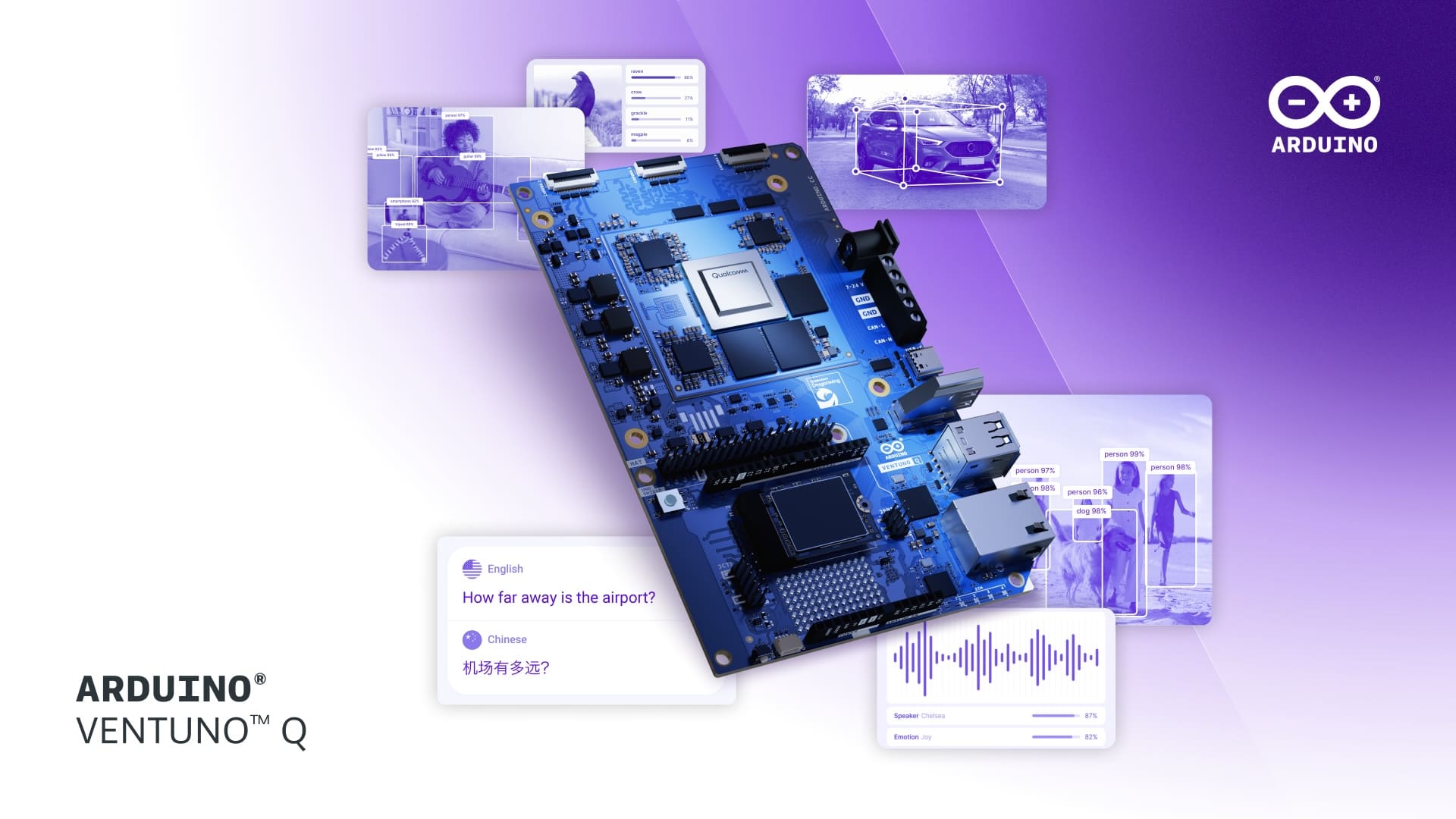
Arduino wants to make clear that it is no longer solely operating in the realm of educational electronics or simple prototypes. The company announced ahead of Embedded World 2026 its new platform Arduino VENTUNO Q, a board focused on Edge AI, robotics, and real-time physical control, built on Qualcomm Dragonwing IQ8 Series processors. This launch positions Arduino in a much more ambitious category than its classic boards and confirms the company’s strategic shift since its integration into Qualcomm’s ecosystem.
The proposal is not meant to compete with a conventional maker’s board but with the growing market of compact systems capable of running AI models locally while simultaneously controlling motors, sensors, and actuators with low latency. Arduino presents VENTUNO Q as a platform designed for perception, decision, and action to coexist on a single hardware, aligning with the surge of industrial edge AI and autonomous robotics. However, many of its promises will need to be tested once the product hits the market and is used outside of demonstration environments.
A “Double Brain” for AI and Real-Time Control
The most distinctive element of VENTUNO Q is its “dual brain” architecture. On one side, it integrates a Qualcomm Dragonwing IQ8 processor, listed officially as IQ-8275, responsible for inference, operating system, and AI loads. On the other, it adds a STM32H5F5 microcontroller, aimed at fast response tasks and deterministic control. Arduino affirms that both units communicate via an RPC bridge, which in theory enables combining the flexibility of a Linux environment with the precise timing required for robotics, motion, and certain industrial interfaces.
On paper, the board is well-equipped. Arduino mentions up to 40 TOPS of acceleration in the NPU, 16 GB of RAM, 64 GB of storage, and expansion via M.2 with NVMe SSD. It also confirms official support for Ubuntu and Debian on the main platform, while the microcontroller runs the Arduino environment over Zephyr OS. This combination aims to attract both embedded profiles and developers familiar with Linux, Python, or ROS 2.
Connectivity and I/O also suggest a more professional use case than typical educational boards. Public documentation mentions CAN-FD, PWM, high-speed GPIO, support for ROS 2, connectors for multiple MIPI-CSI cameras, advanced audio, displays, and 2.5 Gb Ethernet. The official Arduino blog further adds Wi-Fi 6 and Bluetooth 5.3, key features if the board aims to position itself in connected robotics or industrial/commercial edge AI applications.
From Classic Arduino to Industrial-Grade Edge AI
This announcement also carries a branding message. The name VENTUNO, meaning twenty-one in Italian, is no coincidence: Arduino uses it to connect the new platform with the legacy of the UNO family and to commemorate the organization’s twenty-first anniversary. But beyond this symbolic nod, it marks a significant step up in scale. The company promotes VENTUNO Q as a system designed to transition smoothly from prototyping to production, bringing local AI closer to applications like offline assistants, interactive kiosks, visual inspection, traffic monitoring, robotic arms, or service robots. These are plausible use cases for this hardware, although current applications remain at the proposal stage rather than confirmed commercial deployments.
Another key aspect is the effort to simplify development. Arduino states that VENTUNO Q will operate within Arduino App Lab, a unified environment for sketches, Python scripts, and AI workflows, with access to pre-trained, optimized models via Qualcomm AI Hub and Edge Impulse. The product page mentions support for local LLMs, VLM, Whisper, Melo TTS, MediaPipe, YOLO-X, and PoseNet, signaling a clear strategy: not just selling a board but offering a complete hardware, software, and pre-integrated models experience to accelerate testing and prototyping.
This is where Arduino and Qualcomm seem to want to differentiate VENTUNO Q from other AI SBCs. Instead of presenting it as a generic mini-PC with an NPU, they position it as an “intelligent machine” designed from the ground up for “movement, reaction, and manipulation.” Compatibility with UNO shields, Modulino nodes, Qwiic sensors, and even Raspberry Pi HATs reinforces this open ecosystem approach rooted in Arduino’s traditional ethos. The question remains whether this ecosystem can maintain Arduino’s hallmark simplicity amid the complexities of this more demanding platform.
Availability, Context, and What Still Needs to Be Clarified
Price has not yet been announced, which is a crucial detail if Arduino truly aims to make this new edge AI generation accessible. Qualcomm has confirmed that VENTUNO Q will arrive in Q2 2026 via Arduino’s official store and distributors such as DigiKey, Farnell, Macfos, Mouser, and RS. Arduino’s official statement is more cautious, simply stating it will be available “soon” and inviting users to register for updates.
The business context also helps explain this move. In October 2025, Qualcomm announced the acquisition of Arduino, assuring that the brand, its tools, and its mission would continue to operate with their own identity, but with access to more advanced edge computing and AI technologies. VENTUNO Q appears to be the most tangible manifestation of this new phase: a shift from traditional educational boards toward a focus on sectors like robotics, machine vision, and autonomous systems.
In summary, Arduino VENTUNO Q is not just an evolution of the maker-oriented lineup but a statement of intent. The company aims to compete in the physical edge AI market with a platform that blends Linux, NPU, real-time microcontroller, and Arduino’s ecosystem. If it delivers on its promises, it could become a highly attractive platform for advanced prototyping, technical education, and early industrial product development. If not, it risks remaining a visually impressive but overly complex and costly board that may exceed the needs or budgets of Arduino’s traditional user base. The final verdict will depend on the pricing, actual support, and performance outside the initial demo environment.
Frequently Asked Questions
What is Arduino VENTUNO Q?
Arduino VENTUNO Q is a new board aimed at edge AI, robotics, and real-time physical control, announced by Arduino with Qualcomm Dragonwing IQ8 processors and a STM32H5 microcontroller.
How powerful is the AI capability of VENTUNO Q?
Arduino and Qualcomm state that the platform provides up to 40 dense TOPS of acceleration in the NPU, designed for local vision, voice inference, and generative models at the edge.
What operating system does Arduino VENTUNO Q use?
The main platform supports Ubuntu and Debian, while the microcontroller runs the Arduino environment on Zephyr OS for deterministic, low-latency tasks.
When will Arduino VENTUNO Q be available?
Qualcomm has indicated it will be available in Q2 2026, while Arduino refers to its launch as happening “soon” via its official store and partners.