
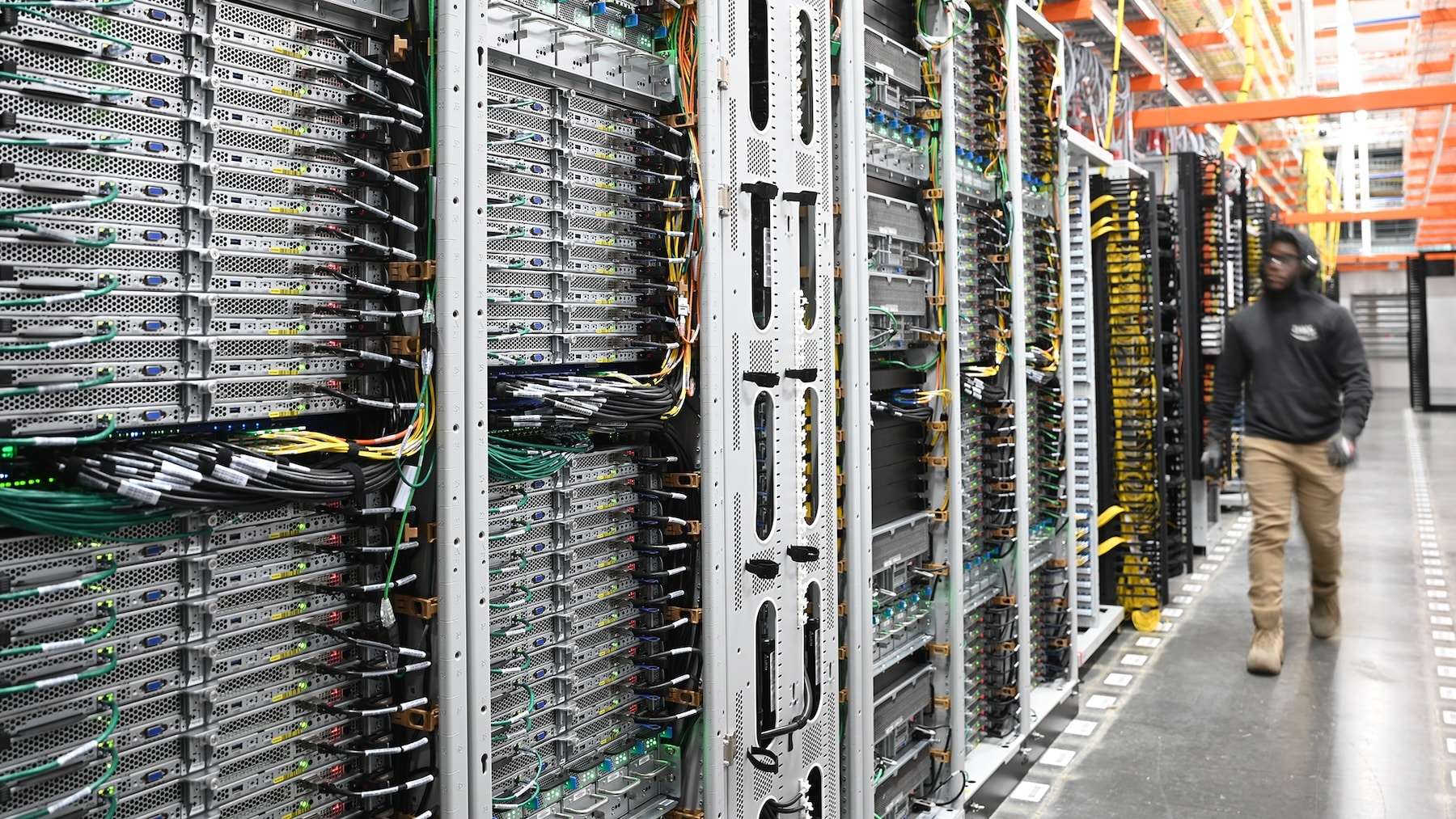
The Government of Aragón has officially approved a new section of the General Interest Project of Aragón promoted by Amazon Web Services (AWS). This approval allows the commencement of construction for new data center buildings in Walqa, Huesca, and Villanueva de Gállego, Zaragoza. The project advances from the urbanization phase to the construction phase, including the building of facilities, electrical substations, hydraulic infrastructure, fire protection systems, and associated technical equipment.
This decision marks the third final partial approval of AWS’s second PIGA in Aragón and represents a significant step forward in the expansion plan announced for 2024. Amazon’s total planned investment in Spain totals €33.7 billion through 2035, positioning Aragón as the core of AWS’s cloud region in the country and as one of the areas rapidly increasing its presence in cloud computing, artificial intelligence, and data centers.
From Urbanization to Campus Construction
The approval covers detailed projects for Phase 1 of the expansion of the Villanueva de Gállego 1, Villanueva de Gállego 2, and Walqa campuses. According to information shared by the Government of Aragón, the projects are distributed across a plot of just over 13 hectares near the existing operational data center, another of more than 68 hectares in the newly urbanized area of Villanueva de Gállego, and a third of 69 hectares in Walqa.
Until now, the process had focused on planning, zoning, and basic infrastructure. The new approval enables a more visible phase: the physical construction of buildings and auxiliary facilities necessary for the operation of the data centers. This includes interior urbanization of the plots, electrical substations, water treatment plants, fire protection systems, and electrical and mechanical infrastructure.
After the Government meeting, Octavio López, the Minister of Housing, Development, Logistics, and Territorial Cohesion, explained that the project now enters the construction and interior execution phase of the plots. The process also involves obtaining relevant environmental and sector-specific permits, a critical step for such infrastructure, which requires energy, water, connectivity, land, and administrative coordination.
AWS has been operating infrastructure in Aragón since 2022, when it opened the AWS Europe (Spain) Region. The company chose this community due to its available land, connectivity, access to renewable energy, and geographic position. Since then, Aragón has been strengthening its narrative as a potential tech hub for Southern Europe—a concept that gains momentum with new campuses, logistics facilities, and related supply chain projects.
An Investment Focused on Industrial Impact and Skilled Employment
Amazon’s announced plan increases its total investment in Spain to €33.7 billion, aimed at expanding and supporting its cloud and artificial intelligence infrastructure. The company estimates that this overall investment will contribute €31.7 billion to Spain’s GDP by 2035 and support the equivalent of approximately 29,900 full-time jobs annually in local companies.
In Aragón, the anticipated impact is particularly significant. Amazon estimates a contribution of €18.5 billion to the regional GDP by 2035 and the equivalent of about 13,400 full-time jobs on average per year, including direct, indirect, and induced employment. Of this, 4,200 positions are expected to be directly generated by Amazon’s investment in the region.
The project encompasses more than just data center buildings. AWS has also announced new facilities related to its supply chain in Aragón, including an assembly and testing plant for servers, a logistics warehouse, and a manufacturing and repair site for AI servers. Once fully operational, these facilities could generate around 1,800 additional jobs.
This is particularly relevant because a common question about data centers is how much employment they generate once construction is completed. While the building phase involves many companies, daily operations typically require fewer staff than traditional factories. The industrial activities linked to servers, logistics, and repairs can broaden the local impact beyond just campus maintenance.
There will also be effects on local suppliers in engineering, construction, electrical work, climate control, security, transportation, maintenance, and professional services. The key will be ensuring that this spending isn’t limited to the initial construction phase but helps establish enduring technical capabilities in the region.
Energy, Water, and Sustainability: The Most Sensitive Aspect of Growth
The expansion of data centers comes amid a global debate about the energy consumption of artificial intelligence. Major cloud providers need more capacity to train and run models, store data, deliver enterprise services, and meet growing demand. This presents Aragón with both economic opportunities and the responsibility to manage critical resources effectively.
Amazon states that AWS data centers in Aragón offset 100% of their electricity use with renewable energy since their launch in 2022. The company is also investing in 100 solar and wind projects across Spain, 17 of which are in Aragón. Additionally, AWS supports five hydropower projects in the community, with an investment of over €17 million, as part of its global goal to become “water positive” before 2030—that is, returning more water to communities than it consumes.
These commitments will be closely scrutinized by the public. While data centers can attract investment, skilled employment, and technological activity, they also raise concerns about electricity use, water consumption, grid capacity, territorial impact, and tangible benefits for citizens. Public acceptance will increasingly depend on measurable sustainability metrics, transparency, and ensuring that infrastructure development does not negatively compete with other industrial, agricultural, or urban uses.
Aragón has clear advantages: available land, renewable energy production, strategic logistics position, and an institutional strategy aimed at attracting major tech projects. Yet, becoming a true digital hub requires more than just announcing investments. It demands workforce training, links with universities and technical colleges, specialized suppliers, electrical planning, interconnection capacity, talent housing, and an industrial policy that leverages the arrival of hyperscalers to develop a local ecosystem.
The new progress in AWS’s PIGA reinforces this direction. The region has moved from announcing future capacity to approving specific projects in Huesca and Zaragoza. If schedules are met, the new facilities will expand the cloud footprint, helping Aragón become an integral part of AWS’s European network and increasingly involved in AI demand.
The challenge now is to turn this investment into more than just infrastructure. Aragón has the opportunity to leverage AWS’s presence to attract talent, develop technical skills, reinforce local providers, and connect data center growth with a more productive economy. While construction begins on the plots, the real measure of impact will be in the business ecosystem that develops around these projects.
Frequently Asked Questions
What has the Government of Aragón approved regarding AWS?
It has officially approved a part of the “AWS Region Expansion in Aragón” PIGA, enabling the start of construction for new data center buildings and related services in Walqa and Villanueva de Gállego.
Where will the new data centers be built?
The approved projects concern the Villanueva de Gállego 1, Villanueva de Gállego 2, and Walqa campuses, with parcels of over 13, 68, and 69 hectares, respectively.
What is Amazon’s projected investment in Spain?
Amazon has announced a total investment of €33.7 billion in Spain through 2035 to expand and support its data center, cloud, and AI infrastructure.
What economic impact is expected in Aragón?
According to Amazon’s estimates, the investment will contribute €18.5 billion to the regional GDP by 2035 and support an estimated 13,400 full-time equivalent jobs annually in local companies.
