
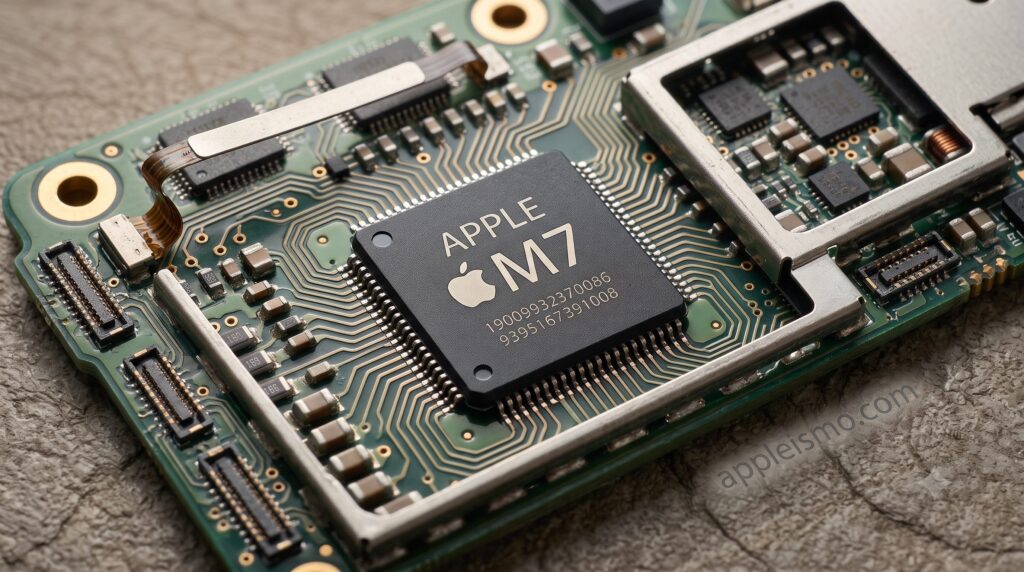
Apple may be preparing a M7 Ultra with up to 1.5 TB of unified memory and a significant leap in artificial intelligence processing. The processor wouldn’t arrive before 2028, and its maximum configuration would depend on the easing of supply chain issues affecting the global memory market.
Information, attributed to sources close to Apple’s road map, paints a picture of a product more akin to a workstation for large models than a conventional Mac upgrade. It also suggests that the company aims to use a single architecture for professional equipment and dedicated servers, although neither the chip nor its capabilities or timeline have been officially confirmed.
Key points of the supposed M7 Ultra in 20 seconds
- Apple is exploring a configuration of up to 1.5 TB of unified memory.
- The processor is expected around 2028.
- The basic M7 could appear in the first half of 2027.
- Versions like M7 Pro and M7 Max would arrive later that year.
- Apple would launch only the base M6 and omit M6 Pro, Max, and Ultra variants.
- The main goal is to improve inference and local AI workloads.
- The reference to Blackwell describes a performance category, not a proven equivalence.
- The M7 Ultra could also serve as a basis for future Apple servers.
- The 1.5 TB availability will depend on price and DRAM supply.
- Apple has not confirmed any of these specifications.
Leaked road map suggests Apple has shortened the development cycle between the M6 and M7. The design of the latter reached manufacturing preparation roughly six months after the first, enabling an earlier launch focused on AI and graphics.
The base M6 might debut in fall 2026 in entry-level devices, but the company would jump directly to the M7 family to update its professional processors. The M7 Ultra would be reserved for 2028, following the Pro and Max variants.
This schedule is unusual. Since the M1 launch, Apple has used Pro, Max, and Ultra variants to extend each architecture into professional laptops, workstations, and desktops. Omitting higher-end M6 variants could concentrate resources on deeper design changes but might also extend the lifespan of current chips.
Memory could be more important than core count
The 1.5 TB figure better explains the possible role of the M7 Ultra than any generic comparison to Nvidia. Apple isn’t solely seeking more operations per second but capacity to load entire models within a single memory space.
In Apple Silicon systems, CPU, GPU, and Neural Engine share memory. There’s no need to maintain separate copies in RAM and dedicated graphics memory. This architecture minimizes data movement and allows the GPU to leverage much more memory than typically available on a workstation with a single GPU card.
The M3 Ultra already supports up to 512 GB of unified memory, offers over 800 GB/s bandwidth, and uses UltraFusion to connect two M3 Max chips as a single logical unit. Apple claims such a setup can run models with over 600 billion parameters, depending on quantization, software, and additional memory needs.
Raising the limit to 1.5 TB would triple the official capacity of the M3 Ultra. Such a system could host large models, multiple versions of a single model, or extensive contexts without relying on multiple servers.
| Unified Memory | Indicative Usage |
|---|---|
| 128 GB | Development, medium-sized models, image generation |
| 256 GB | Local inference of large quantized models |
| 512 GB | Models with hundreds of billions of parameters |
| 768 GB | More context, concurrency, scientific workloads |
| 1.5 TB | Large local models, multiple agents, server use |
Memory size alone doesn’t determine performance. A model might fit entirely but run slowly if the system lacks sufficient bandwidth to read its parameters.
Inference of large models is often limited by data movement. To produce each token, the accelerator repeatedly needs to access the model weights. Doubling capacity without increasing memory bandwidth would allow larger models but not necessarily faster responses.
Apple will need to include a wider bus, additional controllers, and a GPU capable of handling that throughput. They also must manage power consumption and heat within a compact package with unusually high memory capacity for a non-server device.
Industrial availability could alter the product. The configuration would require many high-density DRAM chips, at a time when manufacturers are increasingly investing in HBM for data center accelerators. Therefore, the 1.5 TB figure should be seen as a designed or evaluated capacity, not a guaranteed option for consumers.
Approaching Blackwell doesn’t mean replacing Nvidia
The mention of performance close to the Blackwell category is the most intriguing and also the hardest to interpret. Blackwell doesn’t specify a single performance level: Nvidia’s architecture appears in professional cards, server accelerators, and complete systems with dozens of GPUs.
An M7 Ultra could approximate a specific Blackwell product in certain inference tests but fall far behind in training, scientific computations, or distributed workloads. Without details on the specific model, numerical precision, power, memory, or software, this reference offers only a rough guide.
Nvidia designed Blackwell around Tensor Cores, HBM memory, low-precision formats, and NVLink connections to interconnect multiple accelerators. Larger systems can group 72 GPUs within high-speed domains and extend to full clusters.
Apple would take a different approach. The M7 Ultra would offer a significant amount of memory in a compact device with shared CPU and GPU memory. It could be appealing for private inference, experimentation, model development, video processing, simulation, and workloads not requiring scaling across hundreds of GPUs.
| M7 Ultra, according to rumors | Nvidia Blackwell platform |
|---|---|
| Large unified memory | High-bandwidth dedicated HBM |
| Single integrated system | GPU, servers, and clusters |
| Targeted at Mac and Apple services | Sold to cloud providers, enterprises, and OEMs |
| Metal, MLX, and Core ML | CUDA, TensorRT, and extensive libraries |
| Potential advantage in local capacity | Advantage in compute and distributed scaling |
| Unconfirmed configuration | Products already available |
Software will play a big role. Nvidia has spent years building CUDA, compilers, libraries, and tools for workload distribution across GPUs. Many AI projects are first developed on Nvidia platforms and later adapted to other environments.
Apple’s Metal, Core ML, and MLX are designed for machine learning on shared memory. To ensure a future Mac with 1.5 TB is useful, it’s not enough for models to load—you need operators, kernels, and quantization formats that can leverage the chip without forcing developers to rebuild their apps.
A fairer comparison isn’t with a cluster of Blackwells for training. The M7 Ultra could compete with small servers designed for local models—especially when memory capacity outweighs raw maximum performance.
From Workstation to Infrastructure for Apple Intelligence
The rumored M7 Ultra also fits with Apple’s expansion into their own AI servers. The company already uses Apple Silicon in Private Cloud Compute, infrastructure that handles tasks too heavy for iPhone, iPad, or Mac to process locally.
These servers use custom hardware, Secure Enclave, verified boot, and a minimal OS to restrict admin access and protect personal data. Apple states requests are processed temporarily, and even staff cannot access user data during operation.
Based on leaked info, Apple plans to launch a server with M5 Ultra first, then consider a second-generation M7 Ultra setup in 2029. The same processor could appear a year earlier in a high-end Mac.
Shared architecture benefits include easier testing of models in a Mac similar to the final deployment environment. It also reduces reliance on external accelerators and gives Apple more control over hardware, OS, libraries, and infrastructure.
This doesn’t mean Apple will sell the M7 Ultra as a general Nvidia alternative. Likely, they’ll reserve servers for Apple’s internal AI work and restrict commercial versions to Mac Studio or Mac Pro.
Price remains a major unknown. A system with 1.5 TB of memory could be very expensive—even before market conditions improve. Its target users would likely include media studios, labs, AI developers, and organizations prioritizing local model execution without relying on external services.
The M7 Ultra concept suggests a niche: a compact machine with server-class memory and desktop tools. Its success depends less on outperforming Blackwell benchmarks and more on making large models practical for local use.
Frequently Asked Questions
Has Apple announced the M7 Ultra?
No. The chip, the 2028 timeline, and the 1.5 TB figure are based on journalistic sources and unconfirmed reports.
Could it run any AI model?
Massive models could fit into the memory, but compatibility and performance will depend on format, quantization, and support from Metal, MLX, or Core ML.
Will it be a direct competitor to Nvidia Blackwell?
It may match certain inference workloads, but Nvidia offers a platform optimized for data centers and multi-GPU scaling. They serve different markets.
Why might the 1.5 TB version not materialize?
Apple needs large quantities of high-density memory, and market factors like cost, production capacity, and data center demand could limit or delay this configuration.
