
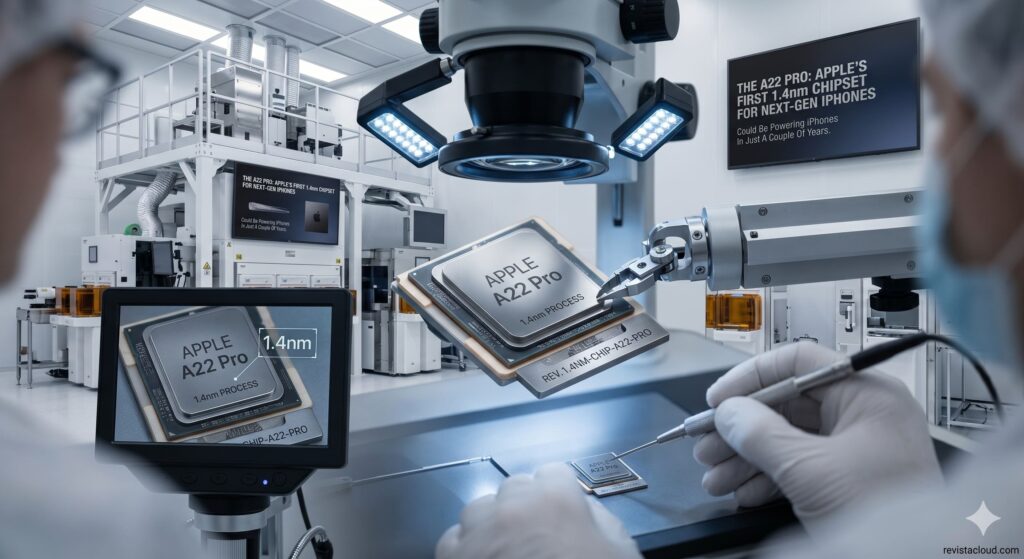
Apple has not yet debuted its first 2 nm chips, but the discussion about the next technological leap has already begun. According to recent reports attributed to Mark Gurman, the company could utilize in 2028 its first processor manufactured with TSMC’s hypothetical 1.4 nm process node, possibly the A22 Pro designed for high-end iPhones.
This information should be approached with caution. Apple has not confirmed the name A22 Pro, the fabrication node, or the specific iPhone family that would debut it. What TSMC has confirmed is that its A14 technology, commercially associated with the 1.4 nm generation, will move into volume production in 2028. If schedules align, Apple would once again be among the first clients to access TSMC’s most advanced node.
This transition follows an already anticipated intense shift. The A20 and A20 Pro are expected to be Apple’s first chips manufactured on 2 nm, while the subsequent generation may rely on an improved version of that node. If the A22 Pro does arrive in 2028, it would mark the transition from 2 nm nanosheet transistors to a denser, more efficient generation.
TSMC A14: the real driver behind the rumor
While the “A22 Pro” name gets most of the attention, the key factor is TSMC. The Taiwanese company has presented its A14 node as a direct evolution of N2, featuring second-generation nanosheet gate-all-around transistors and a NanoFlex Pro architecture to enhance design flexibility.
TSMC states that A14 will deliver between 10% and 15% higher performance at the same power consumption, or 25% to 30% lower power at comparable performance, compared to N2. It also promises over a 20% increase in logical density. In a mobile device, these improvements can translate to more power for AI tasks, better battery life, smaller chips, or a combination of these benefits.
| TSMC Node | Expected Timeline | Relevance for Apple |
|---|---|---|
| N3 / N3E | Current and recent generation | Foundation for A17, A18, and subsequent chips |
| N2 | Volume production before A14 | Apple’s major leap into 2 nm technology |
| N2P | Evolution of N2 | Possible intermediate node for Pro chips |
| A14 | Volume production expected in 2028 | Candidate for future A22 Pro |
| A14 with backside power | Planned after initial A14 | Focused on efficiency improvements |
It is important to remember that “nanometers” today no longer denote a simple physical transistor measurement but are commercial labels summarizing a technological generation. Nevertheless, they remain useful for understanding evolution: each leap generally implies greater density, better energy efficiency, and increased capability to integrate advanced functionalities.
For Apple, efficiency is as critical as performance. An iPhone cannot sustain indefinite increases in power consumption and temperature. Each node improvement is leveraged to balance the CPU, GPU, Neural Engine, image processing, modem, security, and local AI tasks.
The A22 Pro might arrive after the 20th anniversary iPhone
The current schedule places the A22 Pro in 2028, after the 2027 20th-anniversary iPhone. This anniversary generation has been rumored to be one of Apple’s most ambitious designs, with screen, glass, and form factor changes. The jump to a 1.4 nm chip would follow shortly after, at a time when Apple might further differentiate its standard and Pro lines.
This strategy isn’t new. Apple has historically reserved its most advanced chips for Pro models before scaling down technologies to more affordable versions. If early A14 wafers prove especially costly or scarce during initial production months, it makes sense for Apple to restrict the advanced process to the A22 Pro and keep the standard A22 on a less costly node.
| Product Hypothesis | Likely Scenario |
| A20 / A20 Pro on 2 nm | Apple’s first transition to N2 |
| A21 Pro on N2P | Intermediate upgrade before A14 |
| A22 Pro on 1.4 nm | Initial use of the most advanced node | A22 standard on prior node | Cost control consideration |
| Pro models as priority | Allows for higher-margin premium models |
This pattern aligns with Apple’s business model. Pro models tend to carry higher prices, larger margins, and customers willing to pay extra for camera, display, battery, and performance upgrades. If a last-generation wafer becomes very expensive, Apple can more easily justify it on those high-end devices.
Why wafer costs will be a decisive factor
Moving to 1.4 nm will not be inexpensive. Industry estimates suggest that the cost of a TSMC A14 wafer at this process could be significantly higher than previous generations—potentially tens of thousands of dollars per wafer. While these figures should not be taken as official, the trend is clear: each advanced node requires more investment, more manufacturing steps, increased complexity, and carries higher initial yield risks.
This cost factor explains why Apple might reserve the A22 Pro for its top-tier iPhones. It’s not just about owning the latest node but also about absorbing the industrial costs that not all products can support.
| Cost Factor | Impact on Chip |
| More expensive wafers | Higher costs per SoC |
| Initial limited production | Prioritizing large customers like Apple |
| Fabrication yield | Affects number of usable chips per wafer | More complex design | Higher engineering costs |
| Packaging and memory | SoC isn’t the only costly component |
| Pro segmentation | Enables margin protection |
Apple’s advantage lies in volume, procurement power, and the ability to reserve advanced manufacturing capacity years in advance. The company has historically been one of TSMC’s top customers for cutting-edge nodes. This relationship allows Apple early access to new technologies but also exposes it to higher costs if it wishes to maintain that edge.
Local AI: the true future of new nodes
The A22 Pro should not be seen solely as a faster chip for opening apps or gaming. The primary battleground will be on-device AI. Apple is trying to bolster its approach to private AI, emphasizing local processing whenever possible and cloud support when necessary.
A more efficient node enables increasing the Neural Engine’s capacity, running larger models locally, improving camera functions, translation, voice interpretation, image processing, and managing more contextual assistants without sending excessive data off-device.
| iPhone Area | How a 1.4 nm node can help |
| Neural Engine | More AI operations per watt |
| Camera | Advanced computational processing |
| Siri & Assistants | Better local response with more context |
| Battery | Lower power consumption during sustained tasks | Security | More functions within enclave and local processing |
| Gaming | Improved GPU with less thermal pressure |
| Video | More efficient encoding and editing |
The difference won’t be just in TOPS or core counts. Memory, bandwidth, storage, thermal systems, and hardware-software integration will also play vital roles. Apple typically leverages node jumps to redesign multiple components simultaneously, not just to boost clock speeds.
The race with Qualcomm, MediaTek, and Samsung
If Apple reaches 1.4 nm in 2028, its competitors won’t be standing still. Qualcomm, MediaTek, and Samsung will also seek advanced nodes for their mobile platforms. The key differences lie in their relationships with TSMC and their ability to reserve capacity early in each gen’s cycle.
Qualcomm and MediaTek generally rely on TSMC for their top-tier chips but may alternate with Samsung Foundry depending on generation, cost, and availability. Samsung is attempting to regain ground with its own gate-all-around nodes but faces the perception that TSMC’s processes are more mature.
| Company | Dependence on advanced nodes |
| Apple | Usually reserves early capacity at TSMC |
| Qualcomm | Competing in premium Android performance |
| MediaTek | Seeking efficiency and cost benefits in high-end ranges |
| Samsung | Combines own design with foundry business |
| TSMC | Main supplier of cutting-edge mobile nodes |
Apple’s advantage is not just in being first. It is in designing chips for a limited set of devices, controlling iOS, and optimizing both hardware and software integration. This vertical integration allows Apple to extract greater value from each node upgrade compared to a third-party supplier serving multiple manufacturers with diverse needs.
Risks of looking too far ahead
Discussing a 2028 A22 Pro when 2 nm chips have yet to arrive in iPhones requires caution. Semiconductor timelines can shift. Volume production may be delayed, costs may rise, initial yields could be lower than expected, or Apple might reserve the node for another product family.
There’s also the possibility that the commercial name changes. Apple might label a different design as A22 Pro, skip naming conventions, introduce Ultra variants, or reserve the node for an iPad, Mac, or other device category. Current information points to a reasonable probability but not to a confirmed plan.
| Uncertainty | Potential Changes |
| TSMC Schedule | Delays or slower ramp-up | Wafer cost | Reduced initial adoption |
| Fabrication yield | Fewer chips available initially | Apple’s strategy | Limited to Pro models or select products | Product name | Name could change or be reused | AI Needs | More focus on memory or packaging |
What remains clear is the direction: Apple aims to continue using the most advanced nodes to sustain its performance-per-watt advantage. TSMC seeks to maintain its leadership against Samsung and Intel. And the mobile device is increasingly becoming a platform for on-device AI, not just a communication tool.
A smaller leap in appearance, but enormous in implications
The potential 1.4 nm A22 Pro won’t alone transform the iPhone. But it could usher in a new phase: more expensive chips, a focus on local AI, and increased difficulty in offering these technologies across all models. The gap between a standard iPhone and a Pro could widen if Apple reserves the most advanced nodes for the higher-margin versions.
For consumers, in less technical terms: will it be noticeable? The answer depends on how Apple utilizes the chip. If the leap only improves benchmarks, it might go unnoticed. But if it enables better local AI, longer battery life, smarter cameras, and less heat, it could make a significant difference.
The mobile industry has been exhausting easy improvements for years. Displays are highly refined, cameras are elite, and raw power often exceeds real-world needs. The next battlefield will focus on efficiency, AI capabilities, autonomy, and integrated services. In this context, a node like A14 might still make sense, despite higher costs.
Apple doesn’t need to be first to claim “1.4 nm.” It needs to turn that node into an experience that justifies the Pro iPhone’s premium price. That will be the true test of the A22 Pro, should it arrive in 2028.
Frequently Asked Questions
What is the A22 Pro?
The A22 Pro is the rumored name for an upcoming Apple chip possibly arriving in 2028, debuting in high-end iPhones.
What does 1.4 nm mean?
It refers to the A14 generation from TSMC, associated with the 1.4 nm class. It’s not a literal physical measurement but a label indicating a more dense and efficient process technology.
What improvements does TSMC’s A14 promise?
TSMC claims that A14 will deliver 10–15% higher speed at equal power, or 25–30% lower power consumption at similar performance compared to N2, along with over 20% higher logical density.
When might the first 1.4 nm iPhone arrive?
Current reports suggest 2028, but Apple hasn’t confirmed. The schedule will depend on TSMC, costs, availability, and product strategy.
