
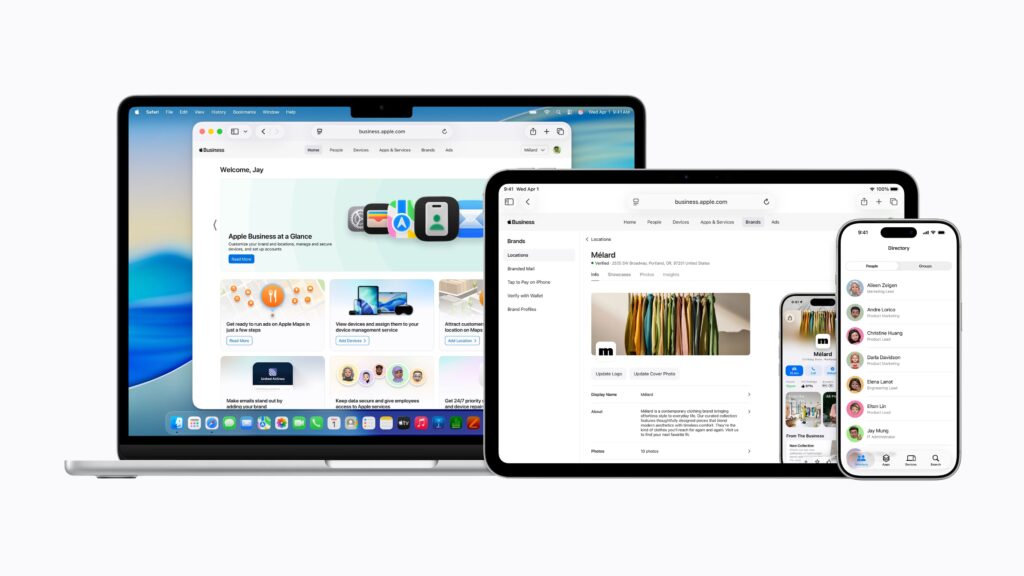
Apple has taken a step into the enterprise market with Apple Business, a new platform that combines device management, email, and calendar with custom domains, corporate directory, and brand presence tools, in addition to opening the door to local advertising on Apple Maps. The service will launch on April 14, 2026 in more than 200 countries and regions, replacing Apple Business Essentials, Apple Business Manager, and Apple Business Connect, which will cease to exist as separate products.
This news is significant because it’s not just a rebranding. Apple is bundling several components that were previously scattered into a single interface, creating a more coherent offering for businesses already within its ecosystem. The proposal merges two very different layers: the classic IT and productivity layer, with integrated MDM and identity management, and a clearly business-oriented layer, with enriched profiles, location insights, branding in Wallet and Mail, and advertisements in Maps to attract local customers.
Apple aims for companies to manage more within its ecosystem
The first pillar of Apple Business is integrated device management. Apple states that the platform will provide a centralized view of devices, settings, and security, and will include new Blueprints for deploying predefined configurations and apps with zero-touch deployment, as long as devices are purchased through Apple or authorized resellers. It also expands availability of Apple Business Manager to over 200 countries and regions and adds features such as Managed Apple Accounts, group and role management, app distribution from the App Store, and an Admin API for large-scale deployments.
In practice, this brings Apple closer to offering a kind of enterprise suite, especially for small and medium-sized businesses that prefer not to manage too many separate tools. Apple emphasizes that its new platform is designed for organizations with limited IT resources, making it clear that it’s not only for traditional large enterprises but also for SMBs and businesses with lean structures.
Email, calendar, and custom domains: Apple moves closer to Google and Microsoft
The second major layer of Apple Business is productivity and collaboration. The company has confirmed it will include integrated services for email, calendar, and directory, with the option to use an existing domain or purchase a new one through the platform. It also mentions features like calendar delegation and an internal directory to facilitate contact among employees and teams.
This move is interesting because it brings Apple a bit closer to the domain dominated by suites like Google Workspace and Microsoft 365. Apple hasn’t presented this as a full replacement for those platforms but rather as a way to establish a basic professional identity and native collaboration layer within its ecosystem. For businesses already operating with Mac, iPhone, and iPad, the appeal lies in reducing complexity and increasing integration.
Maps becomes a new advertising surface for Apple
The most innovative aspect from a tech and product perspective pertains to Apple Maps. Apple announced that this summer, businesses in the US and Canada will be able to create ads on Maps. These will appear when users search for businesses or in a new Suggested Places experience based on relevance, recent searches, and nearby trends. The ads will be clearly marked and can be purchased through Apple Business or, for existing advertisers and agencies, via their current workflow in Apple Ads.
This expands the role of Maps within Apple’s commercial strategy. It’s no longer just a navigation or discovery app but also a new transactional and advertising platform. For Apple, it’s also a way to tie together local presence, branding, and performance within a single ecosystem. For the market, it signals that the company continues to strengthen its advertising business, all while maintaining its privacy stance. Apple assures that user locations and ads interacted with in Maps are not associated with Apple IDs, that personal data remains on the device, and that no data is shared with third parties.
Branding layer gains more prominence
Apple will also incorporate all functions of Apple Business Connect into Apple Business, relating to how a company appears within the Apple ecosystem. This includes brand profiles, enriched location listings, promotions and customized actions in Maps, local interaction analytics, visible branding in the Mail app and iCloud Mail, and brand presence in Tap to Pay on iPhone.
Overall, Apple aims to enable a company to control not only its devices and users but also its digital identity within Apple from a single platform. This makes Apple Business more than just a management panel: it’s a combination of an IT console, a basic productivity suite, and a commercial presence platform.
Free to start, with paid extras
Apple Business will be free for new and existing users of previous enterprise platforms, though there will be paid add-ons. In the US, Apple will offer additional iCloud storage up to 2 TB per user starting at $0.99 per month per user, and AppleCare+ for Business from $6.99 per month per device or $13.99 per month per user for up to three devices. The Apple Business app, along with email, calendar, and directory features, will require iOS 26, iPadOS 26, or macOS 26.
The final takeaway is quite clear: Apple aims to strengthen its enterprise presence with a more unified offering where hardware, management, identity, and local visibility are under one umbrella. For SMBs, this could simplify their operations attractively. For larger companies, the decision will depend on whether they want to further deepen their engagement with the Apple ecosystem or maintain a more open architecture with specialized tools.
Frequently Asked Questions
When will Apple Business be launched?
The service will be available on April 14, 2026, in over 200 countries and regions.
What services does it replace?
Apple Business will replace Apple Business Essentials, Apple Business Manager, and Apple Business Connect.
What does Apple Business include?
It includes integrated MDM, email, calendar, directory, brand and location management, local insights, and later, ads on Apple Maps in the US and Canada.
Will Map ads be available globally?
Not initially. Apple has announced this feature for the United States and Canada starting this summer.