
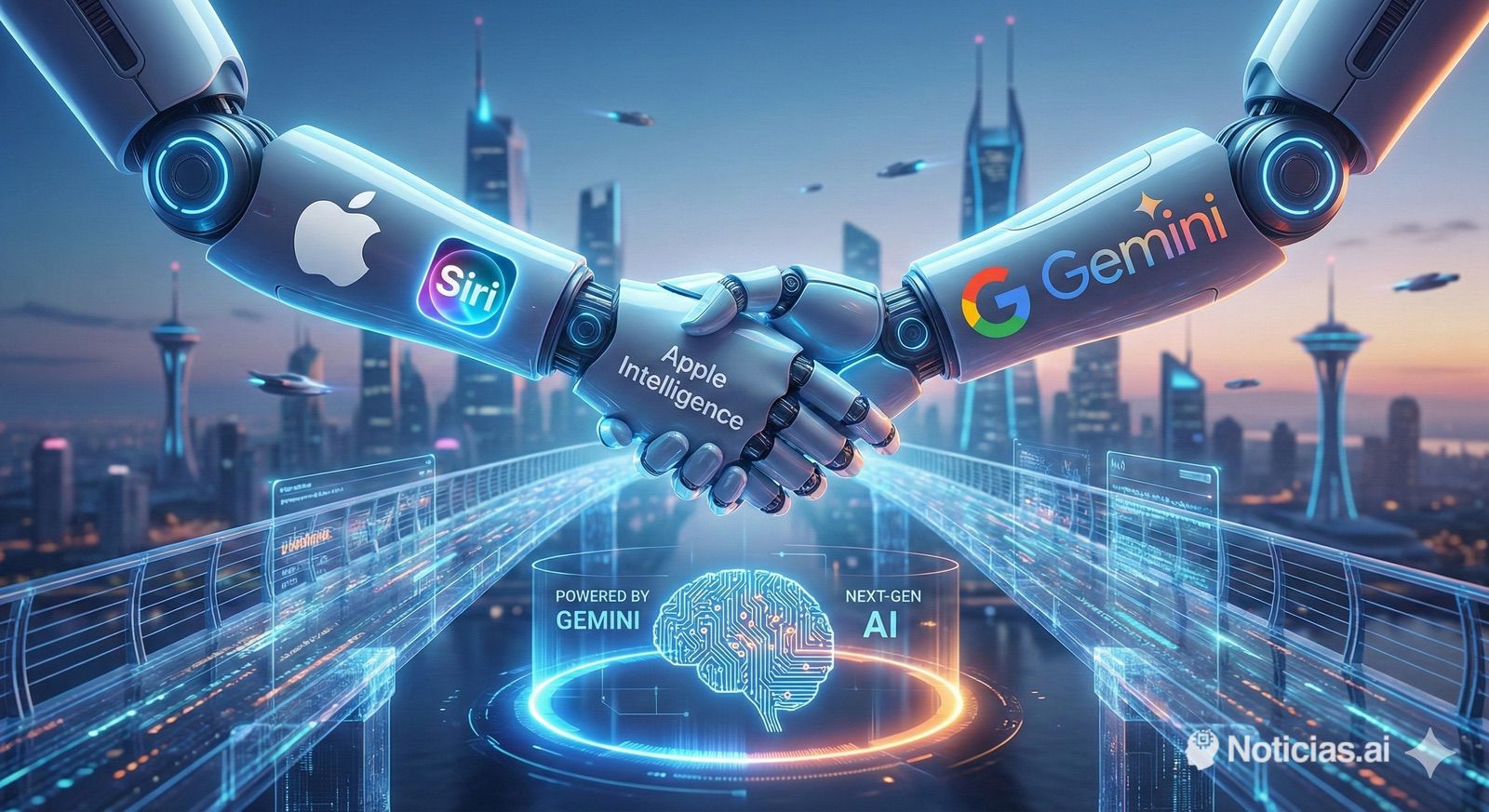
Apple and Google have formalized a multi-year collaboration that quietly but profoundly reconfigures the immediate future of artificial intelligence on mobile devices. In a joint statement, both companies confirm that the next generation of Apple Foundation Models will be based on Google’s Gemini models and cloud technology, a move designed to boost future Apple Intelligence features and, especially, a more personalized version of Siri arriving throughout 2026.
The key phrase of the announcement doesn’t just refer to a one-time integration: Apple explains that, after a “careful assessment,” it determined that Google’s AI technology is “the most capable foundation” for its next generation of foundational models. Practically, this suggests that Apple prioritizes accelerating and maturing Gemini technology to support new capabilities, while maintaining control over the product — focusing on what it does best: user experience, system integration, and a privacy-centric message that has become a hallmark.
The delicate point: an “Apple” AI built on Google technology
In the market, the idea of “own AI” has become an ambiguous label. This agreement makes it even more blurred. Apple insists that Apple Intelligence will continue to run on devices and, when necessary, will utilize Private Cloud Compute, its cloud architecture designed to handle more complex requests without compromising — according to the company — “industry-leading” privacy standards. But the technical foundation of the new models will be Gemini, which introduces an inevitable tension: if the “engine” is from Google, users might wonder which part of the intelligence truly belongs to Apple.
Apple attempts to address this perception with a clear separation of layers: Gemini as the foundational technology; Apple as the integrator deciding what runs locally, what is processed on Apple’s servers, and how data is limited so only the minimally necessary information is used for each request. The overall message is that users shouldn’t notice “Google” behind Siri, even though the performance and understanding of the assistant are supported by that collaboration.
Private Cloud Compute: the “bridge” for challenging requests
The Private Cloud Compute architecture has been the key piece Apple has been working on for months to differentiate itself in generative AI. The company has explained that when a request cannot be resolved on the device, the system can transfer processing to Apple silicon servers, designed — according to Apple — to minimize data exposure and allow independent security checks. The announcement with Google explicitly relies on this idea: Apple is not promising “cloud AI” simply, but its own cloud infrastructure that acts as an extension of the device.
In practice, this also points to a division of labor: the device handles quick, private tasks; Apple’s cloud takes care of the heavier ones; and Gemini sets the capacity benchmark for the model. For readers of a tech publication, this nuance is important: the agreement does not necessarily imply that Siri requests travel directly or visibly to Google’s infrastructure, at least as publicly described.
Siri, the assistant that was meant to reinvent itself… and arrives delayed
The promise of a more personalized Siri has been a central topic in discussions about Apple and AI for some time. Reuters frames this move as part of an effort to modernize Siri after internal delays, scheduling the renewal later in 2026. This aligns with the “this year” mentioned in the announcement (published already in January 2026). The focus here is not just the timeline: it’s the kind of leap expected from an assistant in 2026, where conversation and context are no longer extras but minimal requirements.
The industry interpretation is straightforward: Apple doesn’t want to fall behind in “everyday AI.” Phones, watches, and computers have become the places where users expect AI to act as a layer of productivity and real help, not just a demo. And Siri, historically, has been the natural interface for that layer. If Apple manages to make the new Siri more useful —without sacrificing control and privacy— it gains narrative momentum. If it doesn’t, the reputational cost will be high, because markets no longer reward empty promises.
Elon Musk’s criticism: “concentration of power” and platform clash
A few hours after the announcement, Elon Musk criticized the deal on X with a concise message: he sees it as a “reasonably questionable concentration of power” for Google, given that the company also controls Android and Chrome. This statement summarizes a concern that goes beyond business rivalry: AI is becoming infrastructure, and those who control infrastructure, platforms, and distribution channels could end up influencing the digital experience of billions.
Musk’s comment alone does not determine regulatory impact, but it amplifies an ongoing debate: the Apple–Google relationship has faced scrutiny for years over previous commercial agreements. Now, adding a strategic alliance in AI models and cloud technology could spark new questions about dependence, competition, and concentration in the digital economy.
An agreement indicative of the next phase: success isn’t about “having a model” but about putting it in the hands of the user
This collaboration reinforces a current trend: AI power is increasingly decided by distribution and product, not just benchmarks. Google gains presence within Apple’s ecosystem; Apple acquires a technological foundation ready for the leap; and users—if everything proceeds as promised—should experience a more capable Siri without sacrificing the brand’s privacy philosophy.
The real question remains the “how”: which functions will arrive, at what pace, with what limitations, and how transparent will the data journey be? In 2026, that will be the true test for Apple Intelligence.
Frequently Asked Questions
What changes in Apple Intelligence if the new models are based on Gemini?
The underlying technology of Apple’s next models will be based on Gemini, aimed at enabling more advanced features and a more personalized Siri within the Apple ecosystem.
Will Siri send my data to Google under this agreement?
The public announcement emphasizes that Apple Intelligence will run on the device and, for complex requests, on Private Cloud Compute, maintaining Apple’s privacy standards. Technical workflows at the detailed level of auditing have not been publicly disclosed.
When will the “more personalized” Siri arrive?
The announcement mentions it arriving “this year” (already in 2026), and Reuters places the renewal later in 2026, so a rollout is expected during this year.
Why is there talk of “concentration of power” around Google?
Because Google already operates massive platforms (Android and Chrome), and with Gemini as the technological base for Apple, its potential influence in consumer AI on a global scale would increase.
via: Appleismo