
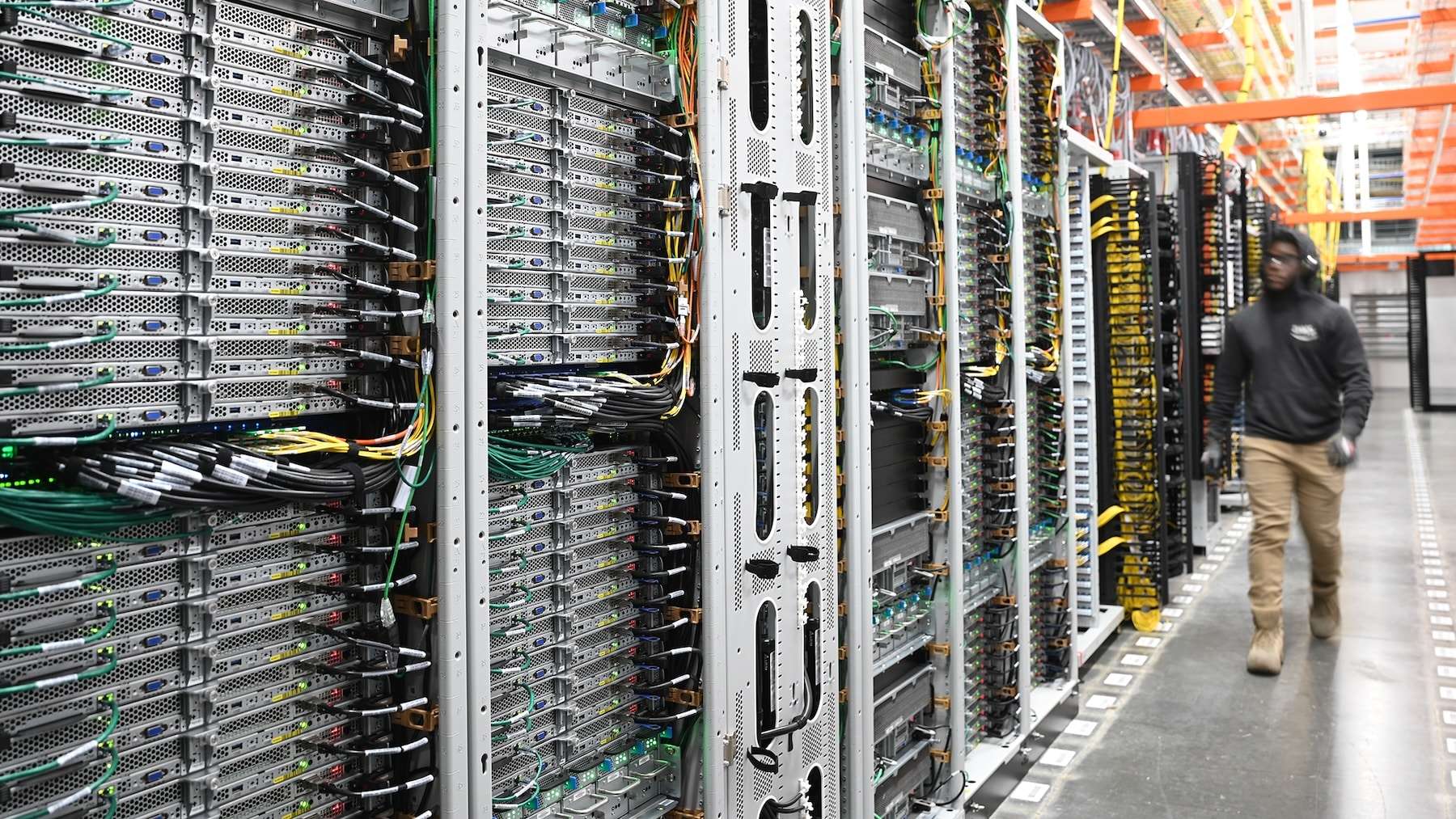
Antimatter aims to carve out a niche in AI infrastructure by offering a different approach from the large data centers: combining energy, small modular facilities, and distributed cloud software to primarily run inference tasks. The rise of open and open-weight models, including those developed in China, could expand the number of companies capable of deploying AI without relying directly on U.S. closed models.
The keys to Antimatter in 20 seconds
- Antimatter integrates energy, modular data centers, and distributed cloud software.
- It operates 10 units across eight locations, with over 3,400 GPUs and 26 MW, according to the company.
- Its goal for 2030 is to reach 1,000 installations, over 300,000 GPUs, and 1 GW.
- This strategy aligns with the growth of open models that can run on alternative infrastructures.
- CoreWeave emerges as one of the major competitors in the new “neocloud” market.
The opportunity is especially compelling because the AI market is beginning to separate into two layers. One involves who develops the models; the increasingly important other is who provides the necessary GPUs, energy, and software to run them.
In recent years, both layers have been closely tied to the United States. OpenAI, Anthropic, Google, and Meta dominated much of the conversation around models, while AWS, Microsoft Azure, Google Cloud, and specialized companies like CoreWeave handled an increasing share of infrastructure.
The appearance of competitive open-weight models from China introduces a new variable.
DeepSeek, Alibaba with Qwen, and Moonshot AI with Kimi have demonstrated that a company can access advanced models whose weights can be downloaded and deployed on infrastructure of their choice, depending on the specific licensing conditions.
This turns infrastructure into a potentially model-independent market.
From buying an API to choosing where to run the model
The change seems minor but significantly alters the architecture of an AI application.
When a company directly uses a provider’s closed API, many infrastructure decisions are bypassed. The provider runs the model, and the client pays for its use.
With downloadable weights, another option emerges: download the model and rent computing capacity from a different provider.
That’s where neoclouds come into play.
CoreWeave is probably the best-known example of this new category. The company built its business around large GPU clusters dedicated to AI workloads and has secured multimillion-dollar contracts with some of the biggest tech firms.
Antimatter proposes a different architecture.
The company presents itself as a vertically integrated neocloud combining three businesses: Data Factory, focused on energy; Policloud, responsible for modular data centers; and Hivenet, providing the distributed software layer.
The idea is to bring computing to locations where electricity is already available, instead of building massive data centers and waiting to secure sufficient electrical capacity afterward.
According to their data, Antimatter launched in April 2026 with 10 Policloud units distributed across eight locations, over 3,400 GPUs, and more than 26 MW of operational capacity. They also claim to have over 1 GW of contracted capacity and ongoing projects.
These figures are provided by the company itself and should be differentiated from independently verified capacity.
Smaller data centers near energy sources
Antimatter’s architecture partially departs from the trend toward ever-larger AI campuses.
Policloud uses modular, containerized data centers that can be installed in locations with existing energy capacity.
Each unit can host up to approximately 400 GPUs, according to the company.
Later, Hivenet connects these resources through a software layer designed to make physically separate installations operate as a single cloud infrastructure.
The system includes Kubernetes-based orchestration, virtual machines, bare metal servers, distributed storage, encrypted overlay networks, GPU passthrough, and centralized observability.
This approach is particularly suitable for inference.
Training some of the world’s largest models requires enormous GPU clusters connected via low-latency networks. That need favors large, physically concentrated clusters.
Inference, however, has different characteristics.
Once a model is trained, requests can be geographically distributed in certain scenarios. Proximity to users, electricity costs, and GPU availability then become more influential factors.
Antimatter is building its strategy around this market.
Chinese models add another piece
The international expansion of open weights Chinese models may indirectly benefit providers like Antimatter.
A European company doesn’t necessarily need to use a Chinese cloud platform to run a model developed in China.
They can download weights when their license allows and run them on servers located in Europe.
The same applies in reverse for American or European open models.
This separation between model and infrastructure introduces more competition.
An AI provider no longer has to be the one offering the model; they can simply compete in providing GPUs, memory, storage, networks, energy, and an efficient inference layer.
This is precisely the terrain where companies like CoreWeave, Nebius, Nscale, and other specialized providers are trying to grow against traditional hyperscalers.
There’s even an interesting paradox: CoreWeave is also leveraging Chinese models.
The company recently promoted its infrastructure for running Kimi K2.6 from Moonshot AI and claims to have achieved the best results among 11 providers analyzed by Artificial Analysis for inference of that model.
Thus, the rivalry isn’t necessarily “Western cloud vs. Chinese models.”
It might become a global competition to run the same models on different infrastructures.
Antimatter aims for 300,000 GPUs by 2030
Antimatter’s published plans are ambitious.
By 2027, they aim for 100 Policloud units, over 20 locations, 30,000 GPUs, and more than 160 MW of operational capacity.
The stated goal for 2030 increases to 1,000 units, over 100 locations, 300,000 GPUs, and more than 1 GW.
These are business targets, not currently existing capacity.
The gap between planning and actual infrastructure is especially significant in data centers. Securing financing, transformers, electrical connections, GPUs, cooling, permits, and customers can determine how much of that plan becomes operational infrastructure.
Antimatter also claims that their architecture can roughly halve customer costs and deploy new capacity about five times faster than a hyperscale data center. They estimate around five months from site selection to operation. Again, these are company estimates that will need validation as the number of installations increases.
Electricity becomes a key factor in AI location decisions
Perhaps the most interesting part of the project isn’t the GPUs but energy itself.
The growth of AI is pushing operators to seek sites where they can secure tens or hundreds of megawatts. In some markets, the challenge isn’t just building a facility but finding an electrical grid capable of powering it and establishing a connection in a reasonable timeframe.
Antimatter aims to flip this problem.
Instead of asking where to build a large data center and then bringing in power, it searches for available energy capacity and deploys compute modules alongside it.
The company reports having infrastructure in the U.S., Europe, and Gulf Cooperation Council (GCC) countries, plus technological agreements with AMD and Seagate.
This approach doesn’t eliminate technical challenges. Distributing GPUs across multiple locations adds complexity in networking, storage, security, maintenance, and orchestration. Not all AI workloads can be effectively fragmented across independent centers.
That’s why Antimatter initially focuses on inference, where a geographically distributed architecture is potentially more competitive than synchronized training of huge models.
If open-weight models continue to improve, it could result in a much more diverse AI infrastructure ecosystem.
Customers might pick models from Chinese, U.S., or European companies, run them on NVIDIA or AMD GPUs, and host them in regional neoclouds without these decisions needing to be tied to a single provider.
Then, the competition won’t be solely about who has the best model.
It will also depend on who can secure electricity, quickly deploy GPUs, and execute models at the lowest cost.
Frequently Asked Questions
What is Antimatter?
Antimatter is an AI infrastructure company formed from Data Factory, Policloud, and Hivenet. It combines energy, modular data centers, and distributed cloud software, with a focus on inference workloads.
Does Antimatter directly compete with CoreWeave?
Both target the specialized AI infrastructure market but employ different architectures. Antimatter emphasizes distributed modular facilities near energy sources.
Can a European company run a Chinese-developed model without using a Chinese cloud?
Yes, if the model offers downloadable weights and licensing permits such use. It can be hosted on their own infrastructure or third-party servers located in Europe.
How many GPUs does Antimatter aim to have?
Currently, the company states it has over 3,400 GPUs and plans to surpass 30,000 by 2027 and reach over 300,000 in 2030. These are targets, not existing capacity yet.
