
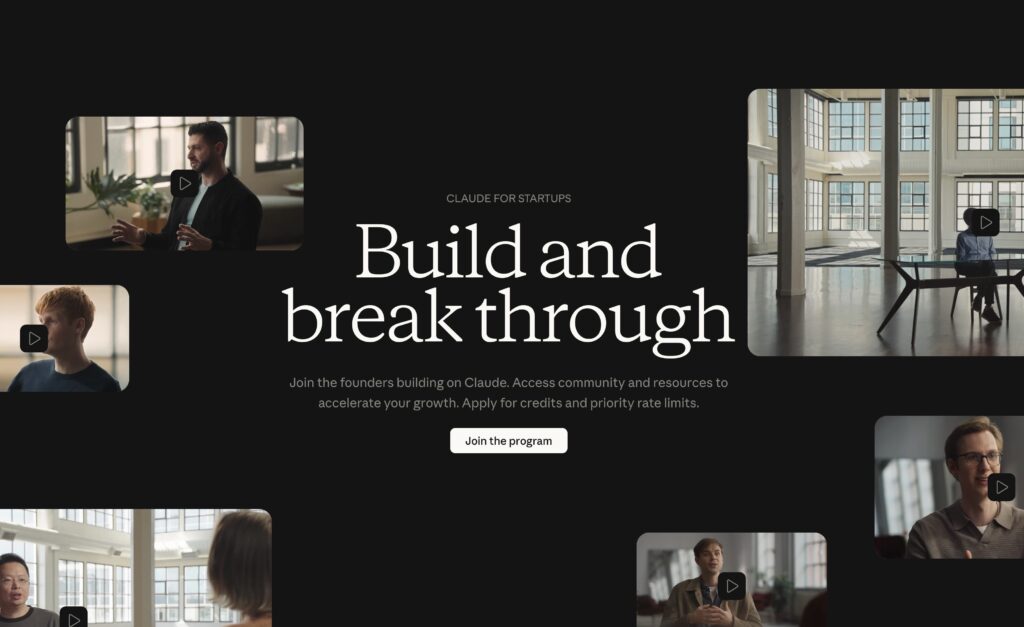
Anthropic has launched Claude for Startups, a program aimed at early-stage founders and startups building products, agents, or workflows on Claude. The initiative combines access to community, events, technical resources, and for companies that meet certain criteria, free API credits and priority usage limits.
The movement goes beyond a developer promotion. Anthropic aims to position Claude as a construction platform for new AI companies, not just as an advanced chatbot or a new API in the stack. For a startup, this distinction matters: choosing an early-stage model influences architecture, costs, latency, user experience, agents, security, development tools, and future dependency on the provider.
Claude for Startups arrives at a time when AI lab competition is shifting from benchmarks to distribution. OpenAI, Google, Anthropic, xAI, Mistral, and others don’t just need to demonstrate better reasoning, programming, or context handling. They need real teams to build products on top of their models. And startups are especially valuable because they make quick decisions, iterate often, and can become major clients if product-market fit is achieved.
A program designed for product-building, not just model testing
The program encompasses several pieces of the Claude ecosystem. The first is Claude API, the layer that allows integration of Anthropic’s models into applications, SaaS, internal assistants, automation workflows, or native AI products. For a startup, the API is where model intelligence translates into business functionality: classification, generation, analysis, agents, support, search, coding, or reasoning over documents.
The second component is Claude Code, Anthropic’s agent-based development tool. Its role goes beyond code completion; it can read a codebase, edit files, execute commands, work with development tools, and assist with creating tests, debugging, reviewing changes, automating repetitive tasks, or preparing pull requests. In a small team, this capability can accelerate the transition from prototype to usable version.
Claude Managed Agents adds another layer. Anthropic presents it as a way to create production agents with MCP, code execution, and tool use. This is relevant because many startups are no longer just building simple conversational interfaces—they’re trying to create systems that query data, call APIs, process files, execute tasks, and coordinate multiple steps with control and traceability.
The fourth piece is Claude Cowork, aimed at delegating work with files, research, and daily tasks to tools already used by the team. Here, the focus shifts from “using AI in the product” to “using AI within the company itself.” For a startup, this can mean fewer hours spent on documentation, analysis, synthesis, material preparation, market research, or operational support.
| Product | Role within a startup |
|---|---|
| Claude API | Integrate Claude models into products and services |
| Claude Code | Accelerate development, testing, debugging, and technical automation |
| Claude Managed Agents | Create agents with MCP, tools, and code execution |
| Claude Cowork | Delegate work with files, research, and internal tasks |
| API Credits | Reduce initial experimentation and development costs |
| Priority rate limits | Avoid early blocks when testing or deploying to production |
Criteria for accessing credits
The program is open to early-stage founders and startups building with Claude, but Anthropic differentiates between participating in the community and qualifying for additional benefits. To receive API credits and priority limits, the company must have received funding from an institutional investor, been founded within the last four years, and not previously obtained credits from Anthropic for startups.
Application requires a Claude Console account, company email, website, and a brief description of what is being built. Anthropic also notes that startups backed by an affiliated fund or accelerator can mention this in the application, which reinforces the program’s connection with the venture capital ecosystem.
Credits apply to Claude’s own API via Claude Console. They do not cover use of Claude through third-party platforms like AWS Bedrock or Google Vertex AI. This is important for startups already deploying on a specific cloud and wishing to maintain a multi-cloud strategy or leverage infrastructure marketplaces. The credits incentive promotes direct engagement with Anthropic.
Startups that do not meet funding criteria can still join the program to access events, community, hackathons, Founder Days, meetups, and online sessions. Practically, Anthropic is creating two tiers: a broad community and learning layer, and a more selective layer with financial and operational advantages.
Why rate limits are as critical as credits
In early stages, free credits are attractive because they reduce experimentation costs. However, for a technical startup, usage limits can be equally or more important. A prototype might work well with few users but break when faced with customer testing, demos, batch loads, or agents making many calls per task.
Priority rate limits help mitigate this friction. If a startup is building an agent that calls multiple tools, analyzes documents, and executes chained steps, a single user interaction can consume many model calls. Without appropriate limits, the product might seem unstable even if the design is solid.
Anthropic has already announced increased usage limits for Claude Code and the API, supported by compute agreements and capacity expansion. This context helps explain why the startup program isn’t just marketing—serving models at scale has become a core aspect of AI providers’ competitive landscape. Without sufficient compute, there are no meaningful credits, reliable agents, or scalable products.
For a startup, this becomes a practical question: will the provider support growth if the product takes off? Model quality is important, but so are availability, latency, limits, billing, observability, and support.
A strategy to capture the native AI stack
Claude for Startups reflects a clear ambition: Anthropic wants to be involved in multiple layers of a startup’s lifecycle. The API integrates into the product. Claude Code supports development. Managed Agents fit into the agent architecture. Cowork is part of internal operations. Events and community engagement build ties with founders and investors.
This strategy can be very powerful. If a company builds its MVP with Claude Code, integrates Claude API into its product, deploys tools-based agents with Anthropic, and uses Claude Cowork for internal tasks, switching costs grow over time. Not due to artificial barriers, but because everything becomes interconnected around a single platform.
For founders, this can be advantageous by reducing complexity and enabling rapid progress. However, it also requires early consideration of portability and cost control. Not all startups need an architecture agnostic from day one, but it’s wise to avoid locking all business logic into prompts, tools, or workflows that are difficult to migrate.
A good practice is to layer the product: business logic, orchestration, evaluation, model provider, external tools, and data. This approach allows leveraging Claude without completely sacrificing the ability to switch models, compare performance, or add alternatives to specific tasks.
What startups should consider before applying
The program is especially appealing to startups already building with agents, code, documents, support, internal tools, automation, or intensive data analysis. It may also suit companies needing to move quickly from prototype to production without high inference costs in the early months.
But not all startups should rely solely on credits. It’s vital to estimate ongoing costs, review pricing, forecast token volume, measure latency, design evaluation systems, and assess which parts of the product are truly dependent on Claude. Credits help start, but the real cost emerges as user engagement grows.
It’s also important to carefully read the program’s terms. Anthropic reserves the right to select beneficiaries, modify or suspend the program, and set eligibility requirements. Credits may have tax implications, and benefits do not guarantee specific outcomes. For funded startups, this is normal; for smaller or bootstrapped teams, it’s a reminder that initial advantages don’t replace financial planning.
Claude for Startups confirms that AI race isn’t just about possessing the most powerful model. It’s also about who enables the next generation of products within their platform. Anthropic aims for founders to use Claude not just for answering questions but for coding, creating agents, operating teams, and building entire companies around its models.
If the program attracts startups with real products, it could strengthen Anthropic’s position in the enterprise AI market. Plus, if their tools reduce development time and inference costs, Claude could shift from a technical option to a core part of many young companies’ DNA. The main wager is to dominate the stack before it becomes entrenched.
Frequently Asked Questions
What is Claude for Startups?
It’s an Anthropic program for early-stage founders and startups looking to build products, agents, or workflows using Claude.
What benefits do selected startups get?
They may receive free API credits, priority usage limits, program resources, events, hackathons, Founder Days, meetups, and early access to updates.
Who qualifies for free credits?
Startups backed by institutional investors, founded within the last four years, and that haven’t previously received credits from Anthropic for startups.
Are the credits valid for using Claude via AWS Bedrock or Google Vertex AI?
No, credits are only applicable to Claude’s own API through Claude Console, not third-party platforms.
