
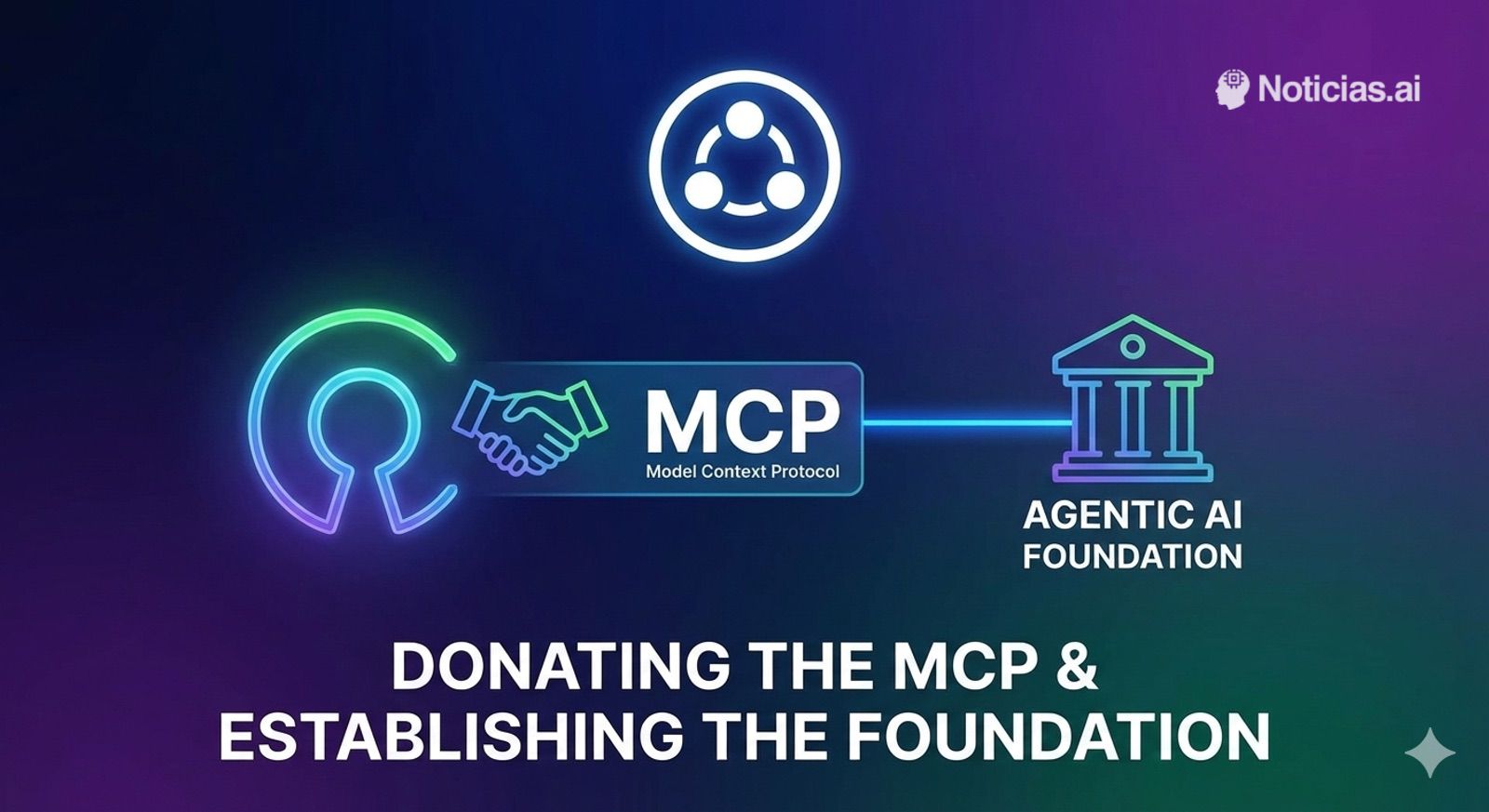
The battle to dominate the next generation of artificial intelligence isn’t just fought with models: it’s also about the “plumbing” that connects those models to data, APIs, and enterprise systems. A key move has just taken place in this arena: Anthropic has donated the Model Context Protocol (MCP) to the Linux Foundation, doing so alongside OpenAI and Block as co-founders of the new Agentic AI Foundation (AAIF), backed by giants like AWS, Google, Microsoft, Cloudflare, and Bloomberg.
The core message is clear: the industry wants an open and neutral standard for the era of Agentic AI, where models evolve from simple chatbots to agents capable of acting, calling tools, and operating autonomously on complex infrastructures.
MCP: From “everyone in their own way” to a common standard
MCP was born at Anthropic as a protocol to connect AI applications with external resources: APIs, databases, CRMs, development tools, or internal services. Until now, each provider and company handled this problem their own way, with specific, little-reusable integrations.
With MCP, that approach changes:
- An system exposes its capabilities through a MCP server.
- Any compatible client (Claude, ChatGPT, Gemini, editors like VS Code, IDEs, desktop clients, etc.) can discover these tools and use them without bespoke integrations.
In practice, MCP introduces an abstraction layer between models and tools similar to what USB or HTTP represented in their respective domains: a common language for AI agents and corporate systems to understand each other.
Within just a year, the protocol has gained significant adoption, according to data shared by Anthropic:
- Over 10,000 public MCP servers active, ranging from “developer-first” integrations to deployments in Fortune 500 companies.
- Support in top-tier products like ChatGPT, Cursor, Gemini, Microsoft Copilot, and Visual Studio Code.
- Official SDKs in major languages and tens of millions of downloads per month of Python and TypeScript packages.
This is complemented by a community-driven registry where MCP servers can be discovered, and a connector directory in Claude listing dozens of integrations.

Agentic AI Foundation: The new home for MCP (and more)
To ensure MCP isn’t perceived as “owned” by a single provider, Anthropic has decided to donate it to the Linux Foundation, within a new dedicated fund: the Agentic AI Foundation (AAIF).
The AAIF launches with three foundational projects:
- Model Context Protocol (MCP), as a standard for connecting agents and tools.
- goose, driven by Block, focusing on agent workflows and automation in financial and payment products.
- AGENTS.md, an OpenAI proposal to document and describe AI agents, their capabilities, and requirements in a standardized way.
The choice of the Linux Foundation isn’t accidental. The organization has already demonstrated its ability to orchestrate large open ecosystems like Linux, Kubernetes, Node.js, and PyTorch, where direct competitors collaborate on the core infrastructure that their products rely on.
The AAIF aims to replicate this model in agentic AI: a common foundation of standards, tools, and documentation maintained neutrally, on which each company can innovate without repeatedly reinventing integration layers.
Why this matters to technical teams
Beyond the headlines, this move has concrete implications for developers, architects, and platform teams:
1. Fewer fragile integrations, more reusable connectors
Instead of building bespoke integrations for “my proprietary assistant” or “my specific copilot,” companies can invest in MCP servers serving their entire AI ecosystem. Switching models or providers no longer requires rewriting entire orchestration layers.
2. More reasonable governance, auditing, and security
A clear standard makes policy definition easier: what tools a model can use, with what parameters, under which identity, and how to audit its actions. In regulated environments — finance, healthcare, government — this is essential for deploying agents with real access to critical systems.
3. Improved observability and control in agent flows
The MCP specification, along with its SDKs and tooling, points toward more observable workflows: call traces, server metrics, error handling, and timing. The Agentic AI Foundation can serve as the forum to establish best practices and common extensions for these aspects.
4. Cross-cloud portability
The fact that AWS, Google Cloud, Microsoft Azure, and Cloudflare already support MCP infrastructure sends a clear signal: the protocol is becoming part of cloud primitives, making it easier to deploy agents close to data wherever it resides.
A possible “Kubernetes moment” for agentic AI
The comparison with Kubernetes reemerges repeatedly when analyzing this movement. In 2015, Google donated K8s to the CNCF, establishing the de facto standard for container orchestration, on which nearly all cloud providers and application platforms now depend.
Now, Anthropic, OpenAI, Block, and major cloud providers are signaling similarly: the infrastructure for AI agents—including tool protocols, agent specifications, and common libraries—should not fragment into countless incompatible solutions.
The commitment to MCP and the Agentic AI Foundation indicates that, at least in this layer, the industry prefers collaboration:
- Sharing the common language (protocol, tools, documentation).
- Competing in what truly makes a difference: models, UX, agent quality, vertical integration, costs, and value-added services.
What’s next
In the short term, the impact will be most visible to developers: more SDKs, more third-party MCP servers, improved integrations in IDEs, desktop clients, and productivity tools. In the medium term, companies currently testing isolated agents will start considering more serious architectures based on standards, with MCP and AAIF at the core of the conversation.
The image of direct competitors collaborating under the Linux Foundation umbrella sends a clear conclusion: the future of development is agentic, and the industry has just decided that agreeing on the “plumbing” that will support that future is more important than duplicating efforts on incompatible proprietary solutions.