
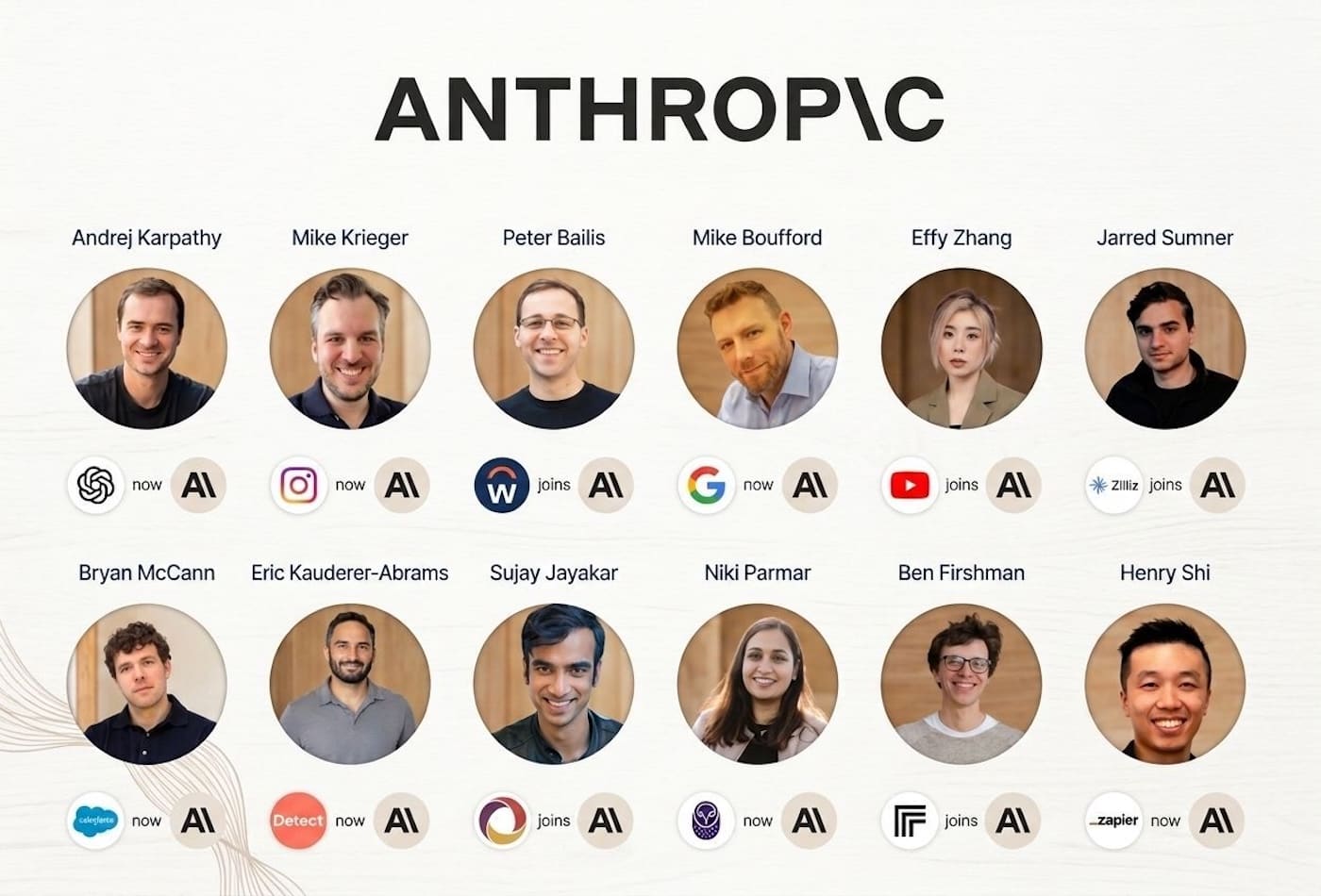
Anthropic is no longer competing only with Claude. It is also vying for the individuals who can shape the next generation of software. In recent months, the company has attracted prominent profiles in artificial intelligence, product, development infrastructure, and platforms for programmers— a clear sign indicating the sector’s direction: moving away from isolated chatbots toward agents capable of working on code, documents, tools, and real business workflows.
The list is impressive. Andrej Karpathy, a founding member of OpenAI and former head of AI at Tesla, has joined Anthropic to work on pretraining. Mike Krieger, co-founder of Instagram, has joined as Chief Product Officer. Peter Bailis, former CTO of Workday, has taken a technical role at the company. Anthropic also acquired Bun, the JavaScript runtime and toolkit created by Jarred Sumner, to strengthen Claude Code’s infrastructure. They are complemented by profiles like Niki Parmar, co-author of the original Transformer paper and member of Anthropic’s technical team, or Ben Firshman, founder of Replicate, who publicly announced his joining the Labs team.
Not all moves are of the same nature. Some are direct hires, others come through acquisitions, and some follow longer-term trajectories within the AI ecosystem. But the pattern is hard to ignore: Anthropic is becoming a hub where top founders, CTOs, and leading researchers are willing to return and rebuild from within, even without the senior executive titles they might hold in traditional tech giants.
The new AI war is fought in product and code
The first phase of generative AI was model-centric. Parameters, benchmarks, context window, reasoning ability, and response quality mattered most. While all that remains relevant, it is no longer enough. The next phase demands turning these models into tools seamlessly integrated into the daily work of developers, analysts, companies, and technical teams.
This better explains Anthropic’s strategy. Mike Krieger brings experience in large-scale product development. Instagram was not just a good idea but a platform capable of transforming complex technology—social image and video sharing—into a simple user experience for hundreds of millions. Claude needs a similar approach: not just a powerful model, but a product that users and companies want to use consistently.
The acquisition of Bun points to another layer of the problem. Bun provides infrastructure for developers: runtime, package manager, bundler, and environment designed to accelerate JavaScript and TypeScript development. Its entry into Anthropic is not ornamental. Claude Code must operate on real codebases, run tools, understand projects, and work with reasonable latencies. Having a team that has built modern tooling from scratch can make a real difference in that space.
Andrej Karpathy’s addition adds a deeper dimension. He is not only a symbolic figure due to his roles at OpenAI and Tesla but works at the core technical level of foundational models. According to TechCrunch, he will focus on pretraining, one of the most costly and critical phases for enhancing Claude’s capabilities. His return to research within Anthropic emphasizes the lab’s desire to accelerate both product development and scientific progress.
The rise of elite ‘individual contributors’
One of the most discussed moves has been Peter Bailis. Moving from CTO of Workday to a technical team role at Anthropic might seem unusual from an outside perspective. However, in frontier labs culture, the title of member of technical staff can be one of the most influential positions. It’s not about managing large organizations but working close to the core where systems are built.
This phenomenon reflects a cultural shift in Silicon Valley. For years, the natural career progression for top technical talent was to lead larger teams, become vicepresident, or take on CTO roles. In the AI era, many prefer to return to positions closer to the product, the model, the code, and applied research. Hierarchy matters less than being where strategic technical decisions are made that can redefine the market.
Niki Parmar exemplifies this trend. She was a co-author of “Attention Is All You Need,” the paper introducing the Transformer architecture, the foundation of today’s large language models. After co-founding Adept and Essential AI, her presence at Anthropic underscores an especially important focus: building systems capable of acting with tools and executing tasks, not just generating text.
Ben Firshman contributes another piece: experience in platforms for deploying models and making AI usable by developers. Replicate became well-known for facilitating the use of machine learning models via accessible platforms. That expertise is crucial now, as frontier models need to become integrable, observable services within real workflows.
| Profile | Key Experience | What they bring to Anthropic |
|---|---|---|
| Andrej Karpathy | OpenAI, Tesla, Eureka Labs | Research, pretraining, foundational models | Mike Krieger | Instagram, Artifact | Product, user experience, scaling | Peter Bailis | Workday, Google | Systems, enterprise engineering, technical leadership | Jarred Sumner | Bun | Tools, runtime, developer infrastructure | Niki Parmar | Transformer, Adept, Essential AI | Research in architectures and agents | Ben Firshman | Replicate | AI platforms, deployment, developer community |
Claude Code as the new epicenter
The common thread in many of these moves is Claude Code. Anthropic’s developer tool has shifted from a utility for assisted programming to a strategic asset. The company reports that Claude Code reached \$1 billion in annual recurring revenue in just six months, underscoring why this area is being so heavily reinforced.
AI programming is evolving quickly. Autocompletion was just the beginning. Later, assistants capable of generating functions, explaining bugs, or proposing tests emerged. Now, the focus is on agents that can understand a repository, plan migrations, modify multiple files, run tests, fix bugs, and document changes. Achieving this requires better models, but also execution environments, fast tools, permission controls, integration with repositories, observability, and user experience.
Anthropic appears to be building exactly that stack: Claude as the core model, Claude Code as the developer interface, MCP as a standard for connecting tools and data, Bun as the tooling backbone, and a team increasingly composed of those who have built products, languages, runtimes, platforms, and AI infrastructures.
As a result, the company is moving away from the image of a lab focused solely on safety and research. While it maintains that narrative, it is increasingly looking like an enterprise and developer-first software platform. This hybrid approach could be a competitive advantage if they can sustain Claude’s quality while transforming its capabilities into concrete products.
The next leap will be operational
The underlying message is not that Anthropic has “won” the AI race. Companies like OpenAI, Google DeepMind, Meta, xAI, Mistral, and others still compete fiercely with models, infrastructure, capital, and talent. However, the concentration of top profiles at Anthropic indicates a shared intuition among many builders: the next technological leap will not only be about answering better but about working better.
Future models will need to program more autonomously, handle external tools, operate across applications, respect permissions, recognize uncertainty, and produce auditable outcomes. This requires a tough combination: frontier research, systems engineering, product design, security, user experience, and a developer culture.
Anthropic is recruiting for exactly that blend. They are not just hiring model researchers or product executives; they’re gathering people who have built global social networks, programming runtimes, AI platforms, enterprise systems, and foundational models. This mix explains why the company has become one of the most watched in the sector.
The next technological leap might be near, but it won’t happen just by making models bigger. It will happen when AI can integrate into real work with sufficient reliability, control, and usefulness. Anthropic is positioning itself precisely at that point: where models stop being demos and start becoming a new layer of software execution.
FAQs
Why is Anthropic attracting so much top technical talent?
Because Claude and Claude Code are at the heart of the race for AI agents, autonomous programming, and assisted work tools powered by advanced models.
How important is Andrej Karpathy to Anthropic?
Karpathy brings research experience in models, pretraining, and large-scale AI, with prior roles at OpenAI and Tesla.
Why is the acquisition of Bun relevant for Claude Code?
Because Bun provides modern infrastructure for developers—an essential area if Claude Code is to work on real projects quickly and reliably.
What does it signify that CTOs and founders are accepting technical roles at Anthropic?
It shows that many high-level profiles prefer working close to the core AI technology rather than sticking to traditional executive roles at larger firms.
